

The National Employment Standards (NES) are the minimum employment entitlements that every employee in Australia's national workplace relations system must receive. They are set by the Fair Work Act 2009 and cannot be undercut by any award, enterprise agreement or employment contract. This guide explains what the NES is, who it covers, the 11 entitlements it guarantees (including superannuation), which of them apply to casual employees, and why the standards sit at the very base of the system.
Key takeaways
- The NES is a set of 11 minimum entitlements that apply to employees in the national system, whatever their award, agreement or contract.
- Superannuation is the newest, eleventh NES entitlement, sitting alongside leave, hours, notice and redundancy pay.
- Casual employees get only some NES entitlements, though the list has grown to include paid family and domestic violence leave and casual conversion.
- Employers must give every new employee the Fair Work Information Statement, and every casual the Casual Employment Information Statement.
- The NES is a floor, not a ceiling: awards and agreements can add to it but never take it away.
What the National Employment Standards are
The National Employment Standards are the core set of minimum entitlements that have to be provided to all employees covered by Australia's national workplace relations system. They were created by the Fair Work Act 2009. The idea behind the NES is simple: no matter what industry you work in or what your contract says, there is a baseline of leave and pay-related entitlements that your employer cannot go below.
Other workplace instruments, including awards, enterprise agreements and individual contracts, cannot provide conditions that are less than the NES, and any term that tries to do so has no effect. Nor can they exclude the NES. That makes the NES the anchor of nearly every employment relationship in the country, from a full-time office worker to a part-time retail assistant or a regular casual.
Who the NES covers
The NES applies to all employees in the national workplace relations system, which covers most Australian workplaces. Coverage does not depend on the award, registered agreement or contract that applies to you: if you are a national-system employee, the NES applies. Because the national system reaches the great majority of employees in Australia, for most people reading this it will be the relevant set of rules.
A minority of workers sit outside the national system, mainly some state public sector and local government employees, who are covered by their state system instead. Even so, two NES entitlements, parental leave and notice of termination, reach some employees who are not in the national system. If you are unsure which system covers you, our employment types guide and glossary can help.
The 11 minimum entitlements
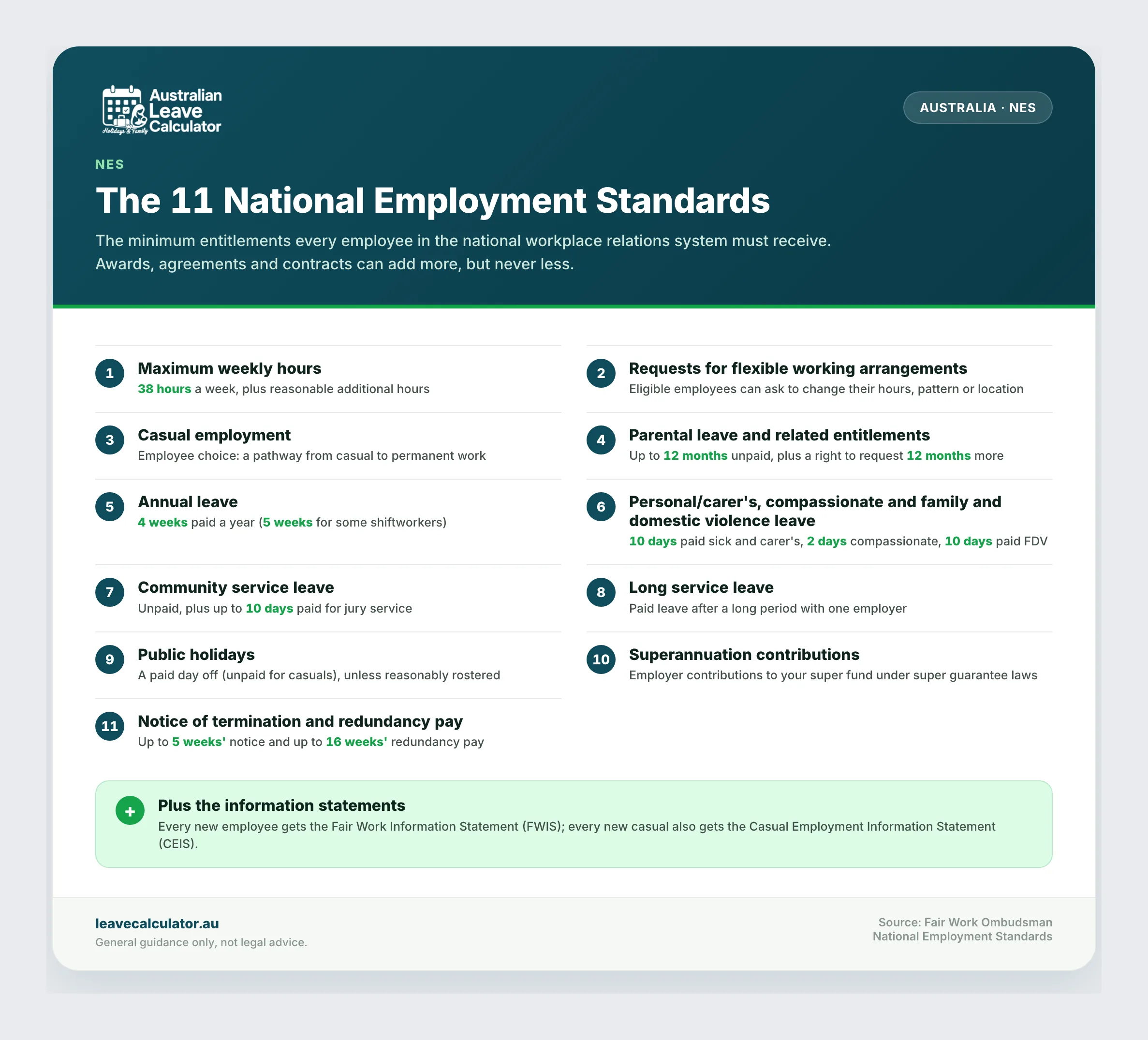
The NES guarantees 11 minimum entitlements. Superannuation is the most recent addition, which is why the Fair Work Ombudsman now lists it as the eleventh standard. The table below summarises each one and the minimum it provides for a national-system employee.
| # | NES entitlement | Minimum it provides |
|---|---|---|
| 1 | Maximum weekly hours | 38 hours per week for a full-time employee, plus reasonable additional hours |
| 2 | Flexible working requests | Eligible employees can request a change to their working arrangements |
| 3 | Casual employment | Employee choice to move from casual to permanent in some circumstances |
| 4 | Parental leave | Up to 12 months of unpaid leave, plus a right to request a further 12 months |
| 5 | Annual leave | 4 weeks of paid leave a year (5 weeks for some shiftworkers) |
| 6 | Personal/carer's, compassionate & family and domestic violence leave | 10 days paid sick and carer's leave, 2 days compassionate leave per occasion, 10 days paid family and domestic violence leave |
| 7 | Community service leave | Unpaid leave for voluntary emergency work; up to 10 days paid for jury service |
| 8 | Long service leave | Paid leave for long, continuous service with one employer |
| 9 | Public holidays | A paid day off (unpaid for casuals), unless reasonably asked to work |
| 10 | Notice of termination & redundancy pay | Up to 5 weeks notice and up to 16 weeks redundancy pay, based on service |
| 11 | Superannuation | Employer contributions to an eligible employee's super fund |
Fair Work Ombudsman, National Employment Standards and the Introduction to the National Employment Standards fact sheet (updated 2026). Legislative reference: Fair Work Act 2009 (Cth) Part 2-2.
Leave and time off in detail
Most of the NES deals with paid or unpaid time off. Full-time and part-time employees accrue 4 weeks of paid annual leave a year, based on their ordinary hours; the balance rolls over and is paid out when they leave. They also get 10 days of paid personal/carer's leave a year for their own illness or to care for family (pro-rata for part-timers), which carries over but is not paid out on termination.
On top of that sit several event-based entitlements: 2 days of compassionate leave per occasion, 10 days a year of paid family and domestic violence leave, community service leave (including up to 10 days paid for jury service), up to 12 months of unpaid parental leave, and long service leave for long tenure. Employees are also entitled to a paid day off on public holidays, unless they are reasonably asked to work.
Sofia works full-time and her award gives 5 weeks of annual leave, one more than the NES minimum of 4. Her employer proposes a new contract offering only 3 weeks. Because 3 weeks is below both the award and the NES floor of 4 weeks, that term has no effect, and Sofia keeps her 5-week award entitlement.
Hours, ending employment and super
The NES caps ordinary hours at 38 per week for a full-time employee, plus any additional hours that are reasonable, and lets an employee refuse extra hours that are unreasonable. When employment ends, employees are entitled to notice of termination of up to 5 weeks (scaled by length of service and age) and, where they qualify, redundancy pay of up to 16 weeks. Small businesses with fewer than 15 employees are generally exempt from NES redundancy pay, but any unused annual leave and long service leave must still appear in the final pay.
Superannuation is the eleventh and newest NES entitlement. It means most employees now have a right to compulsory super contributions under the Fair Work Act as well as under super guarantee tax law, which gives the Fair Work Ombudsman a role in helping recover unpaid super. Awards and agreements can add to these minimums, for example through annual leave loading or longer notice, but they can never reduce them.
Which entitlements apply to casuals
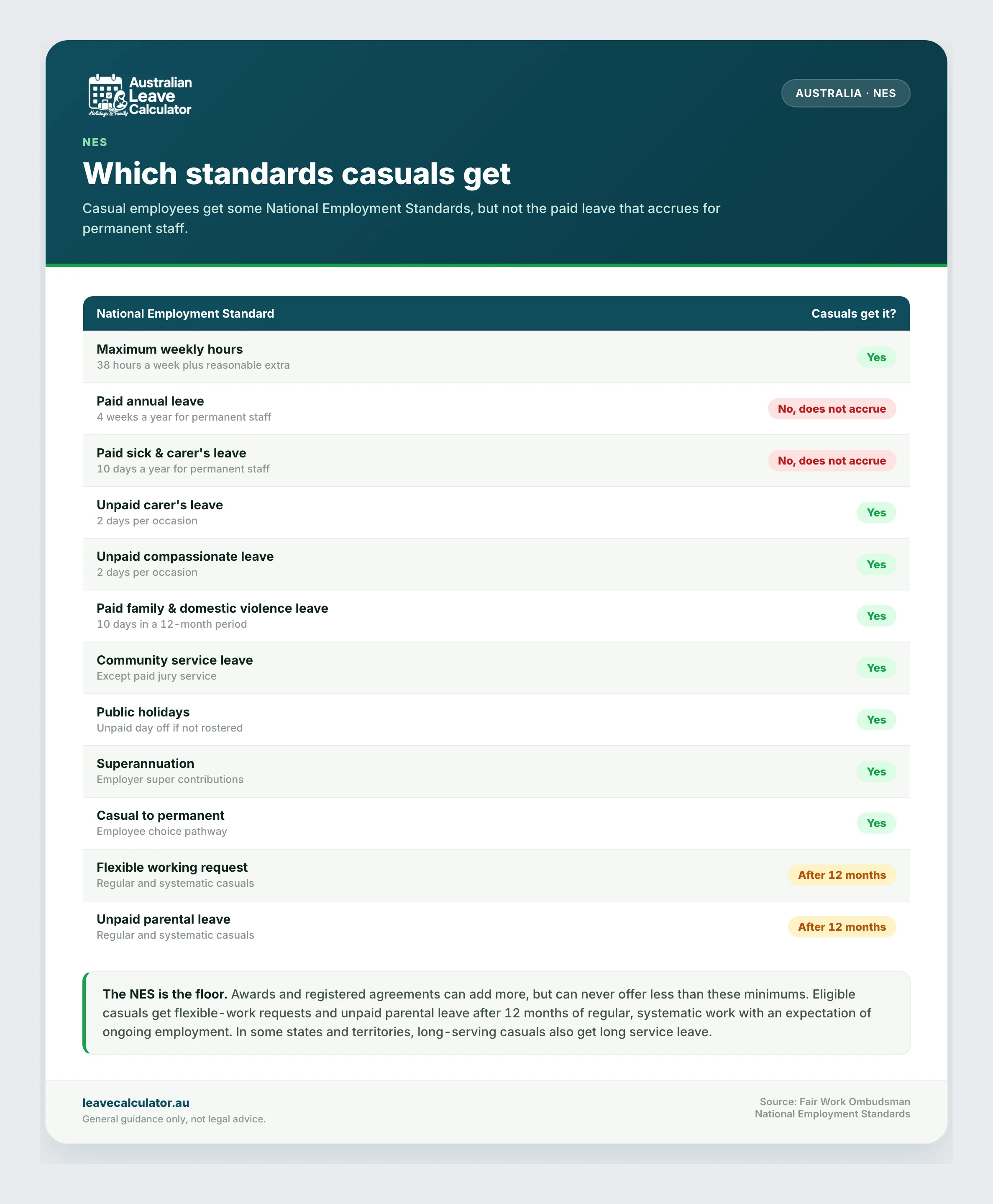
Casual employees receive only some NES entitlements, because their casual loading is paid partly in place of paid leave. The list of what casuals get has grown in recent years and now includes:
- maximum weekly hours;
- 2 days of unpaid carer's leave and 2 days of unpaid compassionate leave per occasion;
- 10 days of paid family and domestic violence leave in a 12-month period;
- community service leave (except paid jury service);
- a day off on public holidays and the right to refuse unreasonable work on them;
- super contributions and the employee-choice casual conversion pathway;
- the Fair Work Information Statement and the Casual Employment Information Statement.
A casual employed on a regular and systematic basis for at least 12 months, with a reasonable expectation of continuing, can also request flexible working arrangements and take unpaid parental leave. Long service leave is different again: casuals can get it in every state and territory, but the test for whether casual service counts as continuous differs between them, as our guide to casual long service leave rules by state explains. For a fuller comparison, see casual versus permanent.
Fair Work Ombudsman, National Employment Standards (Casual employees and the NES) and the Introduction to the National Employment Standards fact sheet. Legislative reference: Fair Work Act 2009 (Cth) ss 13, 55, 61.
The two information statements
The NES also imposes an information duty. Employers must give every new employee a copy of the Fair Work Information Statement (FWIS) before, or as soon as possible after, they start. It summarises the NES, awards, agreements, flexibility arrangements, general protections, termination of employment, and the roles of the Fair Work Ombudsman and the Fair Work Commission.
Every new casual must also receive the Casual Employment Information Statement (CEIS), which explains the definition of a casual, how to move to permanent work, and how disputes are handled. Unlike the FWIS, the CEIS has to be reissued at set points: after 12 months for small-business employers, and after 6 and 12 months, then every 12 months, for other employers.
Fair Work Ombudsman, Fair Work Information Statement and Casual Employment Information Statement. Legislative reference: Fair Work Act 2009 (Cth) ss 124-125B.
A floor, not a ceiling
The NES sets the minimum, but it is not the whole story. Modern awards and enterprise agreements sit on top of the NES and routinely improve on it, with extra annual leave for shiftworkers, higher redundancy scales, allowances or penalty rates. What they can never do is drop below the NES or exclude it.
In practice, read your entitlements as a stack: the NES at the base, then any award or registered agreement, then your contract, with the applicable term most favourable to you usually prevailing. If a contract clause is less generous than the NES on a given entitlement, the NES wins.
How the NES fits with the Fair Work Act
The NES is not a separate law; it lives inside the Fair Work Act 2009, mainly in Part 2-2. The Act defines the entitlements, sets out who is covered, and provides the consequences when an employer breaches them. Because the standards are statutory, a failure to provide them, such as not paying out accrued annual leave or withholding super, is a contravention that the Fair Work Ombudsman can investigate and enforce, with penalties available through the courts.
For the wider picture of how the Act, awards and agreements interact, see our Fair Work Act guide. To turn these rules into real dollar and hour figures for your own situation, use our calculators.
Use the annual leave calculator, or the personal and carer's leave calculator, to see how much leave you have accrued under the NES.
Common questions
What are the 11 National Employment Standards?
They are maximum weekly hours; flexible working requests; casual employment (including casual conversion); parental leave; annual leave; personal/carer's, compassionate and family and domestic violence leave; community service leave; long service leave; public holidays; notice of termination and redundancy pay; and superannuation. Employers must also give new staff the relevant information statements.
Do casual employees get the NES?
Casuals get some of it. They are covered for maximum weekly hours, unpaid carer's and compassionate leave, paid family and domestic violence leave, community service leave, public holidays, super, casual conversion and the information statements. Long-term regular casuals can also request flexible working and unpaid parental leave.
Can my contract or award give me less than the NES?
No. Any award, agreement or contract term that provides less than the NES has no effect, and the NES applies instead. Awards and agreements can only match the NES or improve on it, never cut below it.
Is superannuation really part of the NES?
Yes. Superannuation is now an NES entitlement in its own right, in addition to the long-standing super guarantee obligations under tax law. That gives most employees a workplace-law right to their contributions and lets the Fair Work Ombudsman help recover unpaid super.
What happens if my employer breaches the NES?
Breaching the NES is a contravention of the Fair Work Act. You can raise it with your employer, seek help from the Fair Work Ombudsman, and in serious cases the courts can order back-payment and penalties. See our frequently asked questions for more on resolving problems.

Author & reviewer
Sarah has spent over a decade advising Australian SMBs on Fair Work, NES compliance, and payroll. Based in Sydney, she has worked across hospitality, retail and professional services.