

A modern award is one of the most important documents in Australian employment, yet many workers never read theirs. An award sets the legal minimum pay rates and conditions for a whole industry or occupation, and it sits directly on top of the National Employment Standards (NES). This guide explains what an award is, what it adds beyond the NES, how pay is set by classification, how leave loading and penalty rates work, how to find your award, when an enterprise agreement replaces it, and what happens if no award covers you. Award minimum rates are reviewed every year, and the 2026 minimum wage increase lifted them from the first full pay period on or after 1 July 2026. Award coverage is occupational as much as industrial, which is why office and professional staff sit under awards such as the Clerks Private Sector Award, Professional Employees Award, Banking and Finance Award, Legal Services Award, Educational Services Teachers Award and Education Support Award.
Key takeaways
- A modern award is a legal document setting minimum pay and conditions for an industry or occupation. It applies automatically when your work is covered, whether or not your contract mentions it.
- An award can only add to the National Employment Standards, never fall below them. The NES floor always applies underneath.
- Awards set pay by classification and commonly add penalty rates, overtime, allowances, annual leave loading (often 17.5%) and extra shiftworker leave.
- If a registered enterprise agreement covers your role it applies instead of the award, but it had to pass the better off overall test first.
- If no award and no agreement covers your job you are award and agreement free, and you still get the National Minimum Wage plus every NES entitlement.
What a modern award is
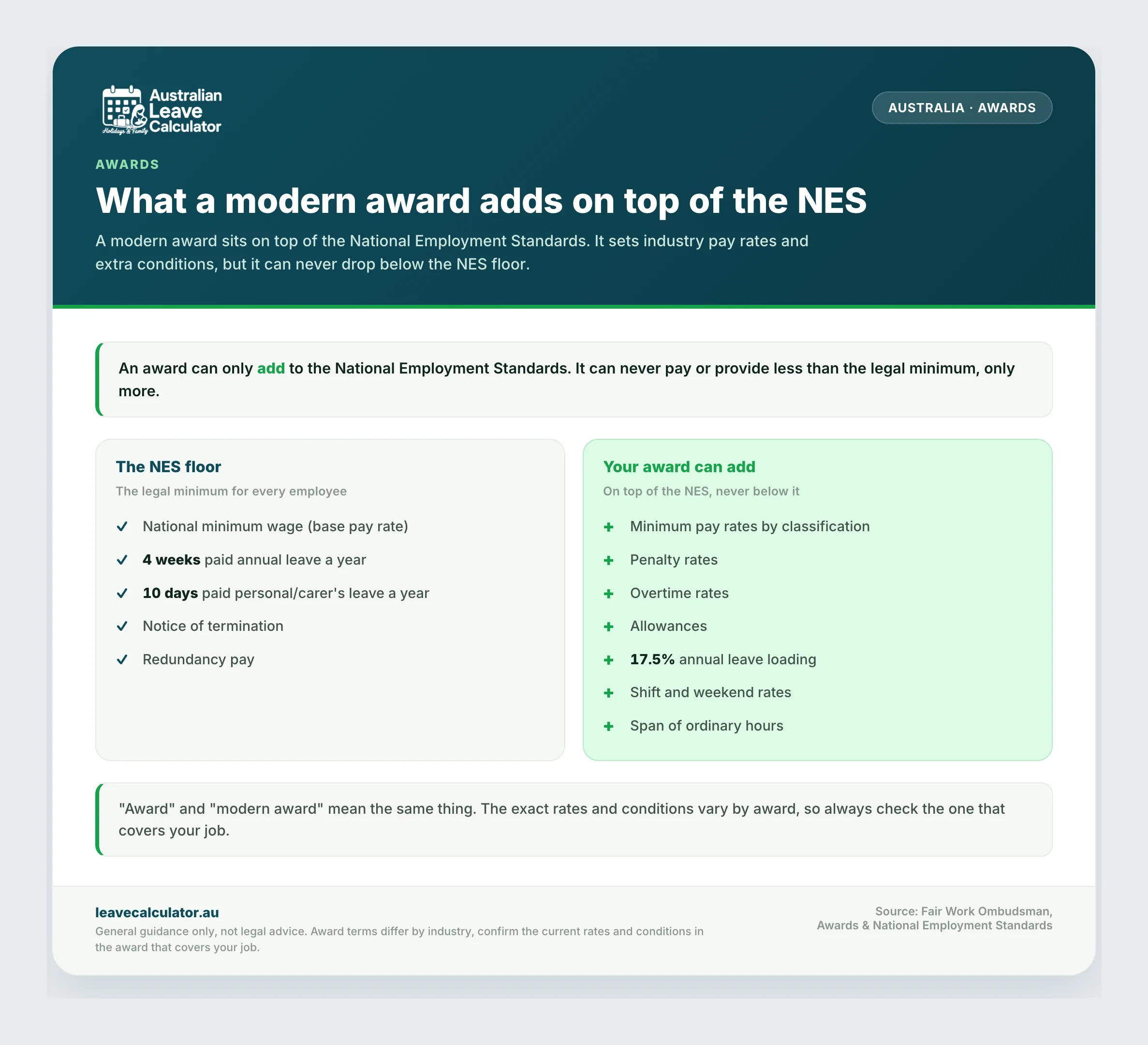
A modern award (often just called an award) is a legal document that outlines minimum pay rates and conditions of employment for a particular industry or occupation. Awards are made and maintained by the Fair Work Commission, the national workplace relations tribunal, and they operate on top of the National Employment Standards. The key point: an award cannot provide conditions less than the NES, and it cannot exclude the NES. It can only match or improve on that federal floor.
Awards apply automatically. If your employer's industry and your job are covered, the award applies whether or not your contract refers to it. Every award has a coverage clause, usually clause 4, describing who it covers. Awards are generally industry awards (such as the Hospitality Award), occupational awards (such as the Clerks Award), or a mix of both. One employer can be covered by more than one award, depending on the jobs employees do.
Fair Work Ombudsman, About awards and National Employment Standards (updated 2026). Basis: Fair Work Act 2009 (Cth) ss.55 and 61.
What an award adds on top of the NES
The NES gives you the baseline: annual leave, personal/carer's leave, public holidays, long service leave and more. If an award covers you, its terms apply in addition to those NES minimums. The extras an award can add include the following.
| Award term | What it adds beyond the NES |
|---|---|
| Pay rates by classification | Minimum hourly and weekly rates for each level or grade of work |
| Penalty rates | Higher pay for evenings, weekends, public holidays and shift work |
| Overtime | Higher rates for hours worked beyond your ordinary hours |
| Allowances | Payments for tools, meals, laundry, travel, first aid and similar |
| Annual leave loading | An extra amount (commonly 17.5%) on top of base pay when taking annual leave |
| Extra shiftworker leave | 5 weeks of annual leave a year instead of 4 for eligible shiftworkers |
| Hours, breaks and rosters | Ordinary hours, meal and rest breaks, and rostering rules for the industry |
Not every award includes all of these, and the detail varies between industries. Some awards also carry their own redundancy scales, or allow rostered days off and time off in lieu of overtime. What applies to you depends on your award's specific clauses.
Classifications and pay rates
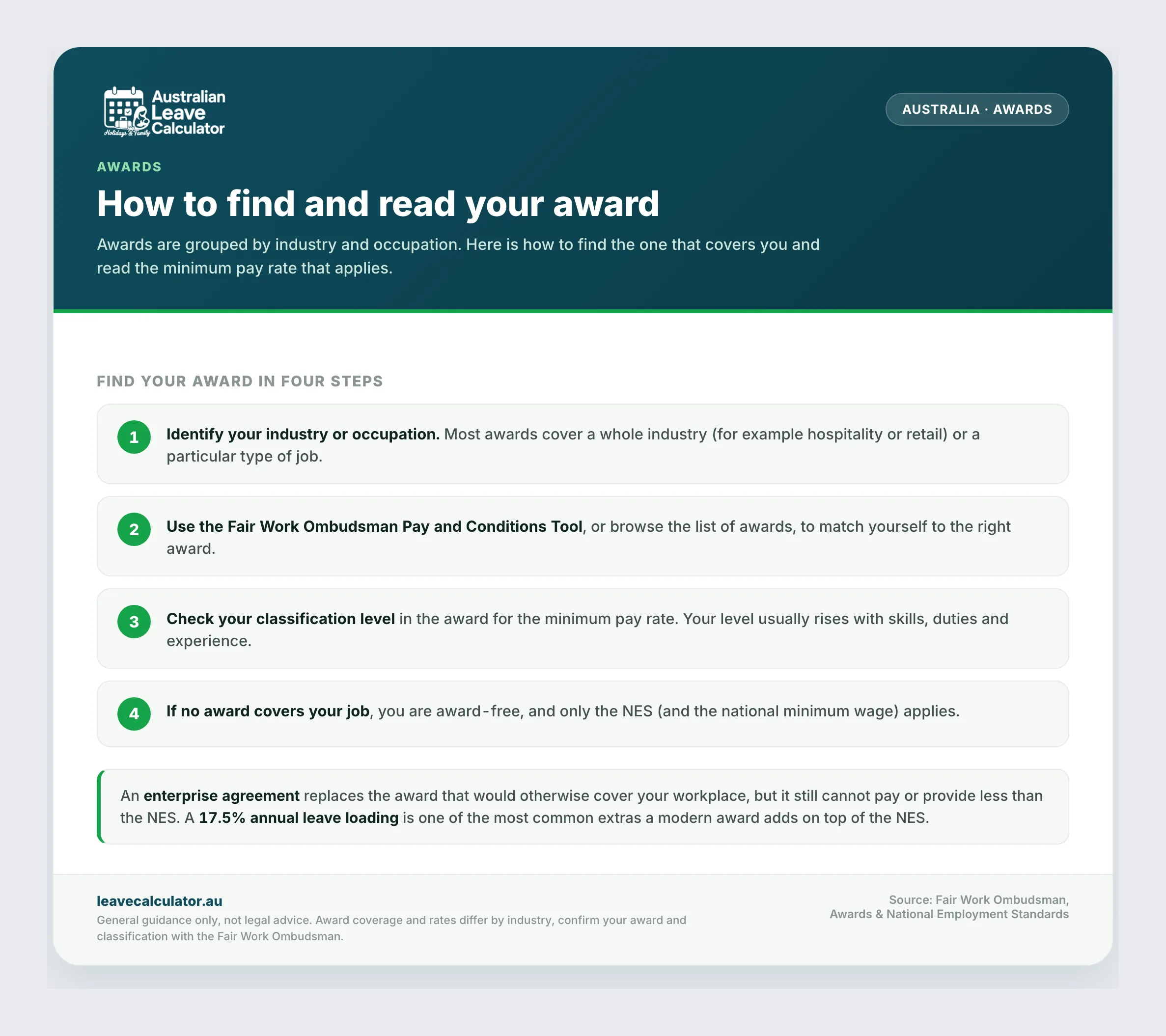
Employees covered by an award are paid according to their classification. Classifications, also called levels or grades, are descriptions of roles and types of work, usually found towards the end of an award (often in Schedule A). To work out an employee's minimum pay rate you need two things: the award that covers them, and their classification level within it.
Classification is not decided by job title alone. Awards look at the duties actually performed, the skills required, any qualifications or training, the amount of experience, and whether the employee supervises others. A classification can change, for example when someone takes on supervision or gains a qualification. Some awards also pay a higher rate when an employee temporarily performs a more senior role, known as working "higher duties".
Leave loading and penalty rates
Annual leave itself is paid at your current base pay rate for the hours taken, which does not include overtime, penalties, allowances or bonuses. Many awards then add annual leave loading on top, most commonly 17.5% of ordinary pay. Some awards instead pay the higher of a 17.5% loading or the weekend and shift penalty rates you would normally have earned, compared over the whole period of leave rather than day by day. Leave loading is not part of the NES, so it applies only if your award, agreement or contract provides it.
Katya works 25 hours a week at a $30 minimum hourly rate and earns a 25% penalty on Saturdays ($37.50 an hour). She takes one week of annual leave with no public holidays in it. Her base week is 25 x $30 = $750. Adding 17.5% loading gives $881.25; paying weekend penalties instead gives $787.50. Because her award pays the higher figure, Katya receives $881.25.
Penalty rates and overtime are separate extras that lift your pay while you are working, not while on leave, rewarding less sociable hours (evenings, weekends, public holidays, shift work) and hours beyond your ordinary hours. When employment ends, unused annual leave is paid out at the rate you would have received had you taken it, including any leave loading that applied.
Fair Work Ombudsman, Payment for annual leave and Calculating annual leave loading (Library K600323). Reference: Fair Work Act 2009 (Cth) ss.16, 89(2), 90.
How to find your award
The quickest way to identify your award is the Fair Work Ombudsman's free Find My Award tool. It asks whether your workplace has a registered agreement, then your industry and occupation, and returns the award that covers you. You can also search by occupation or industry in the FWO Pay and Conditions Tool, which doubles as a calculator for minimum pay rates and some entitlements.
If you already know the name, the full A to Z list of awards is on the FWO website, with each award carrying a code such as MA000004 for the General Retail Industry Award. To confirm coverage yourself, read the award's coverage clause (usually clause 4) and its job classifications: you cannot rely on the award title alone. Our own award directory links common awards to plain-English pay and leave guides.
Where the award title misleads
Two traps account for most wrong guesses. The first is a title that is narrower than it sounds. The Joinery and Building Trades Award is workshop-facing, so on-site carpentry, painting and plastering generally sit under the Building and Construction General On-site Award instead (clause 4.3(c)). The Fitness Industry Award excludes employers already covered by the Registered Clubs or Local Government awards, so a gym inside a licensed club or a council leisure centre is usually not on it at all (clause 4.3). The Contract Call Centres Award is narrower than it sounds: it covers businesses whose principal function is supplying customer contact services to a number of clients under contract (clause 4.2), and excludes a call centre a business runs for its own customers (clause 4.5(b)). The Surveying Award runs the other way: it is an occupational award that covers any employer of professional surveyors and the survey classifications in its Schedule A, to the exclusion of any other modern award (clause 4.1), so a surveyor employed by a mining company can sit under it rather than the mining award, which has no surveying classification. Grape growing sits under the Horticulture Award while the winery sits under the Wine Industry Award, on the same property.
The second trap is an award that is really several awards in one, where the stream you sit in changes the money. The Pastoral Award pays a farm and livestock hand 200% on a public holiday and a piggery attendant 250%. The Timber Industry Award pays 17.5% annual leave loading generally and 20% in its Pulp and Paper Stream. The Meat Industry Award runs separate processing, manufacturing and retail streams with different weekend penalties. Higher education splits into two awards entirely, with general staff covered separately from academic staff, and PACCT staff inside that award working 36.75 ordinary hours a week where everyone else works 38.
Two more are easy to miss because the work does not sound like the industry. The Broadcasting, Recorded Entertainment and Cinemas Award covers cinema staff and journalists as well as film and radio crews, and the Supported Employment Services Award covers employees with disability in Australian Disability Enterprises, where wages are set by classification and then by an assessed percentage under the Supported Wage System. In every one of these cases the coverage clause and the classification list settle it, not the name on the front page.
Where the boundary is somebody else's award
There is a quieter version of the same problem. The award that names your work covers only part of it, and the rest has been carved out to a different award. The Vehicle Repair, Services and Retail Award covers mechanics, panel beaters, service-station staff and vehicle salespeople, but not vehicle manufacturing, which moved to the Manufacturing Award in 2020, and not standalone car parking. The Cleaning Services Award covers contract cleaning only, so a cleaner employed directly by the site occupier usually sits under that occupier's award instead, and retail trolley collection sits under General Retail. The Storage Services and Wholesale Award excludes employers already covered by the Road Transport and Distribution Award, so two warehouses on the same street can be on different awards depending on who runs them. The Funeral Industry Award covers funeral services, removals and coffin manufacturing, but not employers in the cemetery industry (clause 4.3), so staff employed by a cemetery are not on it even when they work alongside a funeral director at a burial. The Clerks Award lists the Airline Operations Ground Staff Award among the industry awards it does not cover (clause 4.4(b)), so check-in and ticketing staff at an airline operations employer are paid from that award's clerical stream, not from Clerks.
The other half of this is assuming an industry's working pattern predicts its penalty rates. The Real Estate Industry Award inverts it. Ordinary hours may be worked on any day of the week under clause 13.1, so the Saturday open and the Sunday auction are ordinary time at 100% with no weekend penalty and no shiftwork clause anywhere in the award, and the public holiday rate is 200% with a 3-hour minimum rather than the 250% most awards pay. Much of the industry then sits outside that grid altogether: a Level 2 or higher employee aged 21 or over who is licensed, experienced and earning at least 125% of their classification rate can agree in writing to commission-only employment under clause 16.7, which switches off minimum rates, overtime, most allowances and annual leave loading.
Enterprise agreements that replace the award
An enterprise agreement is different from an award. Like an award it sets out minimum employment conditions, but it is negotiated between an employer (or group of employers) and their employees and tailored to that workplace. The Fair Work Commission reviews and approves each one. Where a registered enterprise agreement covers your role, it applies instead of the award for the conditions it deals with, and the award does not apply while the agreement is in force.
That does not let an agreement strip your entitlements. Before approval it must pass the better off overall test, so covered employees must be better off overall than under the relevant award. The NES still sits underneath: an agreement cannot provide less than the NES. To check whether one applies to you, ask your employer or search the Fair Work Commission register.
Award-free employees
Most employees are covered by an award or a registered agreement, but some are not. If no award describes your industry and occupation, and no registered agreement covers you, you are award and agreement free. This often applies to some managers and professionals: accountants and finance, marketing, legal, human resources, public relations and IT specialists have not traditionally been award-covered. Always check, though, because the Professional Employees Award and the Miscellaneous Award catch many roles people assume are award-free.
Being award-free does not leave you unprotected. These employees still get at least the National Minimum Wage (from 1 July 2026, $26.44 an hour or $1,004.90 a week for those aged 21 and over) and every NES entitlement, including 4 weeks annual leave, personal/carer's leave and public holidays. They simply miss award extras such as leave loading, penalty rates and allowances, unless their contract provides them. Awards also do not apply to high income employees who have accepted a written guarantee of annual earnings above the high income threshold ($190,100 from 1 July 2026); the NES still applies.
Common questions
Does a modern award override my employment contract?
An award and the NES set minimum standards your contract cannot undercut. A contract can add to them but cannot make you worse off than your award or the NES. If a contract term gives less than the minimum, the award or NES entitlement still applies. See our employee types guide for how this affects casuals and permanents.
How many modern awards are there?
There are well over 100 industry and occupation awards on the Fair Work Ombudsman's A to Z list, each with a code such as MA000009 for the Hospitality Award. Most people are covered by exactly one, though a single employer can apply different awards to different jobs.
Do I always get annual leave loading?
Not always. Leave loading is an extra payment, commonly 17.5%, made on top of base pay when you take annual leave. It is not an NES right, so you get it only if your award, enterprise agreement or contract provides it. Our leave loading guide shows how it is calculated.
What if I think I am on the wrong award or classification?
Check the coverage clause and classification definitions, or run the Find My Award tool. Raise it with your employer first, and if it is not resolved you can contact the Fair Work Ombudsman.

Author & reviewer
Sarah has spent over a decade advising Australian SMBs on Fair Work, NES compliance, and payroll. Based in Sydney, she has worked across hospitality, retail and professional services.