

A probation period is one of the most misunderstood parts of starting a new job. Many people assume that being "on probation" means fewer rights, no leave, and being able to be dismissed with nothing owing. In reality, probation is an informal trial period agreed with your employer, and it changes almost none of your legal entitlements. Every entitlement in the National Employment Standards (NES) applies from your first day, including paid annual leave and paid sick and carer's leave. This guide explains what probation does and does not affect, and how your leave builds up. Notice and probation terms sit in your award, for example the Clerks Private Sector Award, Professional Employees Award, Banking and Finance Award, Legal Services Award, Educational Services Teachers Award and Education Support Award.
Key takeaways
- Probation is an informal trial period, not a National Employment Standards concept, usually set at 3 to 6 months by your contract.
- All NES entitlements apply in full from day one. Probation does not reduce, pause or delay them.
- Paid annual leave (4 weeks a year full-time) and paid sick and carer's leave (10 days a year) accrue from your first day and can be used as they build up.
- If your job ends during probation, you must still be paid your accrued unused annual leave plus the required notice.
- Probation does not change unfair dismissal eligibility: the minimum employment period of 6 or 12 months is set by law, separate from your employer's probation.
What a probation period is (and what it is not)
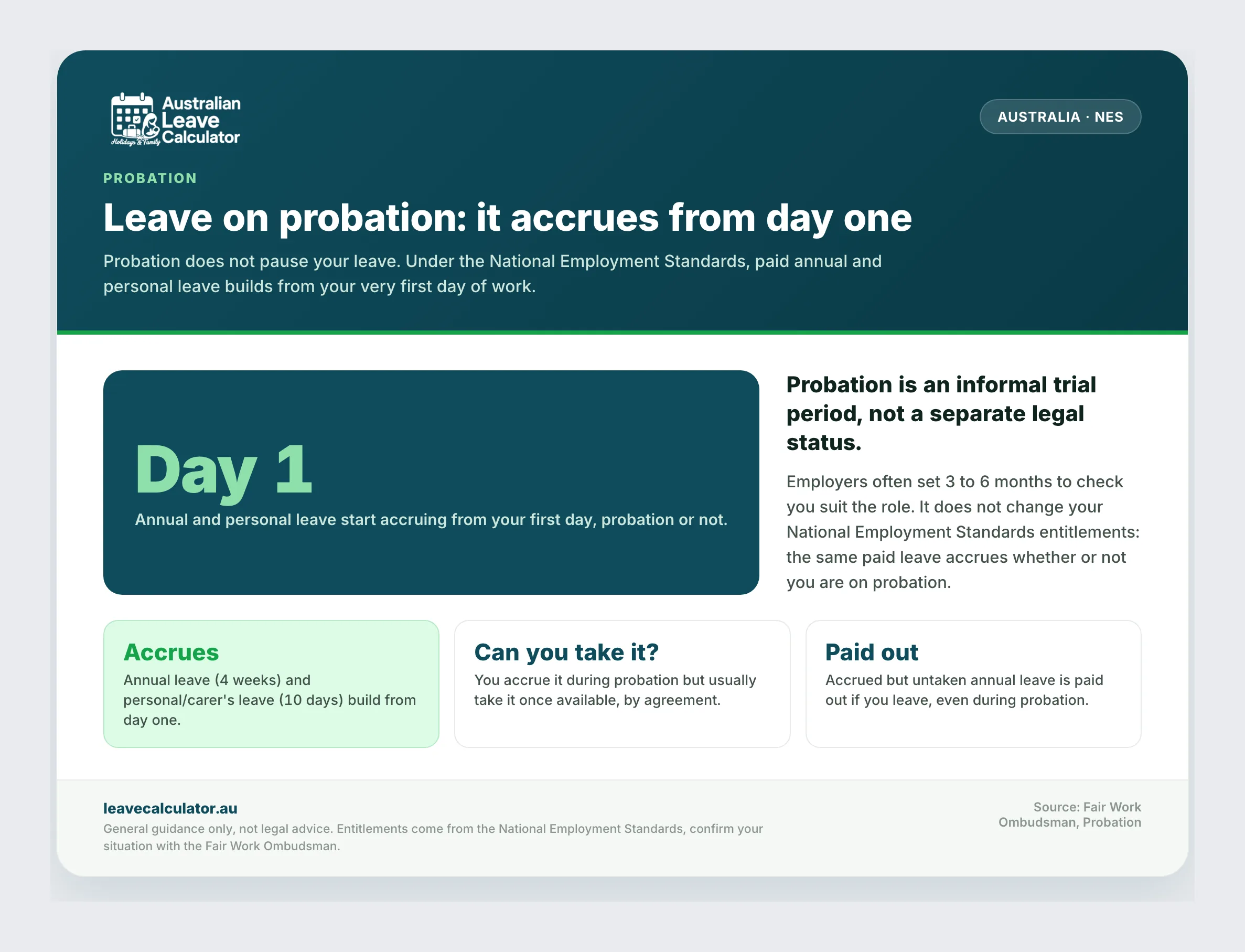
A probation period is a trial arrangement at the start of employment. The Fair Work Ombudsman says probation periods "give an employer and employee an opportunity to check that employees are suitable for the role they've been hired to do."
The employer usually decides the length, which "often ranges from 3 to 6 months, beginning from when the employee starts employment." The length is set by your contract, not the law.
The point that trips people up is that probation is not defined in the National Employment Standards. It is simply a term in your contract, so it cannot reduce, suspend or override any NES entitlement. The Fair Work Ombudsman puts it plainly: "While on probation, employees continue to receive the same entitlements as someone who isn't in a probation period. This includes the entitlements in the National Employment Standards." For the full list, see our guide to the National Employment Standards, which sit under the Fair Work Act 2009.
Fair Work Ombudsman, Probation (updated September 2025).
Your leave accrues from day one
Both your paid annual leave and your paid personal (sick and carer's) leave start building from your first day, probation or not. On annual leave, the Fair Work Ombudsman is explicit: "Annual leave accumulates from the first day of employment, even if an employee is in a probation period."
For a full-time employee the NES accrual rates are:
- Annual leave: 4 weeks a year, based on your ordinary hours (about 2.923 hours for every week worked on a standard roster). See how it maps onto an annual leave 38-hour week (152 hours a year).
- Paid sick and carer's leave: 10 days a year for full-time employees, pro rata for part-time. See sick leave on a 38-hour week or our full personal leave guide.
Leave accrues gradually and any unused balance rolls over year to year. Casual employees accrue neither paid annual nor paid sick leave, as our casual vs permanent guide explains.
Priya starts full-time on a 6-month probation. After 3 months (about 13 weeks) she has accrued about 38 hours of annual leave (one week) and about 25 hours of paid sick and carer's leave (2.5 days). That leave is hers whether or not she passes probation.
Fair Work Ombudsman, Annual leave (updated March 2026) and Sick and carer's leave (updated October 2025). Legislative reference: Fair Work Act 2009 (Cth) ss.86-87 and 95-97.
Taking annual leave during probation
Accruing leave and being allowed to use it are different things, but probation changes neither. The NES sets no minimum service period before you can access annual leave; it can be taken as it accrues, once your employer approves the request.
An employer can refuse a leave request only if the refusal is reasonable. A blanket "no annual leave during probation" policy breaches the NES, because it treats probationary staff as having fewer rights than the law allows; a refusal tied to genuine business needs, such as a peak period, can be reasonable. The Fair Work Ombudsman confirms an employee on probation "is entitled to accrue and access their paid leave entitlements, such as annual leave and sick leave."
Sick leave and carer's leave during probation
If you are genuinely unwell during probation, you can take your accrued paid sick leave. Full-time employees accrue 10 days of paid personal/carer's leave a year, part-time a pro-rata amount, and unused leave carries over. An employer cannot refuse paid sick leave when you are genuinely unable to work through illness or injury.
The same entitlement covers caring for an immediate family or household member who is sick, injured or affected by an unexpected emergency. Casuals, who do not accrue paid leave, still get 2 days of unpaid carer's leave per occasion. See our carer's leave guide and the difference between personal leave and sick leave.
Your employer can ask for reasonable notice of the absence and, if requested, reasonable evidence such as a medical certificate. If you cannot provide it, they may not have to pay you for that absence.
An employer can dismiss during probation, but dismissing someone for exercising a workplace right, such as taking legitimate sick leave, may be unlawful adverse action under the general protections, which apply from day one regardless of probation.
What probation actually affects: unfair dismissal
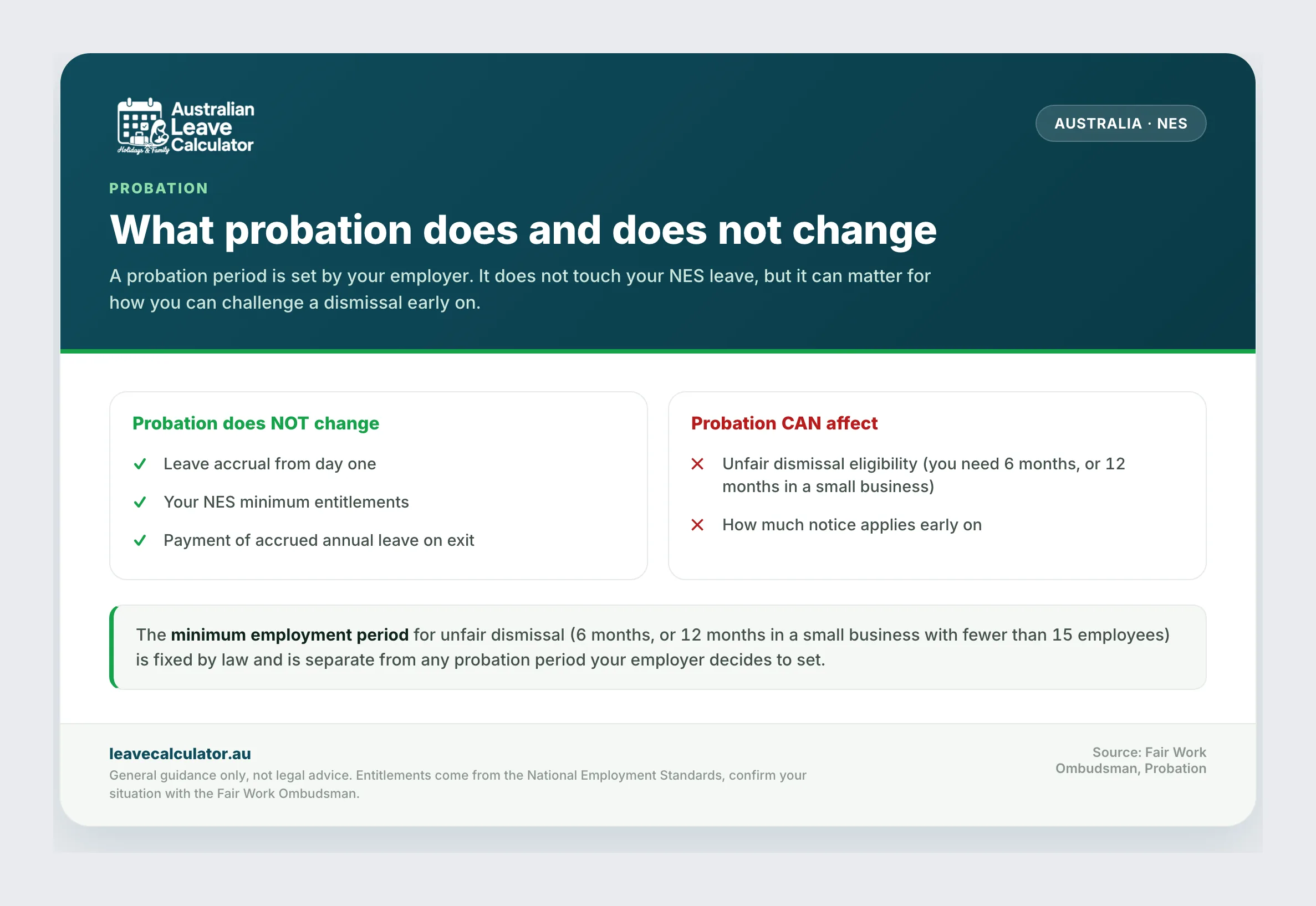
If probation does not change your leave or NES entitlements, what does it affect? Mainly your eligibility to bring an unfair dismissal claim. And even here, what matters is not your contractual probation but a separate legal figure, the minimum employment period.
To lodge an unfair dismissal application with the Fair Work Commission, you must have completed the minimum employment period:
| Employer size | Minimum employment period |
|---|---|
| Small business (fewer than 15 employees) | 12 months |
| Business with 15 or more employees | 6 months |
This period is separate from your contractual probation: a 3-month probation does not give you unfair dismissal protection at 3 months. The Fair Work Ombudsman states you must "have worked for that employer for at least 6 months, or 12 months if you worked for a small business." At a larger employer you can be eligible from 6 months even if you are still called "on probation." If you believe a dismissal was unfair, you have 21 days to apply.
Fair Work Ombudsman, Unfair dismissal (updated June 2026). Legislative reference: Fair Work Act 2009 (Cth) ss.382-383.
Being dismissed during probation
Probation gives no extra dismissal protection, so an employer can end your employment during it. What they cannot do is skip the obligations that apply to any dismissal.
They must give the notice of termination required by the NES and your contract, or pay it out in lieu. For someone dismissed early in their first year, the NES minimum notice is generally one week, though a contract may provide more. They must not dismiss you for an unlawful reason, and a small business should follow the Small Business Fair Dismissal Code to keep the process fair.
The myth that probation lets an employer let you go "on the spot" with nothing owing is wrong. Notice and accrued leave are still payable, as the next section explains.
Pay and final pay if probation ends
If you do not pass probation, you keep everything you have already earned. The Fair Work Ombudsman confirms an employee who does not pass probation is still entitled to "receive notice when employment ends" and to "have their unused accumulated annual leave hours paid out."
So your final pay after an unsuccessful probation should include:
- all wages up to your last day
- payment for any accrued but unused annual leave
- the required notice period, or payment in lieu of that notice.
Accrued paid sick and carer's leave is not paid out on termination, which is true for any employee, not just those on probation. Our final pay guide sets out that last payment in detail.
Fair Work Ombudsman, Probation (updated September 2025).
Common questions
Do I accrue annual leave while on probation?
Yes. Annual leave accumulates from your first day of employment, even during a probation period. Full-time and part-time employees accrue 4 weeks a year (pro rata for part-time), and any unused balance carries over from year to year.
Can my employer refuse my leave because I am on probation?
Not on that basis alone. Probation is not a lawful reason to refuse a leave request. Annual leave can be refused only where the refusal is reasonable, such as a genuinely busy period; paid sick leave cannot be refused when you are genuinely too ill to work.
Does a 3-month probation mean I am protected from unfair dismissal after 3 months?
No. Eligibility depends on the minimum employment period set by law: 6 months, or 12 months at a small business with fewer than 15 employees. That period is separate from your contract's probation, so a short probation does not bring the protection forward.
What am I owed if I am let go during probation?
Wages up to your last day, payment for accrued unused annual leave, and the notice required by the NES and your contract (or pay in lieu). Unused paid sick leave is not paid out. See our final pay guide.
Do casual employees have a probation period?
Casuals can be placed on an informal probation, but it makes even less difference: they do not accrue paid annual or sick leave anyway. They are entitled to 2 days of unpaid carer's leave per occasion. See the casual vs permanent guide.

Author & reviewer
Sarah has spent over a decade advising Australian SMBs on Fair Work, NES compliance, and payroll. Based in Sydney, she has worked across hospitality, retail and professional services.