

The Fair Work Act 2009 is the single piece of federal legislation that sets the minimum pay, leave and job-security rights of most employees in Australia. When people ask what they are entitled to at work, the honest answer almost always starts here: this Act, and the National Employment Standards it contains, are the legal floor that no contract can dip below. This guide explains what the Act is, when it started, the two bodies that run the system, the leave and termination sections that matter most, and who is (and is not) covered by it.
Key takeaways
- The Fair Work Act 2009 (Cth) is the federal law governing employment for most Australian workers. It was assented to on 7 April 2009, and the National Employment Standards took effect on 1 January 2010.
- Two bodies run the system: the Fair Work Commission (the independent tribunal that makes awards and hears disputes) and the Fair Work Ombudsman (the regulator that advises and enforces).
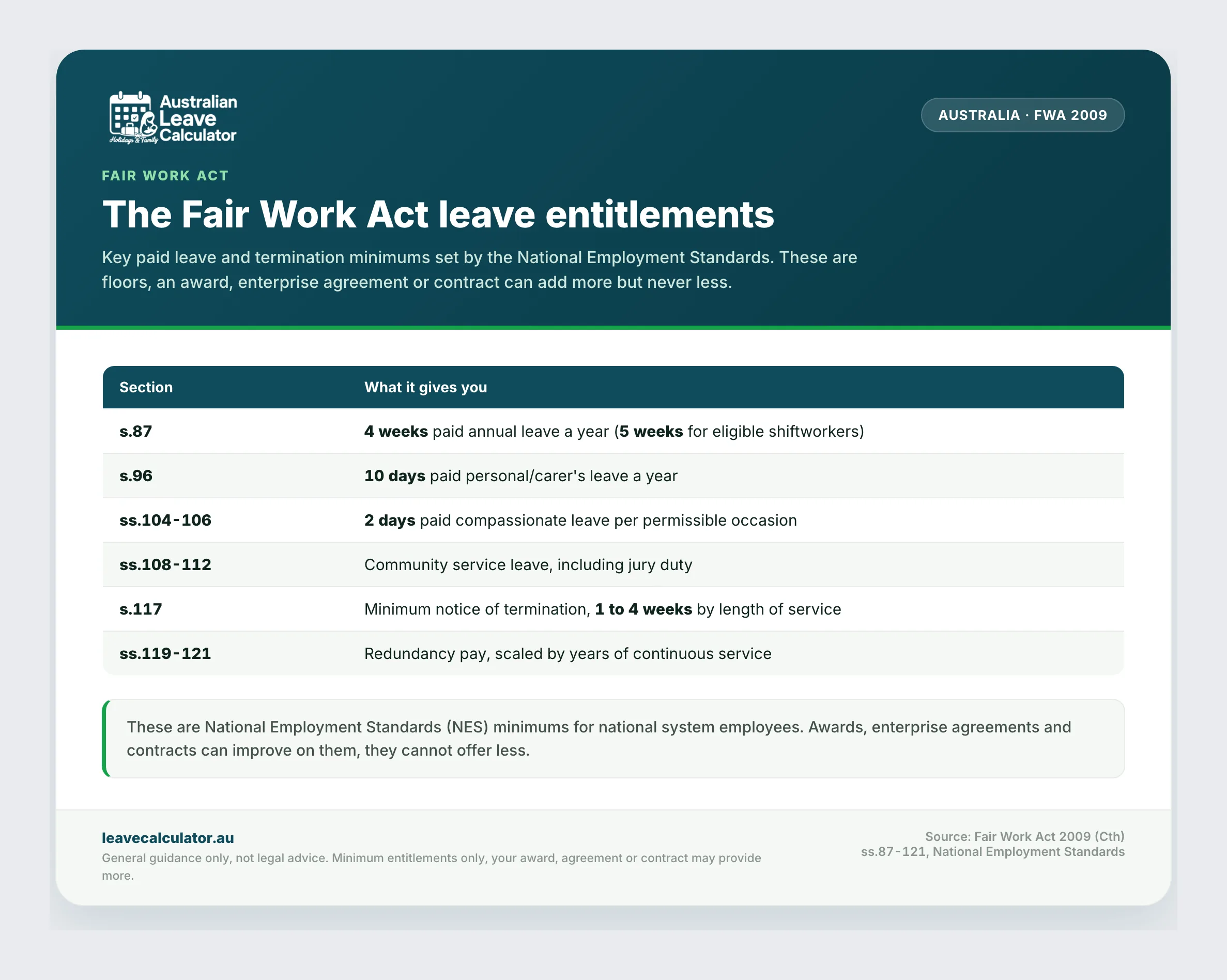
- The core leave rights sit in Part 2-2: 4 weeks annual leave (s.87), 10 days paid personal/carer's leave (s.96) and 2 days compassionate leave per occasion (s.104).
- Notice of termination (s.117) and redundancy pay (ss.119-121) both scale with length of service, with small businesses of fewer than 15 staff exempt from redundancy pay.
- Awards and enterprise agreements sit on top of the Act and can only add to it, never reduce it. No employment contract can take an Act entitlement away.
What the Fair Work Act 2009 is
The Fair Work Act 2009 (Cth) is the primary Commonwealth statute for workplace relations in Australia. It replaced the previous WorkChoices framework and rebuilt the national system around a single safety net of minimum conditions. The Act received Royal Assent on 7 April 2009. Its main institutions began operating during 2009, and the National Employment Standards (the 11 minimum entitlements the Act guarantees) commenced on 1 January 2010. Every figure on this site is checked against those primary sources and recorded in our methodology and sources pages, and you can read who maintains them on the about page.
The Act does far more than set leave. It also creates the framework for modern awards, enterprise bargaining, the national minimum wage, protection from unfair dismissal, and general protections against adverse action. For employees, the part that matters most is the leave and termination safety net, which is the focus here.
Fair Work Act 2009 (Cth), full text on the Federal Register of Legislation. Assent date (7 April 2009) and commencement history per the AustLII compilation endnotes.
The Fair Work Commission and the Fair Work Ombudsman
Two separate bodies administer the Act, and it helps to know which to approach. The Fair Work Commission is the independent national workplace relations tribunal. It makes and varies modern awards, sets the national minimum wage each year, approves enterprise agreements, and hears disputes such as unfair dismissal and general protections claims. If you want to challenge a dismissal or have a matter arbitrated, the Commission is the venue.
The Fair Work Ombudsman is the regulator and educator. It provides free advice to employees and employers, investigates complaints about underpayment and breaches of the Act, and can take enforcement action in court. A simple way to remember the split: the Ombudsman advises and enforces, while the Commission decides and resolves disputes.
Part 2-2: the National Employment Standards
The leave entitlements that matter most to employees are grouped in Part 2-2 of the Act, which sets out the National Employment Standards (NES). The NES is the legislated minimum: an award, enterprise agreement or individual contract can offer more generous terms, but any term that tries to provide less than the NES has no effect. The standards cover maximum weekly hours, requests for flexible working, parental leave, annual leave, personal/carer's and compassionate leave, family and domestic violence leave, community service leave, long service leave, public holidays, notice of termination and redundancy pay, plus the Fair Work Information Statement.
The sections below cover the entitlements people ask about most. For the full set, see our guide to the National Employment Standards.
Annual leave (s.87)
Section 87 entitles every full-time and part-time employee to 4 weeks of paid annual leave for each year of service, calculated on their ordinary hours of work. Certain shiftworkers are entitled to 5 weeks where an award or enterprise agreement defines them as a shiftworker for NES purposes. Leave accrues progressively across the year and accumulates from year to year, so unused leave does not expire. Casual employees do not accrue paid annual leave.
Because leave accrues from the first day of employment, it also builds up during a probation period. When employment ends, any accrued but untaken annual leave must be paid out as part of your final pay, regardless of why you left.
Fair Work Act 2009 (Cth) s.87, via the Federal Register of Legislation. See also Fair Work Ombudsman, Annual leave.
Priya works part-time at 20 hours a week. Over a full year she accrues 80 hours of annual leave (4 weeks at her ordinary hours). If she takes a fortnight off she uses 40 hours and carries the remaining 40 hours into the next year.
Personal, carer's and compassionate leave (ss.96 and 104)
Section 96 gives full-time employees 10 days of paid personal/carer's leave for each year of service, with part-time employees receiving a pro-rata amount. It covers two situations: being unwell or injured yourself, and caring for an immediate family or household member who is ill, injured or facing an unexpected emergency. Like annual leave, it accrues progressively and rolls over year to year, but unlike annual leave it is not paid out when employment ends. Our guide on personal leave versus sick leave explains why the two terms describe the same NES right.
Section 104 adds 2 days of compassionate leave for each permissible occasion, such as when a member of your immediate family or household dies or contracts a life-threatening illness or injury, or where an employee or their partner has a miscarriage. It is paid for full-time and part-time employees and unpaid for casuals. See also our guides to carer's leave and community service and jury duty leave (ss.108-112 cover time off for jury service or voluntary emergency work).
Fair Work Act 2009 (Cth) ss.96 and 104, via the Federal Register of Legislation. See also Fair Work Ombudsman, Sick and carer's leave.
Notice of termination (s.117)
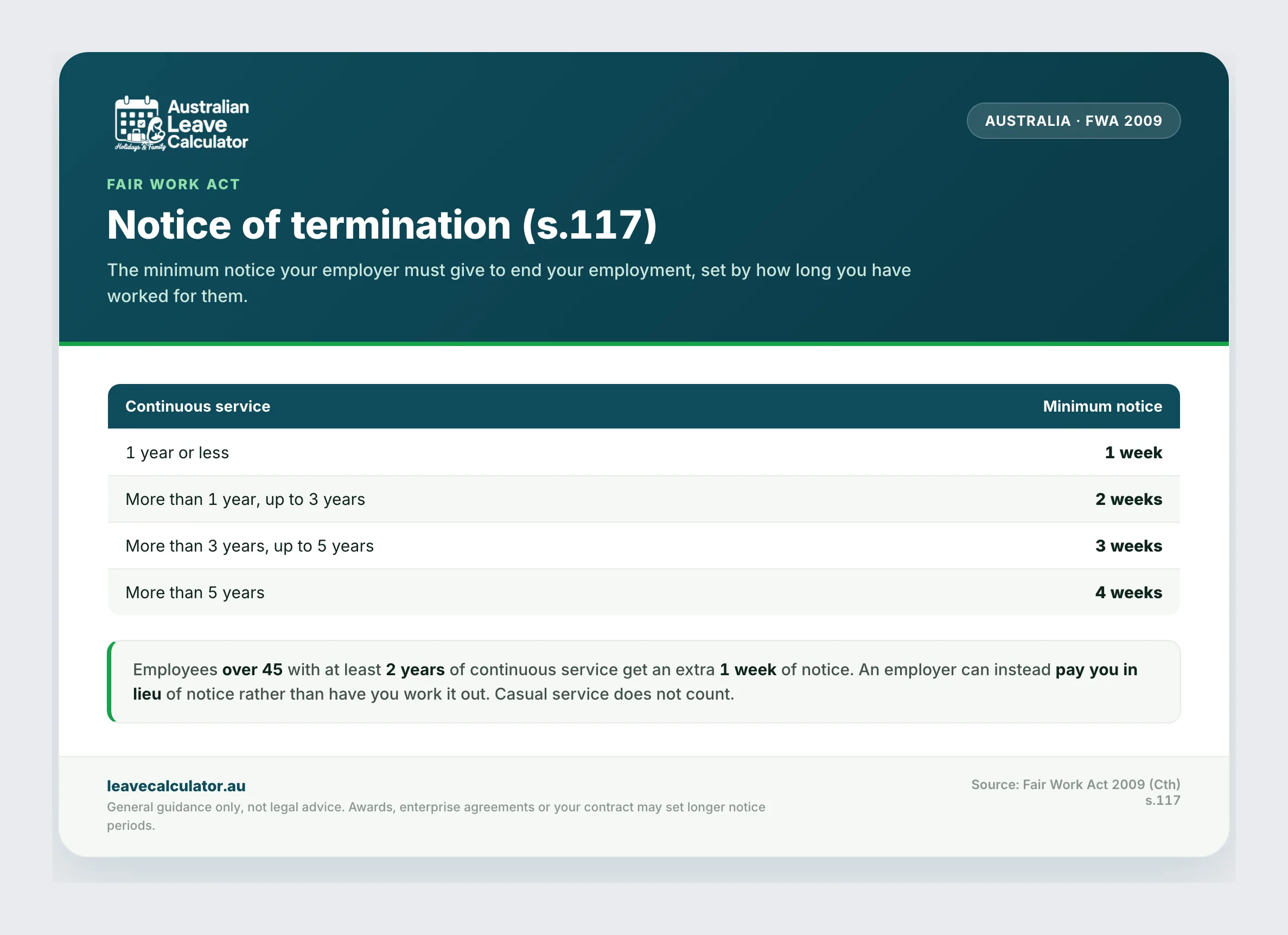
Section 117 sets the minimum written notice an employer must give when ending an employee's employment. An employer must either give notice or pay the equivalent amount in lieu. The minimum period scales with continuous service:
| Continuous service | Minimum notice |
|---|---|
| 1 year or less | 1 week |
| More than 1 year, up to 3 years | 2 weeks |
| More than 3 years, up to 5 years | 3 weeks |
| More than 5 years | 4 weeks |
An employee who is over 45 years old and has completed at least 2 years of continuous service receives an extra 1 week on top of the figure in the table. Periods worked as a casual do not count towards continuous service for this purpose, and some dismissals (for example, serious misconduct) are excluded from the notice requirement.
Redundancy pay (ss.119-121)
Redundancy pay is owed under s.119 when an employer terminates a job because the work is no longer required to be done by anyone (or because of insolvency or bankruptcy), rather than because of anything the employee did. The amount, paid at the employee's base rate for their ordinary hours, scales with continuous service:
| Continuous service | Redundancy pay |
|---|---|
| At least 1 year, less than 2 years | 4 weeks |
| At least 2 years, less than 3 years | 6 weeks |
| At least 3 years, less than 4 years | 7 weeks |
| At least 4 years, less than 5 years | 8 weeks |
| At least 5 years, less than 6 years | 10 weeks |
| At least 6 years, less than 7 years | 11 weeks |
| At least 7 years, less than 8 years | 13 weeks |
| At least 8 years, less than 9 years | 14 weeks |
| At least 9 years, less than 10 years | 16 weeks |
| 10 years or more | 12 weeks |
The drop back to 12 weeks at 10 years is deliberate: at that tenure, long service leave is expected to supplement the payout. Under s.121, redundancy pay is not owed if the employee has less than 12 months of continuous service, or if the employer is a small business employer (fewer than 15 employees, counted per s.23). Under s.120, an employer who finds the employee other acceptable work, or genuinely cannot pay, can apply to the Fair Work Commission to have the amount reduced. Our pages on severance pay and redundancy tax cover how the payment is made up and taxed.
Fair Work Act 2009 (Cth) ss.119, 120, 121 and 23, via the Federal Register of Legislation. See also Fair Work Ombudsman, Redundancy pay and entitlements.
Daniel has worked full-time for a large employer for 3 years when his role is made redundant. Under s.119 he is entitled to 7 weeks of redundancy pay at his base rate, plus 3 weeks of notice under s.117, plus any accrued annual leave paid out in his final pay.
How awards and enterprise agreements sit on top
The NES is the floor, but few employees rely on it alone. Most jobs are also covered by a modern award, an industry or occupation instrument made by the Fair Work Commission that adds detail the Act does not: minimum pay rates, overtime, penalty rates, allowances and annual leave loading. Where a workplace has bargained one, an enterprise agreement can replace the award, but only if it passes the "better off overall test" so covered employees end up better off than under the award.
The rule for reading them together is simple. If your award, agreement or contract gives you more than the NES, you get the better deal. If any of them tries to give you less than an NES entitlement, the NES wins and that term is invalid. Employees covered by no award and no agreement (award and agreement free) still receive the full NES as their minimum.
Who is covered, and the main exceptions
The Act covers the national workplace relations system, which takes in most private-sector employees across Australia and Commonwealth public servants. The best-known exception is Western Australia: employees of unincorporated businesses (such as sole traders and partnerships) and state and local government employees in WA fall under the separate WA state industrial system rather than the Fair Work Act.
Some state and local government employees in other states can also sit outside the national system, and independent contractors are not employees at all, so they get no NES leave (see casual versus permanent for how status is decided). If you are unsure which system applies, the Fair Work Ombudsman can confirm it.
Common questions
When did the Fair Work Act 2009 start?
The Act was assented to on 7 April 2009. Its main institutions began operating during 2009, and the National Employment Standards, the part that sets the minimum leave and termination entitlements, took effect on 1 January 2010.
What is the difference between the Fair Work Commission and the Fair Work Ombudsman?
The Fair Work Commission is the independent tribunal that makes awards, sets the minimum wage, approves enterprise agreements and hears disputes such as unfair dismissal claims. The Fair Work Ombudsman is the regulator that gives free advice, investigates complaints and enforces the Act.
Does the Fair Work Act cover every worker in Australia?
No. It covers most private-sector employees and Commonwealth public servants in the national system. The main exceptions are Western Australian state-system employees (including those working for unincorporated businesses), some state and local government employees, and independent contractors, who are not employees.
Can my contract give me less than the Fair Work Act minimums?
No. The National Employment Standards are a legislated floor. A contract, award or enterprise agreement can offer more than the NES, but any term that tries to provide less than an NES entitlement has no effect, and the NES applies instead.
Where can I read the Fair Work Act myself?
The full, current text is on the Federal Register of Legislation at legislation.gov.au. The Fair Work Ombudsman's website explains the same rules in plain language, and our guides link the sections to calculators for annual leave, personal leave and redundancy.

Author & reviewer
Sarah has spent over a decade advising Australian SMBs on Fair Work, NES compliance, and payroll. Based in Sydney, she has worked across hospitality, retail and professional services.