

Whether you are a casual or a permanent employee shapes almost everything about your job: your hourly rate, whether you build up paid leave, whether you get notice or redundancy pay when the work ends, and how secure your hours are. In Australia the difference is not just a label on a payslip. It is defined in law by the National Employment Standards (NES) and the Fair Work Act 2009, and it turns on one idea: whether there is a firm advance commitment to ongoing work. This guide explains how casual employment is legally defined, why casuals are paid a loading of around 25%, what casuals do and do not get compared with permanent staff, how the employee choice pathway lets eligible casuals convert, and what happens when a so-called casual is really permanent. Casual loading and conversion play out differently by industry: compare the General Retail Award, Fast Food Award, Hospitality Award, Restaurant Award and Registered Clubs Award.
Key takeaways
- A casual is a person who, when they start, has no firm advance commitment to ongoing work and is entitled to a casual loading or casual pay rate (Fair Work Act 2009, s.15A). A regular roster on its own does not make you permanent.
- In place of paid leave, notice and redundancy, casuals are paid a casual loading, commonly 25% on top of the ordinary hourly rate.
- Casuals do not accrue paid annual leave or paid personal/carer's leave, and get no notice of termination or redundancy pay, even after years of regular work.
- Casuals still get 2 days unpaid carer's leave and 2 days unpaid compassionate leave per occasion, unpaid community service leave, and 10 days paid family and domestic violence leave a year. Long-serving casuals can qualify for long service leave under state law.
- After 6 months (12 months in a small business), an eligible casual can use the employee choice pathway to notify their employer that they want to become permanent (Fair Work Act 2009, ss.66A-66M).
How casual employment is legally defined
Under the Fair Work Act 2009, a person is a casual employee if, when they start employment, two things are true: the employment relationship has no firm advance commitment to ongoing work, and the employee is entitled to a casual loading or a specific casual pay rate under an award, registered agreement or employment contract. Both parts of the test must be met.
Whether there is a “firm advance commitment” is not decided by the wording of the contract alone. It is assessed on the real substance, practical reality and true nature of the working relationship. No single factor decides it. The Fair Work Ombudsman lists factors that must be weighed together, including:
- whether the employer can offer or not offer work, and whether that is what actually happens
- whether the employee can accept or reject work, and whether that is what actually happens
- whether it is reasonably likely there will be future work of the kind the employee usually performs
- whether full-time or part-time employees do the same kind of work in the business
- whether the employee has a regular pattern of work, even if it changes over time.
Importantly, a regular pattern of work on its own does not prove a firm advance commitment. Someone who works the same shifts every week can still be a genuine casual if the relationship carries no promise of continuing work.
Working a predictable roster every week does not automatically convert you to permanent status. What matters is the substance of the arrangement: can either side genuinely offer or decline work, and is there any firm commitment to keep it going? If there is not, the law can still treat you as casual.
Fair Work Ombudsman, Casual employees (content last updated 12 May 2026). Legislative reference: Fair Work Act 2009 (Cth) s.15A.
The 25% casual loading
Because casuals miss out on paid leave and other permanent entitlements, they are paid more per hour to compensate. This higher rate is the casual loading. Under many modern awards the loading is 25% on top of the ordinary hourly rate, and 25% is the figure the Fair Work Ombudsman uses in its own casual employee example. The loading is paid in lieu of paid annual leave, paid personal/carer's leave, notice of termination and redundancy pay, entitlements a casual does not receive.
The exact loading depends on your award or registered agreement, so it is not always precisely 25%. Award and agreement free casuals are still entitled to a casual loading or casual pay rate under the national minimum wage order. Check the rate for your job with the Fair Work Ombudsman's Pay and Conditions Tool, or put your own number through the casual loading calculator, which also works backwards from a loaded rate to the base rate inside it. Note that the casual loading is not the same as annual leave loading, a separate top-up paid to permanent staff when they take annual leave; see our leave loading guide for that.
Josh works casual shifts as a bartender at a summer pop-up restaurant. His roster changes each week and he can accept or decline the shifts offered, so there is no firm advance commitment to ongoing work. If his job sits at Level 1 of the Restaurant Industry Award, his minimum base rate is $26.44 an hour, and with the 25% casual loading he is paid at least $33.05 an hour. Josh accrues no annual leave or personal leave and gets no notice or redundancy if the restaurant closes, but that extra $6.61 an hour is the trade-off for the missing entitlements.
What casuals do and do not get
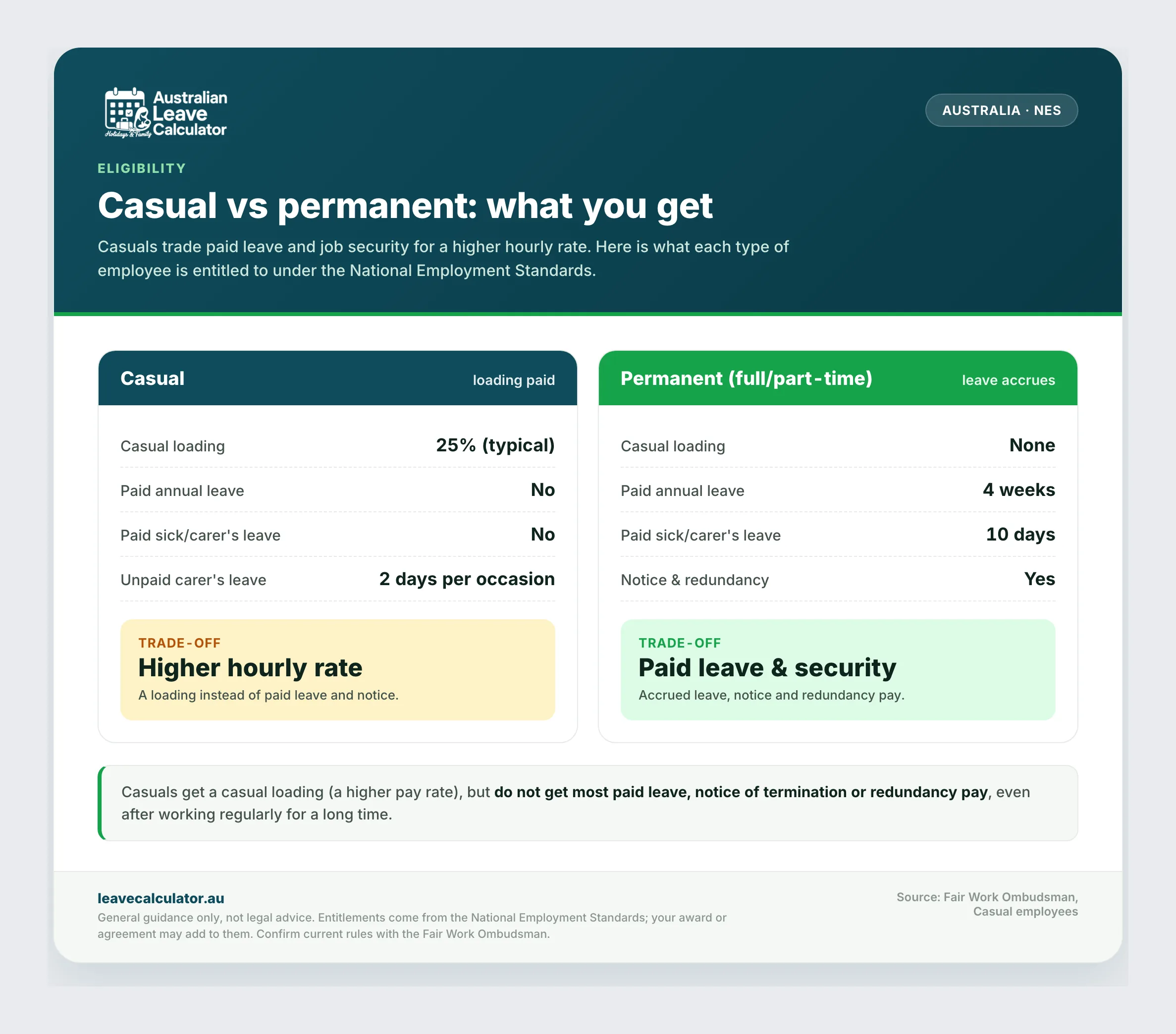
A common misconception is that casuals get nothing beyond their hourly pay. Casuals miss out on the accrued, paid entitlements, but they still hold several rights under the NES. The table below sets out the core differences, sourced from the Fair Work Ombudsman.
| Entitlement | Full-time / part-time (permanent) | Casual |
|---|---|---|
| Paid annual leave | Yes, 4 weeks a year (pro rata if part-time) | No |
| Paid personal/carer's leave (sick leave) | Yes, 10 days a year (pro rata if part-time) | No |
| Unpaid carer's leave | Yes, when paid balance is used up | Yes, 2 days per occasion |
| Compassionate leave | Yes, 2 days paid per occasion | 2 days unpaid per occasion |
| Paid family and domestic violence leave | Yes, 10 days a year | Yes, 10 days a year |
| Unpaid community service leave | Yes | Yes |
| Notice of termination | Yes | No |
| Redundancy pay | Yes, after 1 year (subject to exclusions) | No |
| Long service leave | Yes, under state law | Sometimes, for long-serving regular casuals |
So casuals do get 2 days unpaid carer's leave and 2 days unpaid compassionate leave per occasion, unpaid community service leave, and the same 10 days of paid family and domestic violence leave a year that permanent staff receive. Casuals can also request flexible working arrangements and take unpaid parental leave, but only if they have been employed on a regular and systematic basis for at least 12 months and reasonably expect that to continue. What casuals do not get is most forms of paid leave, notice of termination or redundancy pay, no matter how long they have worked.
Fair Work Ombudsman, Casual employees (content last updated 12 May 2026). Legislative references: Fair Work Act 2009 (Cth) ss.15A, 65, 66A-66K, 67, 102, 104, 106, 108.
Part-time and full-time permanent employment compared
Permanent employment comes in two forms, and both differ from casual work in the same fundamental way: a permanent employee has a firm advance commitment to ongoing employment. A full-time employee usually works around 38 ordinary hours a week and can expect those hours to continue. A part-time employee works fewer, but still regular and agreed, hours each week. Crucially, both full-time and part-time staff accrue paid annual leave and paid personal/carer's leave, and both are entitled to notice of termination and, where it applies, redundancy pay. Part-timers receive these entitlements on a pro rata basis according to the hours they work.
The choice between casual and permanent is therefore a genuine trade-off. Casual work offers a higher hourly rate and the freedom to accept or decline shifts, but no paid time off and no security if the work dries up. Permanent work offers paid leave, notice and predictability, but at a lower base hourly rate because the loading is not paid.
Long service leave and long-serving casuals
Long service leave is the one major entitlement that reaches casuals even though they never accrue paid annual leave or sick leave. The rules sit in each state and territory's own long service leave law, and all eight cover casual employees whose service is continuous. What differs is the test for continuity. Queensland ends continuous service after a break of more than 3 months between contracts, Tasmania deems a casual continuously employed at 32 hours or more in each 4-week period, and only the ACT builds "regular and systematic" into its definition of a casual.
How a casual's pay is averaged, whether the casual loading counts and what happens on resigning early all vary too. Our guide do casuals get long service leave compares all eight jurisdictions section by section, and the long service leave calculator estimates the entitlement for your state.
The employee choice pathway to permanent
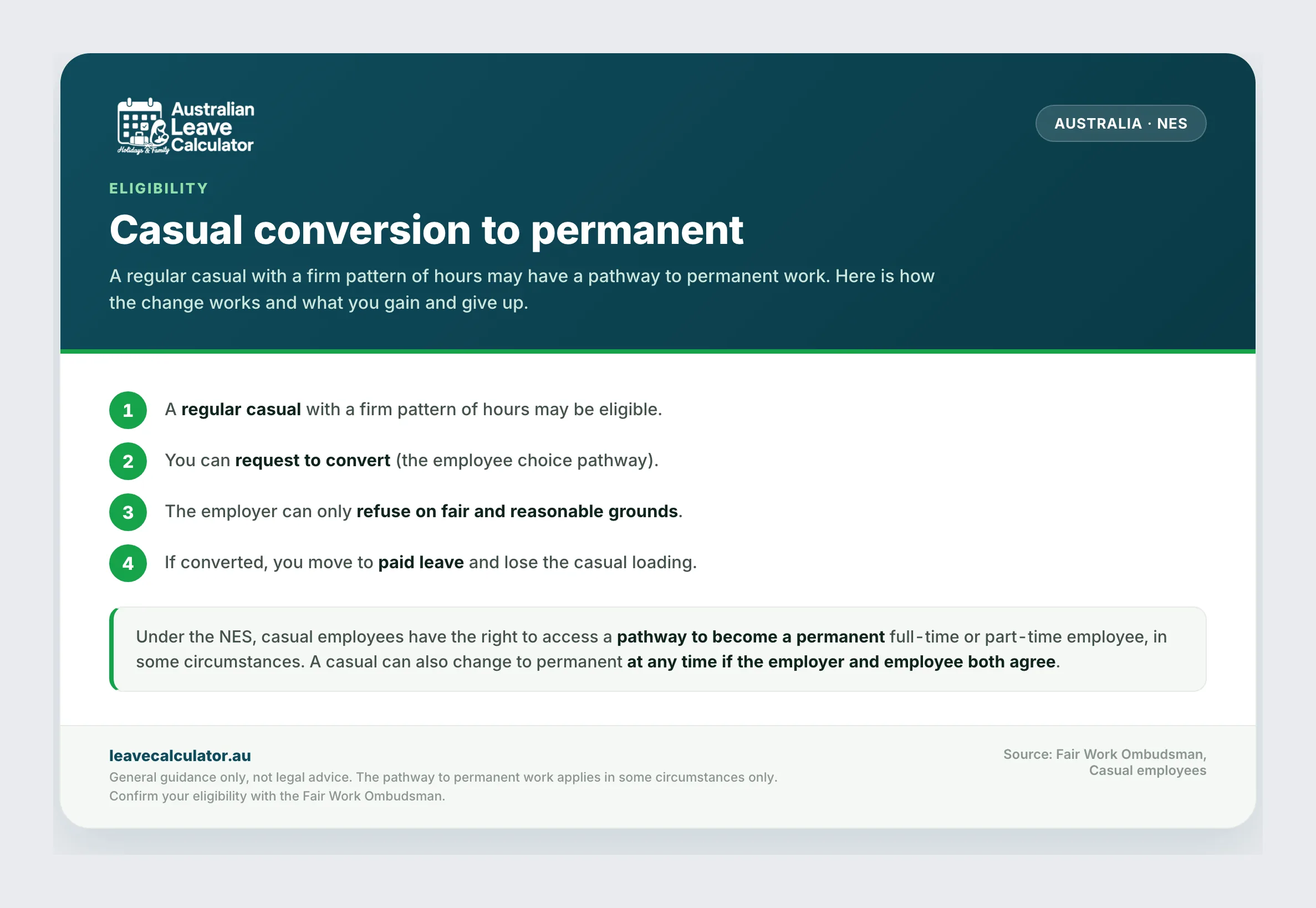
A casual can change to permanent (full-time or part-time) employment at any time if the employer and employee simply agree to it. On top of that, the NES gives eligible casuals a formal route to raise it, called the employee choice pathway. From 26 August 2024 this replaced the older “casual conversion” process, which was repealed rather than renamed. Our casual conversion guide covers what was removed, the sections that replaced it, and the transitional rules for employment that started before that date.
Under the employee choice pathway, a casual can give their employer written notice that they want to become permanent if they:
- have been employed for at least 6 months (or 12 months if employed by a small business), and
- believe they no longer meet the definition of a casual employee.
A casual cannot give notice while already in a dispute about changing to permanent, or if in the last 6 months the employer refused a previous notice or such a dispute was resolved. Before responding, the employer must consult the employee about what would change, then respond in writing within 21 days, either accepting or refusing.
Refusal is only allowed on limited grounds: the employee still meets the casual definition; there are fair and reasonable operational grounds (for example, substantial changes to how work is organised or significant impacts on the business); or accepting would breach a recruitment or selection process required by law. An employer also cannot reduce or vary hours, change the pattern of work, or terminate the employee to dodge these obligations, and casuals are protected from adverse action for exercising this workplace right.
Fair Work Ombudsman, Becoming a permanent employee (content last updated 14 May 2026). Legislative reference: Fair Work Act 2009 (Cth) ss.66A-66M.
Sham arrangements: when a casual is really permanent
Sometimes an employer labels a worker “casual” to avoid paying the entitlements that would apply to a permanent employee. The Fair Work Act calls this a sham arrangement, and there are specific protections against it. It is illegal for an employer to:
- knowingly make a false statement to persuade a current or former full-time or part-time employee to sign a casual contract to do the same, or mostly the same, work, or
- dismiss or threaten to dismiss an employee in order to re-engage them as a casual doing the same, or mostly the same, work.
Courts can impose civil penalties on businesses and individuals for sham arrangements, and a worker incorrectly engaged as a casual may be able to recover entitlements they should have received as a permanent employee. If you think you have been wrongly classified, or that you might really be an employee rather than a contractor, the Fair Work Ombudsman can help. Call the Fair Work Infoline on 13 13 94 between 8am and 5:30pm, Monday to Friday, to speak to an adviser.
Fair Work Ombudsman, Casual employees (sham arrangements). Legislative references: Fair Work Act 2009 (Cth) ss.359B-359C.
Common questions
Do casuals get paid annual leave or sick leave?
No. Casuals do not accrue paid annual leave or paid personal/carer's (sick) leave, no matter how long they work. The casual loading, commonly 25%, is paid instead to compensate. Casuals do still get 2 days of unpaid carer's leave per occasion and 10 days of paid family and domestic violence leave a year. See our personal leave versus sick leave guide for how paid leave works for permanent staff.
Is the casual loading always 25%?
Not always. 25% is the most common rate under modern awards and the figure the Fair Work Ombudsman uses in its examples, but the exact loading is set by your award or registered agreement. Award and agreement free casuals are entitled to a casual loading under the national minimum wage order. Check the Pay and Conditions Tool for the rate that applies to your job.
Can my employer keep me casual forever?
Not if you genuinely no longer meet the casual definition. Once employed for 6 months (12 months in a small business), you can give written notice under the employee choice pathway that you want to become permanent. Your employer must consult you and respond in writing within 21 days, and can only refuse on the limited grounds set out in the Fair Work Act.
Does a regular roster automatically make me permanent?
No. Working the same shifts each week does not, by itself, convert you to permanent employment. What matters is whether there is a firm advance commitment to ongoing work. A regular pattern is one factor a court or the Fair Work Ombudsman weighs, but it is not decisive on its own.
Do casuals ever get long service leave?
Yes, where their service is continuous. All eight state and territory long service leave laws cover casual employees, but each tests continuity differently, so check do casuals get long service leave for the rule where you work.

Author & reviewer
Sarah has spent over a decade advising Australian SMBs on Fair Work, NES compliance, and payroll. Based in Sydney, she has worked across hospitality, retail and professional services.