

One of the most common questions employees and payroll teams ask is whether annual leave keeps building up while you are away from work. Under Australian workplace law the short answer is usually yes, but only while the time off still counts as 'service'. This guide explains the general rule from the Fair Work Act 2009, which paid leave keeps your annual leave growing, which unpaid leave pauses it, and the exceptions that catch people out. For the underlying entitlement, see our annual leave page, and for the legislation itself, our Fair Work Act guide.
Key takeaways
- Annual leave accrues progressively on your ordinary hours, and the test for whether it keeps accruing on other leave is whether that period counts as service.
- Paid leave (annual, sick and carer's, family and domestic violence), long service leave and community service leave all keep your annual leave accruing.
- Most unpaid leave, cashed-out leave and the Paid Parental Leave Scheme pause accrual, but unpaid community service leave is a notable exception that still counts as service.
- A public holiday during annual leave is not deducted, and workers compensation accrual depends on your state or territory scheme.
The general rule: does leave keep accruing?
The Fair Work Act says an employee's entitlement to paid annual leave 'accrues progressively during a year of service ... according to the employee's ordinary hours of work, and accumulates from year to year'. In plain terms, leave builds up steadily across the year rather than landing in one lump, and it is tied to the hours you are contracted to work. Fair Work confirms it starts from your first day of employment, even during a probation period.
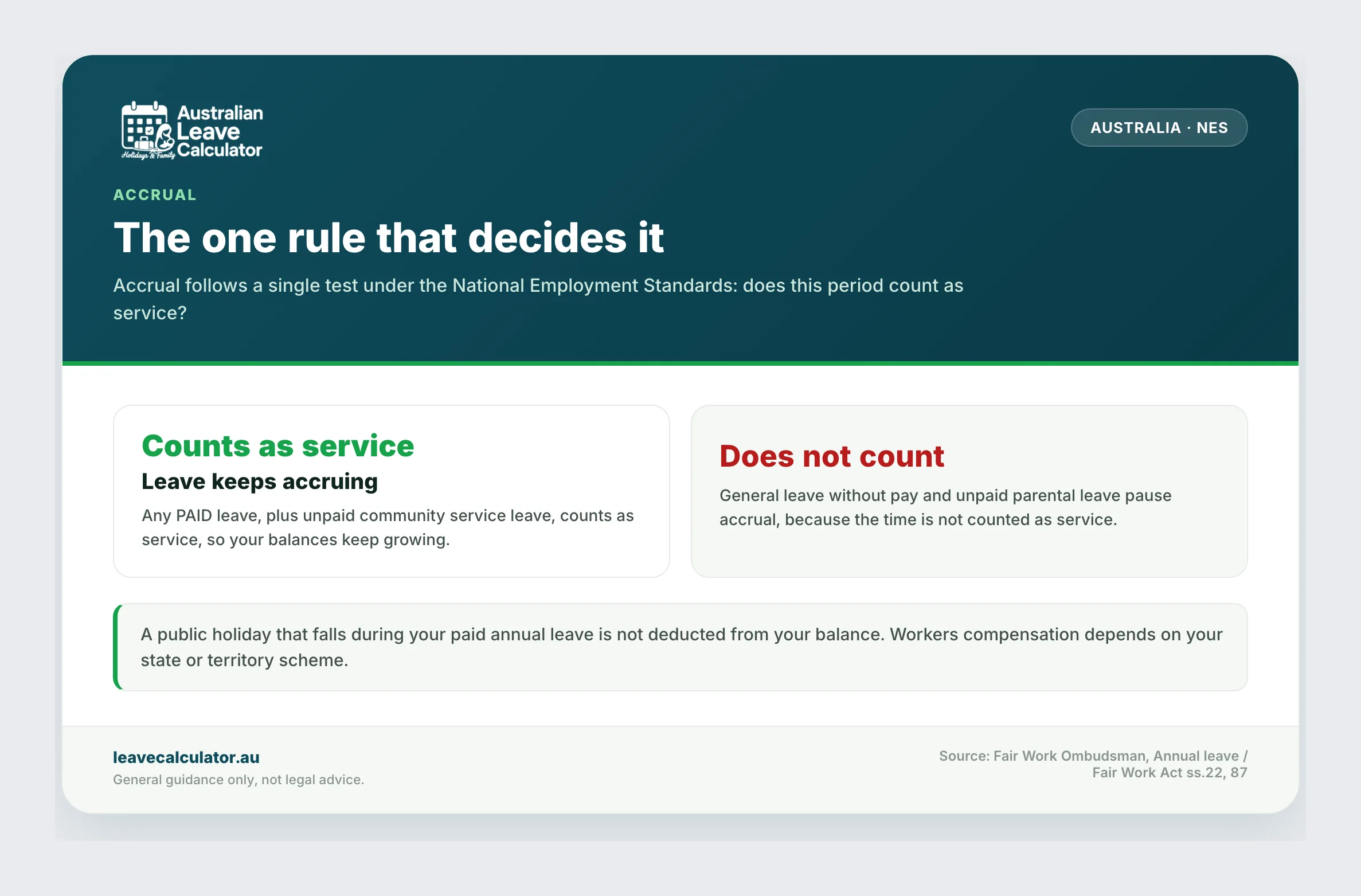
So the real test for whether annual leave keeps accruing while you are on another type of leave is not the label on the leave. It is whether that period counts as service. The Act defines service as the time you are employed, minus any 'excluded period'. Excluded periods are broadly any period of unauthorised absence and any period of unpaid leave or unpaid authorised absence, with a few specific exceptions. If a period counts as service, your annual leave keeps growing. If it is an excluded period, accrual pauses for that time. Importantly, an excluded period does not break your continuous service, it just does not count towards its length.
Paid leave that keeps accruing
Because paid leave is treated as service, annual leave keeps building up while you take it. According to Fair Work, annual leave accumulates when an employee is on:
- paid annual leave
- paid sick and carer's leave (paid personal leave)
- paid family and domestic violence leave
- community service leave, including jury duty
- long service leave.
This means the small amount of leave you accrue does not stop simply because you are on holiday, off sick on paid leave, or taking a long service break. Your other service-based entitlements, such as paid personal leave, generally keep accruing during these periods too.
Public holidays during annual leave
If a public holiday falls in the middle of a period of annual leave, you are not treated as being on annual leave that day. The Fair Work Act provides that where a period of paid annual leave includes a public holiday, the employee 'is taken not to be on paid annual leave on that public holiday'. In practice that day is not deducted from your annual leave balance: you are paid for the public holiday instead, and your holiday is effectively extended by that day. See our public holidays page for how payment works.
Falling ill on holiday works the same way under section 89(2): see sick during annual leave for how to claim the days back.
Unpaid leave that pauses accrual
Most unpaid leave does not count as service, so annual leave stops building up for that time. Fair Work states that annual leave does not accumulate when an employee is on:
- unpaid annual leave
- unpaid sick or carer's leave
- unpaid parental leave.
General leave without pay that you arrange with your employer falls into the same category: it is an unpaid authorised absence and does not count towards service. Two related traps are worth knowing. First, the Australian Government's Paid Parental Leave Scheme is not treated as paid leave, so you do not accrue annual leave while being paid by the scheme if you are on unpaid leave from your employer at the time. Second, leave does not accrue for a period of annual leave that has been cashed out, because you did not actually take that time as service.
The unpaid community service leave exception
There is one exception that surprises people: unpaid community service leave still counts as service. When the Act lists the unpaid periods that are excluded from service, it specifically carves out 'a period of absence under Division 8 of Part 2-2 (which deals with community service leave)'. Community service leave covers activities such as jury duty and eligible voluntary emergency management activities. So even where that leave is unpaid, your annual leave keeps accruing across it. The same section also protects periods of stand down. Our community service and jury duty leave guide has the detail.
Workers compensation: it depends on your state
Workers compensation is one area where there is no single national answer: each state runs its own scheme, so the leave rules differ.
- NSW. Compensation is still payable for a period you are also paid annual or long service leave (Workers Compensation Act 1987 s 49), and sick leave paid before compensation is agreed or awarded is treated as not taken, in proportion to the compensation (s 50). See stress leave in NSW.
- Victoria. WorkSafe does not reduce weekly payments because you take paid annual or long service leave, and refers accrual questions to your agreement and the Fair Work Act (WorkSafe claims manual 3.5.4 to 3.5.6). See stress leave in Victoria.
- Queensland. You keep taking and accruing annual, sick and long service leave while on workers compensation (Workers' Compensation and Rehabilitation Act 2003 s 119A). See stress leave in QLD.
How accrual is actually calculated
Full-time and part-time employees are entitled to four weeks of annual leave for each year of service, based on their ordinary hours of work. Eligible shiftworkers can get five weeks. Because leave accrues progressively, you can think of it as building up a little each pay period rather than all at once. A simple way to find your yearly hours is to multiply your ordinary weekly hours by four.
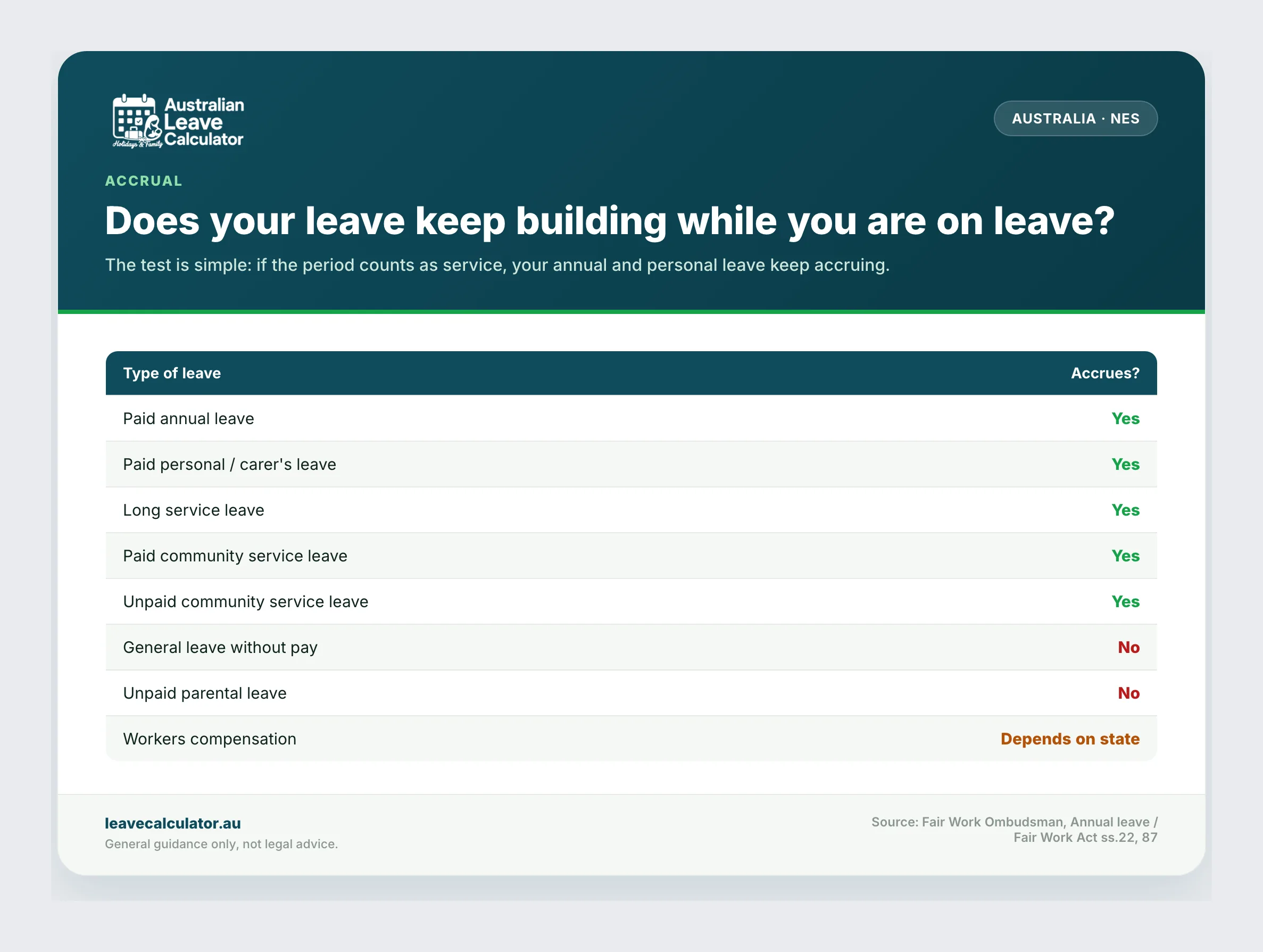
Reference table: which leave accrues
This table summarises whether common types of leave and absence count as service, and therefore whether annual leave keeps accruing during them. Awards and registered agreements can be more generous, so always check yours.
| Leave or absence type | Annual leave accrues? |
|---|---|
| Paid annual leave | Yes |
| Paid sick and carer's leave | Yes |
| Paid family and domestic violence leave | Yes |
| Long service leave | Yes |
| Community service leave, including jury duty (paid or unpaid) | Yes |
| Public holiday during annual leave | Yes (paid, not deducted) |
| Unpaid annual leave | No |
| Unpaid sick or carer's leave | No |
| Unpaid parental leave | No |
| General leave without pay | No |
| Cashed-out annual leave | No |
| Paid Parental Leave Scheme (on unpaid leave from employer) | No |
| Workers compensation | Depends on state or territory scheme |
Common questions
Does annual leave accrue while I am on annual leave?
Yes. Paid annual leave counts as service, so you keep accruing a small amount of leave while you take your holiday.
Do I accrue annual leave during unpaid parental leave?
No. Unpaid parental leave does not count as service, so annual leave does not accumulate during it. See our parental leave page.
If a public holiday falls during my annual leave, do I lose a day?
No. Under the Fair Work Act you are taken not to be on annual leave on the public holiday, so it is not deducted from your balance and you are paid for the holiday.
Does annual leave accrue during long service leave?
Yes. Fair Work lists long service leave as a period during which annual leave keeps accumulating.
Does annual leave accrue during probation?
Yes. Annual leave accumulates from the first day of employment, even if you are still in a probation period.

Author & reviewer
Sarah has spent over a decade advising Australian SMBs on Fair Work, NES compliance, and payroll. Based in Sydney, she has worked across hospitality, retail and professional services.