

Community service leave is one of the matters in the National Employment Standards (NES), and it is the right that lets you take time off to serve on a jury or to volunteer during an emergency or natural disaster. It applies to every employee in the national workplace relations system, including casuals, and there is no upper limit on how long it can run. This guide explains what the leave covers, when it is paid, how jury duty make-up pay is worked out, and the notice and evidence your employer can ask for.
Key takeaways
- Community service leave is an NES right covering jury duty and voluntary emergency management, available to all employees including casuals, with no set limit on length as long as the absence is reasonable.
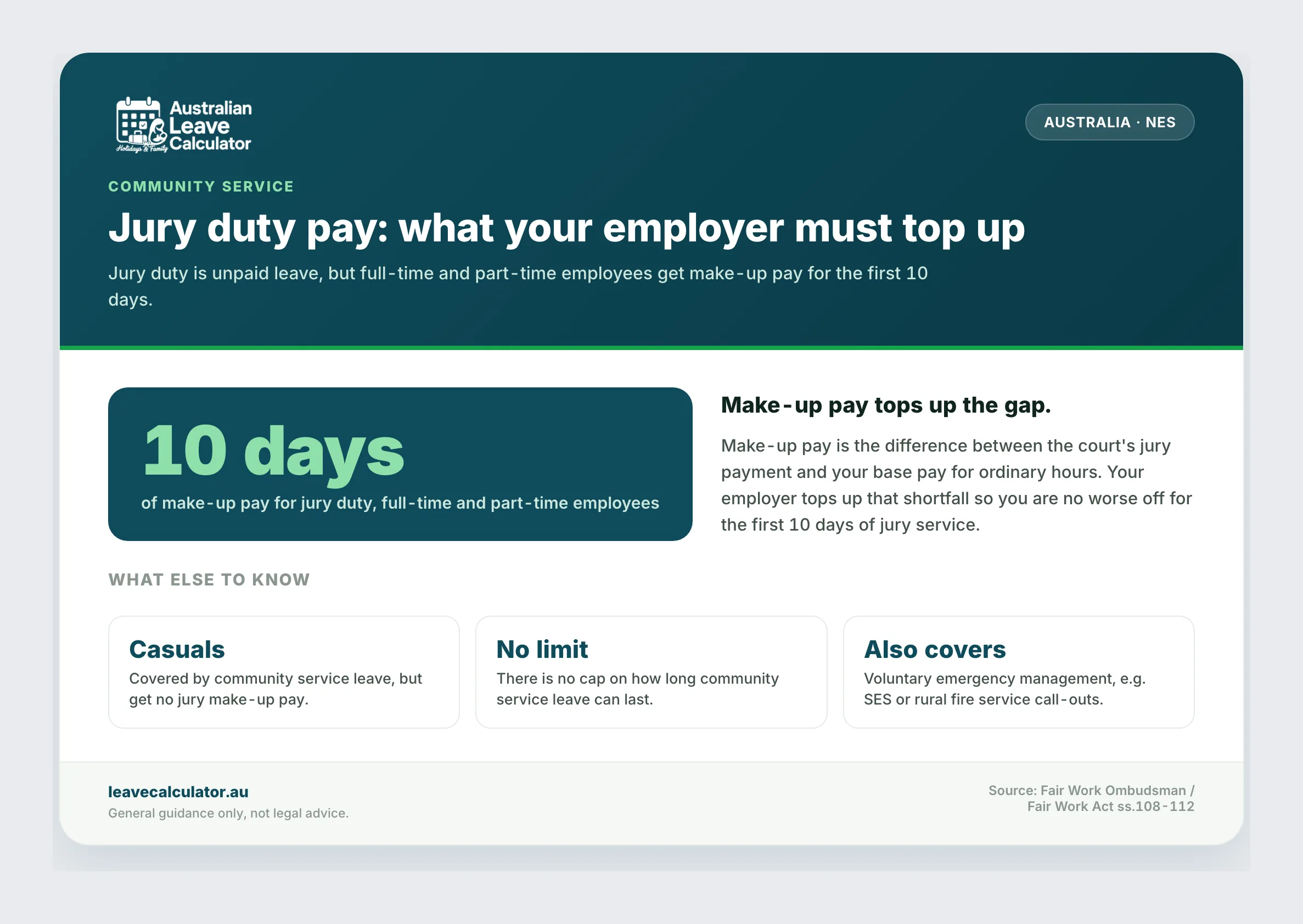
- It is unpaid, except that full-time and part-time employees get jury duty make-up pay for the first 10 days.
- Make-up pay is the base pay rate for ordinary hours minus the court's jury payment (excluding expense allowances); casuals get no NES make-up pay.
- Give notice as soon as possible and provide reasonable evidence, including court payment details, if your employer asks. Source: Fair Work Act 2009 (Cth) ss.108-112.
What the leave covers
Community service leave covers two kinds of activity: jury duty (also called jury service) and voluntary emergency management activities, such as volunteering with the SES or a rural fire service. You are entitled to be absent from work while you are engaged in the activity, plus reasonable travel and rest time around it. Importantly, there is no limit on the total amount of community service leave you can take, so a long jury trial or an extended emergency deployment is still covered.
Fair Work Act 2009 (Cth) ss.108-112. See also Fair Work Ombudsman, Jury duty: "All employees (including casual employees) can take leave to attend jury duty."
Who is entitled
Community service leave is a National Employment Standard, so it applies to all national system employees from their first day. Full-time, part-time and casual employees are all covered. Unlike accrued leave such as annual leave or personal (sick) leave, community service leave does not build up in a bank of hours: it is a standing right you draw on whenever a qualifying activity comes up. Because it sits in the NES, an award or enterprise agreement can add to it (for example, longer paid jury duty) but can never take it away.
When it is paid or unpaid
The general rule is that community service leave is unpaid. There is one exception: jury duty make-up pay for full-time and part-time employees, covered in detail below. Everything else, including voluntary emergency management work, is time off without pay from your employer, although your job and continuity of service are protected. The table below summarises who is paid for what under the NES.
| Activity | Full-time & part-time | Casual |
|---|---|---|
| Jury duty (first 10 days) | Make-up pay from employer | Unpaid under the NES |
| Jury duty (day 11 onwards) | Unpaid by employer | Unpaid under the NES |
| Voluntary emergency management | Unpaid | Unpaid |
Jury duty
If you are summoned for jury duty, you can take community service leave for the whole time you are required to attend court. This includes time spent on jury selection (empanelment), the trial itself, and reasonable travel and rest time. You cannot be dismissed, disadvantaged or pressured out of attending because it is a legal obligation as well as an NES entitlement. Some awards, enterprise agreements or contracts provide more generous jury duty pay than the NES minimum, so check yours.
Jury duty make-up pay
Under the NES, employers must pay full-time and part-time employees for the first 10 days they are absent from work for jury duty. What the employer actually pays depends on whether they ask for evidence of the court's payment:
- If the employer does not ask for evidence, they pay the employee's base pay rate for the ordinary hours the employee would have worked over those first 10 days.
- If the employer does ask for evidence, they only have to pay make-up pay: the difference between the base pay rate for the ordinary hours the employee would have worked and any payment the court makes for jury duty (excluding expense-related allowances).
The employer can require the employee to show two things: that they have taken all necessary steps to claim any jury payment they are entitled to from the court, and the total amount (even if it is $0) the court has paid or will pay for the period. If the employee is asked for this evidence and does not provide it, they lose the right to any pay from the employer for those first 10 days. Your base pay rate is the minimum hourly rate for your ordinary hours; it excludes overtime, penalty rates, loadings, allowances and bonuses.
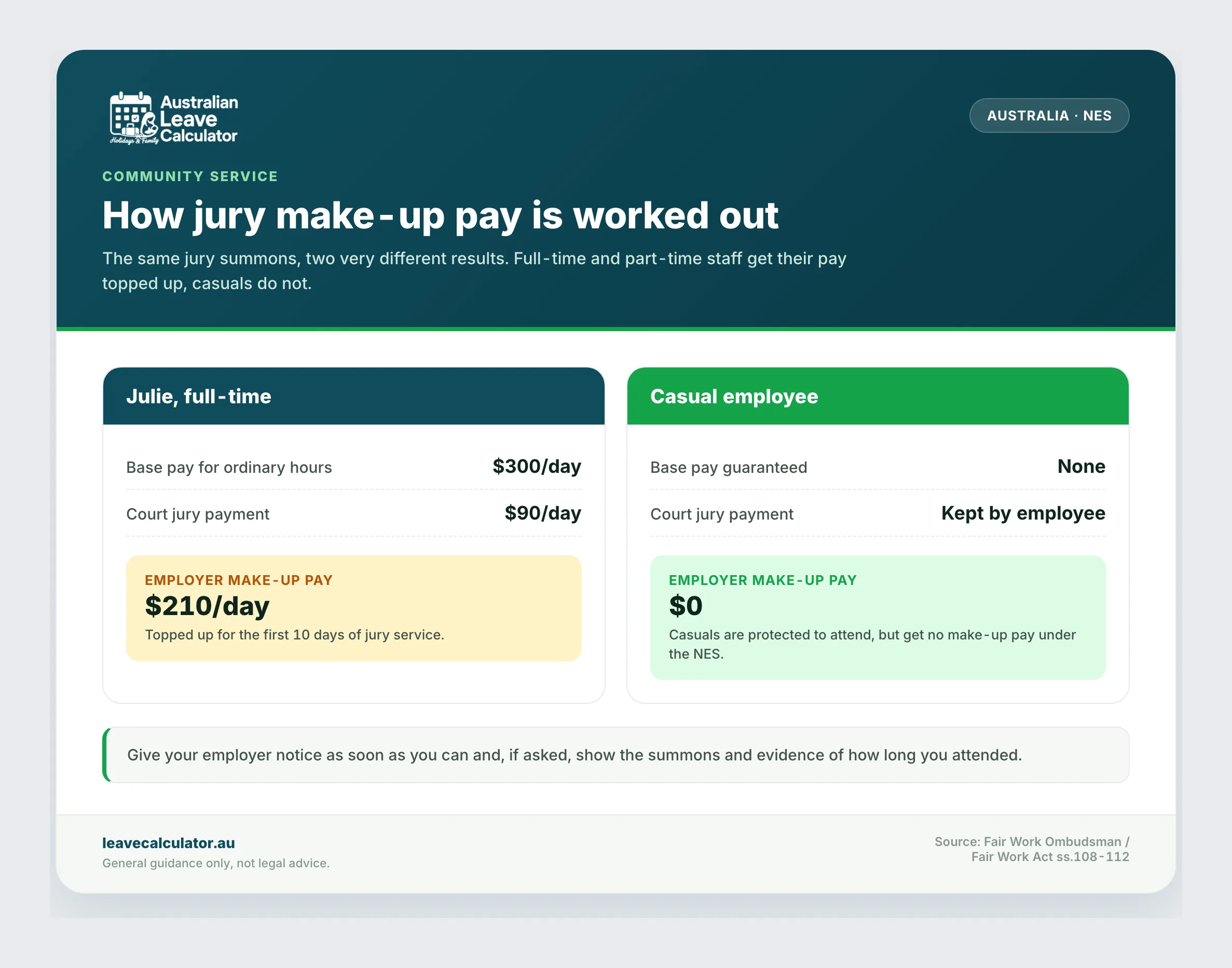
Julie and Samuel are chosen for the same jury. Jury selection and the trial run Monday to Friday for 3 weeks (15 court days). The court pays each of them $90 per day. Each employer asks for evidence of the court payment, so each only has to pay make-up pay for the first 10 days of absence.
Julie is full-time, works Monday to Friday, and her base pay rate is $300 per day, so she is away for all 15 days. Her employer pays make-up pay of $210 per day ($300 base minus the $90 court payment) for the first 10 days, and nothing for the remaining 5 days. The court still pays her $90 per day for all 15 days.
Samuel is part-time, works Monday to Wednesday, and his base pay rate is $250 per day, so he is away for 9 working days. His employer pays make-up pay of $160 per day ($250 base minus $90) for the 9 days he misses. The court still pays him $90 per day for all 15 court days.
| Employee | Base pay per day | Court payment per day | Make-up pay per day | Days of make-up pay |
|---|---|---|---|---|
| Julie (full-time) | $300 | $90 | $210 | First 10 of 15 days away |
| Samuel (part-time) | $250 | $90 | $160 | 9 working days missed |
Voluntary emergency management
The second kind of community service leave covers volunteering during an emergency or natural disaster. You are engaged in a voluntary emergency management activity if all of the following apply:
- the activity involves dealing with an emergency or natural disaster
- you take part on a voluntary basis (whether or not you take or agree to take an honorarium, gratuity or similar payment for it)
- you were requested to take part, or it would be reasonable to expect such a request would have been made if circumstances had permitted
- you are a member of, or have a member-like association with, a recognised emergency management body.
A recognised emergency management body is one with a role or function under a Commonwealth, state or territory emergency plan, a fire-fighting, civil defence or rescue body, or any other body mainly involved in responding to emergencies or natural disasters. This includes bodies such as the State Emergency Service (SES), the Country Fire Authority (CFA) and the RSPCA for animal rescue during disasters. This leave is unpaid, covers reasonable travel and rest time, and again has no set limit provided the absence is reasonable. If an emergency affects your family rather than calling you out as a volunteer, see emergency leave in Australia.
Fair Work Ombudsman, Community service leave (Fair Work Act 2009 (Cth) ss.108-110): "There is no limit on the amount of community service leave an employee can take" and "With the exception of jury duty, community service leave is unpaid."
Casuals & state laws
Casual employees are fully covered by community service leave and can take the time off for jury duty or emergency volunteering. However, under the NES casuals do not get make-up pay for jury duty, because they have no guaranteed ordinary hours to base it on, though an award, enterprise agreement or contract may pay more. State laws continue to apply where they are more beneficial, and they differ on who pays a juror:
| State | Who pays you | Detail |
|---|---|---|
| NSW | The court pays a daily jury fee ($106.30 for days 1 to 10) | How much you get paid for jury duty in NSW |
| Queensland | The court pays a daily attendance fee ($153.30 once you are on a jury, from 1 July 2026) | Jury duty pay in Queensland |
| WA | Your employer keeps paying your normal wage for the whole trial, casuals with an expectation of work included, and claims the fee back from the State | Jury duty payment in WA |
Notice & evidence
To take community service leave you must give your employer notice as soon as possible, which can be after the leave has already started, along with the period or expected period of your absence. If your employer asks, you also have to provide evidence that would satisfy a reasonable person that you are entitled to the leave, such as the jury summons and confirmation of attendance, or proof of your role with a recognised emergency management body. For jury duty make-up pay, that evidence extends to showing what the court has paid or will pay you.
Common questions
Can my employer refuse to let me take jury duty leave?
No. Jury duty is both a legal obligation and an NES entitlement, so you cannot be refused the leave, dismissed or disadvantaged for attending. Your employer can ask for reasonable notice and evidence, but not for permission to be withheld.
Do I keep accruing annual leave while on community service leave?
Yes. Unpaid community service leave is one of the few unpaid absences that counts as service (Fair Work Act s 22(2)(b)(i)), and the Fair Work Ombudsman lists community service leave, including jury duty, as a period in which sick and carer's leave keeps accumulating. See our guide on whether you accrue leave while on leave.
What if my jury duty lasts longer than 10 days?
You can stay absent for the whole trial with no limit, but under the NES the employer's make-up pay obligation stops after the first 10 days. From day 11 the days are unpaid by the employer unless your award, agreement or contract says otherwise; the court may keep paying its jury fees.
Is volunteering as a firefighter or SES member paid?
Not by your employer under the NES. Voluntary emergency management leave is unpaid, though you keep your job and your service is protected. Some employers and instruments choose to pay it, so check your award or workplace policy.

Author & reviewer
Sarah has spent over a decade advising Australian SMBs on Fair Work, NES compliance, and payroll. Based in Sydney, she has worked across hospitality, retail and professional services.