

Leave without pay (LWOP) is any authorised period where you stay employed but step away from work and your ordinary wages stop for that time. People take it for all sorts of reasons: an extended overseas trip, a career break, caring for a family member, study, or simply because they have run out of paid leave. Unlike annual leave or paid sick and carer's leave, most leave without pay is not a standing entitlement under the National Employment Standards (NES). This guide explains when LWOP is a right and when it is not, what it does to your accruals and length of service, and how it affects redundancy, notice and superannuation. If you need time off for an emergency, check emergency leave in Australia first, because some emergencies are covered by paid or protected leave.
If you can see the gap coming, some employers, especially in the public sector, offer purchased leave instead, where the cost of extra weeks is spread across the year's pay. The purchased leave calculator shows the per-pay cost.
Key takeaways
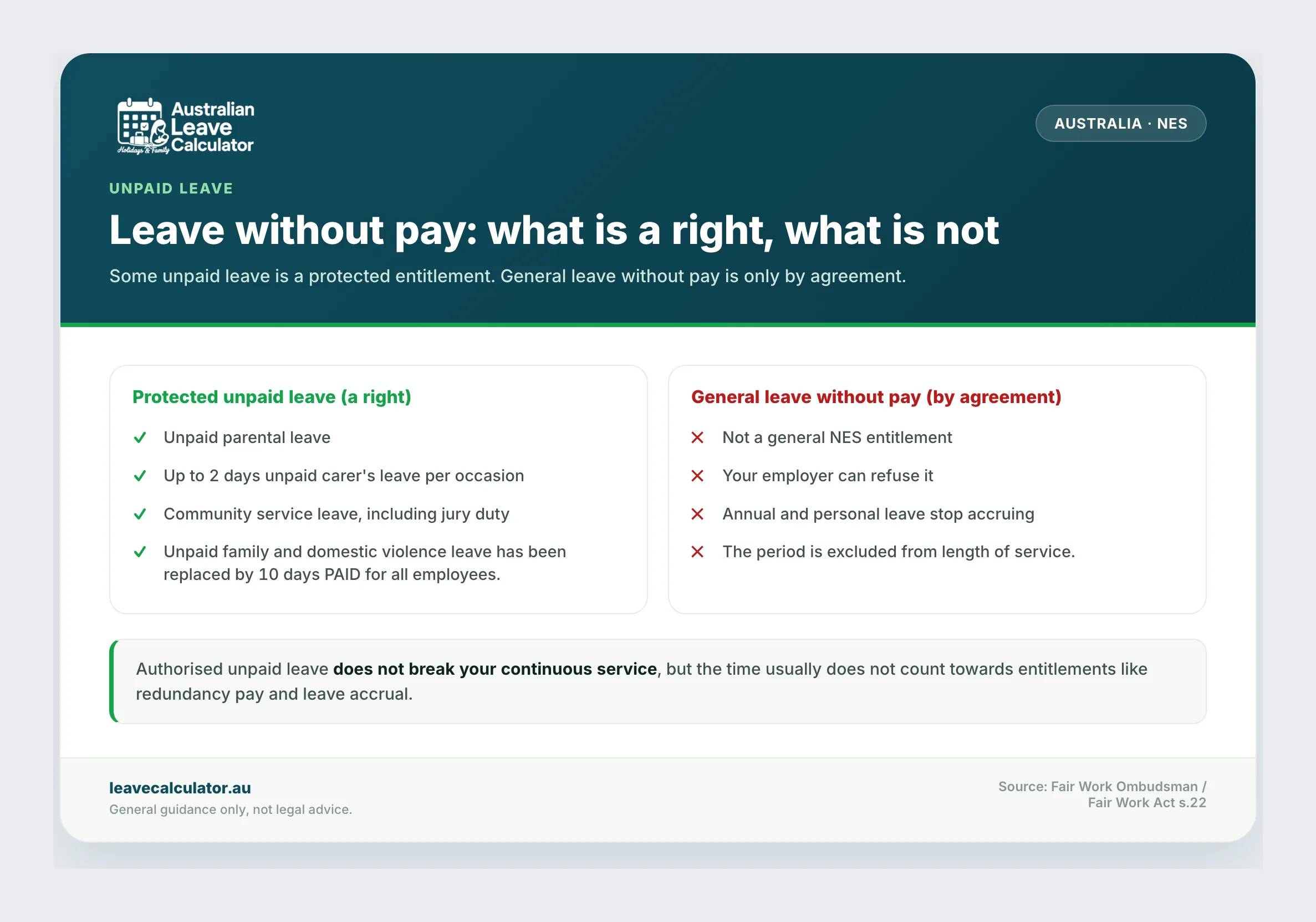
- General LWOP is not an NES right: it is granted by agreement, and your employer can refuse it or set conditions.
- Some unpaid leave is protected by law, including unpaid parental leave, 2 days of unpaid carer's leave per occasion, and unpaid community service leave.
- LWOP does not break your continuous service, but usually does not count towards the length of service used for accruals, redundancy and long service leave.
- The same period is still counted in full for notice of termination, and generally means no annual leave, personal leave or compulsory super accrues while you are off.
What leave without pay means
Leave without pay is when an employee is absent from work without pay. The employment relationship continues, but you are not paid and, in most cases, you are not building up paid leave for that time. LWOP is different from an unauthorised absence, which is time away the employer has not approved (for example, unapproved industrial action or simply not turning up). Unauthorised absences do not count as service at all. Other unpaid and special-purpose entitlements are grouped in types of leave in Australia.
General LWOP is often taken because a worker has no paid leave left, for example a new employee who gets sick before accruing enough paid personal leave and covers the shortfall with unpaid time once the employer agrees. If you are weighing up your options, first check your personal leave and annual leave balances.
Is leave without pay a right?
For most purposes, no. General leave without pay is not a blanket entitlement under the NES. An employee may ask to take unpaid leave for reasons the NES does not cover, but it happens by agreement: the employer can say yes, say no, or set conditions. There is no set amount of general LWOP in the Fair Work Act, and no automatic right to it.
That said, an award, enterprise agreement, employment contract or workplace policy may create a right to unpaid leave in specific situations, so check the instrument that covers your job. For the background, see our guides to the National Employment Standards and the Fair Work Act. A handful of unpaid entitlements, set out below, are guaranteed by law and cannot simply be refused when you qualify.
The December shutdown is where the agreement rule gets tested most often, and the model award term settles it in the employee's favour. Clause 32.5(g) of the Clerks Award, the 2023 model shutdown clause now carried by most awards, lets an employer direct you to take accrued annual leave over a temporary shutdown. For any part of the shutdown that a direction cannot reach, the employer and employee "may agree, in writing, for the employee to take leave without pay". Agree is the operative word, so an employee whose balance has run out cannot simply be placed on unpaid leave because the workplace is closed. Our guide to Christmas shutdown and directed leave covers the 28 days written notice, the direction itself, and the options when the balance does not stretch.
Unpaid leave that is a legal right
Some unpaid leave is an entitlement under the NES. Where you meet the conditions, these are protected and sit apart from general LWOP.
| Unpaid entitlement | Who qualifies | How much | Fair Work Act |
|---|---|---|---|
| Unpaid parental leave | Employees (including eligible casuals) with at least 12 months continuous service | Up to 12 months each parent, or up to 24 months if the employer agrees | ss.70-85 |
| Unpaid carer's leave | All employees, including casuals (once paid sick and carer's leave is used up) | 2 days each time a family or household member needs care due to illness, injury or an unexpected emergency | ss.102-103 |
| Unpaid community service leave | All employees, including casuals | No set limit; for jury duty or voluntary emergency management activity | ss.108-110 |
| Unpaid compassionate leave | Casual employees only (other employees get paid compassionate leave) | Each permissible occasion, such as a serious illness or death in the family | Div. 7, Part 2-2 |
With the exception of jury duty, community service leave is unpaid, and there is no limit on how much an employee can take. For jury duty, an employee may be entitled to payment from their employer for the first 10 days. For more, see our guides to carer's leave and community service and jury duty leave.
Why annual and personal leave stop accruing
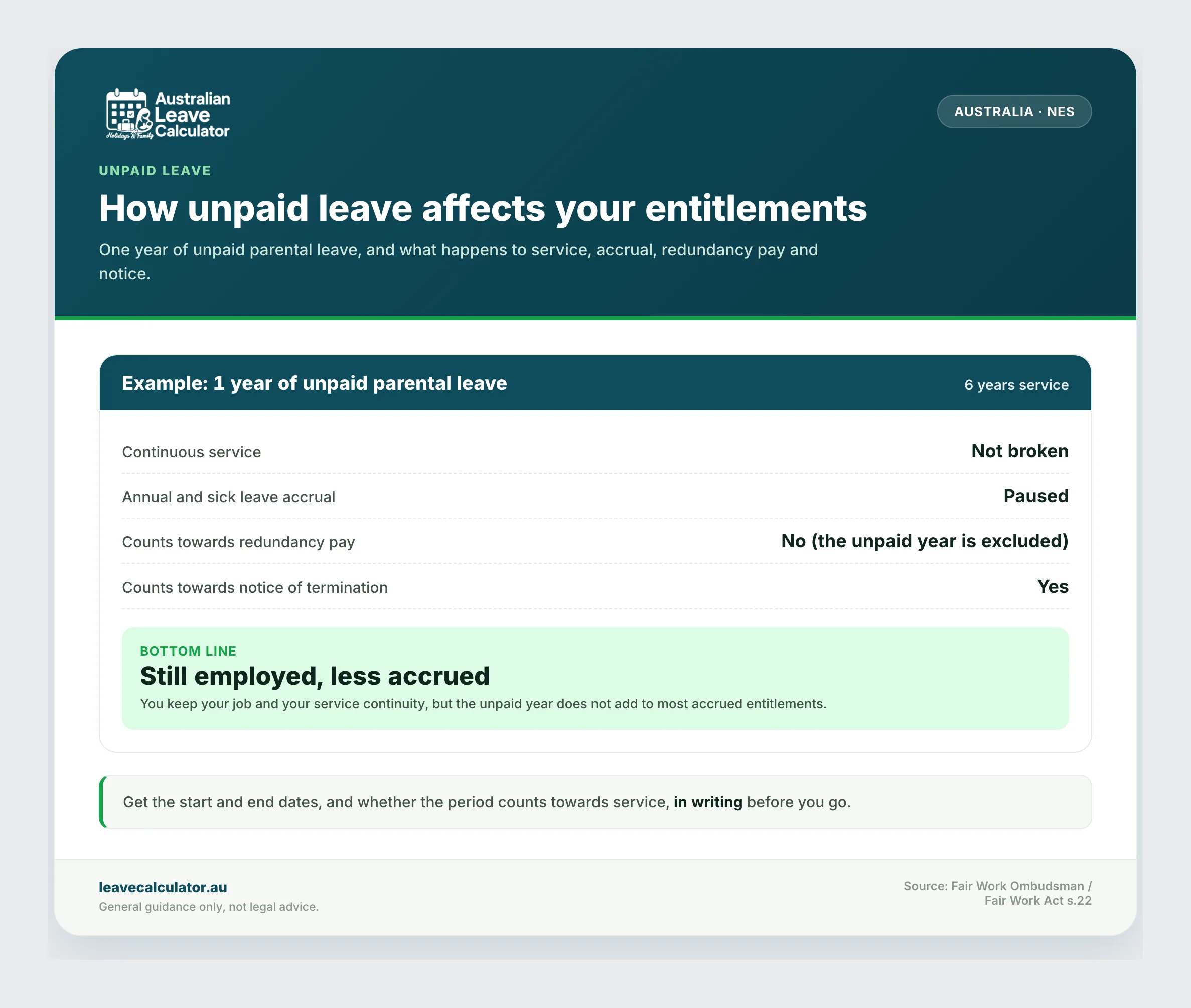
Paid leave builds up based on your length of continuous service. Because most leave without pay does not count towards that length (explained next), you generally do not accrue annual leave or paid sick and carer's leave while you are on it. The Fair Work Ombudsman gives the example of an employee on a year of unpaid parental leave who does not accumulate annual or sick and carer's leave during that year.
There are limited exceptions: paid leave you take within a longer break (for example, using some annual leave) and any agreed keeping in touch days do accrue as normal. Public holidays falling during unpaid leave are generally not paid. For more, see our guides on accruing leave while on leave and public holidays.
Continuous service vs length of service
This is the part that trips people up. Under section 22 of the Fair Work Act, an excluded period (which includes most unpaid leave and unpaid authorised absences) does not break your continuous service, but it does not count towards the length of that continuous service. In plain terms, LWOP does not reset your service clock to zero, but the clock effectively pauses. Unpaid community service leave is the main unpaid leave that still counts as service.
Why it matters: length of continuous service is what many entitlements are calculated on. So a period of LWOP is generally left out when working out annual leave accrual, redundancy pay, and, subject to each state or territory's rules, long service leave. There are important exceptions, though: approved unpaid leave under the NES does count towards continuous service for three things, namely your right to request flexible working arrangements, unpaid parental leave and related entitlements, and notice of termination or payment in lieu. The example below shows how the same block of leave can be counted for one calculation and ignored for another.
A worked example
Marco has worked full-time for the same employer for 6 years, then takes 12 months of unpaid parental leave. During that year he does not accrue annual leave or paid sick and carer's leave. When he returns, his service continues: he does not start again from zero.
A year later, Marco's role is made redundant. For redundancy pay, the employer does not count the unpaid year, so it counts the 6 years before plus the 1 year since, that is, 7 years. For his notice of termination, the employer counts the whole time he was employed, including the unpaid year, that is, 8 years. Same block of leave, two different results.
This split is the most important thing to understand about LWOP. Before an extended absence, ask your employer in writing how the period will be treated for accrual, redundancy and notice, since your final pay can hinge on it.
What happens to your super
Superannuation is generally tied to the wages your employer actually pays you. When you are on leave without pay, no ordinary wages are paid, so as a rule no compulsory super is paid for the time you are off. Paid leave you take (such as annual leave used during a longer break) counts as normal earnings and does attract super.
Some employers choose to keep paying super during unpaid parental leave as an above-minimum benefit, but that is voluntary unless your award, agreement or contract requires it. If super continuity matters to you, for example because of insurance held inside your fund, confirm the position with your employer and the ATO before your leave starts. The glossary explains the terms you will come across.
How to request leave without pay
Because general LWOP is granted by agreement, a clear written request helps both sides. Put the following in writing, and ask your employer to confirm it in writing too:
- the exact start and end dates, and whether the leave is continuous or split into blocks
- the reason for the request
- whether you will use up any paid leave first
- what will happen to your accruals, superannuation and your role while you are away
Common reasons include:
- extended travel or a working holiday
- a career break or sabbatical
- caring for a family member beyond the 2 days of unpaid carer's leave
- study, exams or professional development
- recovering from illness once paid personal leave is exhausted
If your situation is actually a protected NES entitlement, follow the specific notice and evidence rules for that leave type instead. It is also worth checking whether an alternative suits you better, such as using annual leave or cashing out annual leave where permitted. Our FAQ covers other practical questions.
Common questions
Can my employer refuse leave without pay?
Yes. General LWOP is not an NES entitlement, so your employer can refuse it or set conditions. The exceptions are the protected unpaid entitlements above, such as unpaid parental, carer's and community service leave, which you are entitled to when you qualify.
Does leave without pay break my continuous service?
No. Under section 22 of the Fair Work Act, unpaid leave does not break your continuous service, so you do not start a new period when you return. It simply does not count towards the length of that service for most purposes.
Do I keep accruing annual and personal leave while on leave without pay?
Generally no. Because the unpaid period does not count towards your length of service, you usually do not accrue annual or paid sick and carer's leave during it. Paid leave taken within a longer break, and agreed keeping in touch days, do accrue.
Does time on leave without pay count towards redundancy pay?
Usually not. Unpaid leave is generally excluded from the service used to calculate redundancy pay. However, the same period is counted in full for your notice of termination or payment in lieu.
Is unpaid parental leave the same as general leave without pay?
No. Unpaid parental leave is a specific NES entitlement with its own eligibility, notice and evidence rules, and it counts as service for parental leave and notice purposes. General LWOP is at the employer's discretion. See our parental leave page.

Author & reviewer
Sarah has spent over a decade advising Australian SMBs on Fair Work, NES compliance, and payroll. Based in Sydney, she has worked across hospitality, retail and professional services.