

If you have ever booked a day off with the flu, or to look after a sick child, you have used what most Australians call 'sick leave'. Here is what surprises many employees and even some payroll teams: under national workplace law there is no separate entitlement called sick leave. What you are actually drawing on is paid personal/carer's leave, a single National Employment Standards (NES) balance that can be used two ways. This guide explains why 'personal leave' and 'sick leave' are the same thing, how much you get, how it builds up, and the rules for using it yourself versus caring for someone else.
Key takeaways
- Sick leave and carer's leave are two uses of the one 10-day personal/carer's leave balance.
- Full-time employees get 10 days a year; part-timers get a pro-rata share (76 hours on a 38-hour week).
- It accrues and rolls over, but is not paid out when you leave a job.
- Employers can ask for reasonable evidence, even for one day; casuals get 2 days unpaid carer's leave.
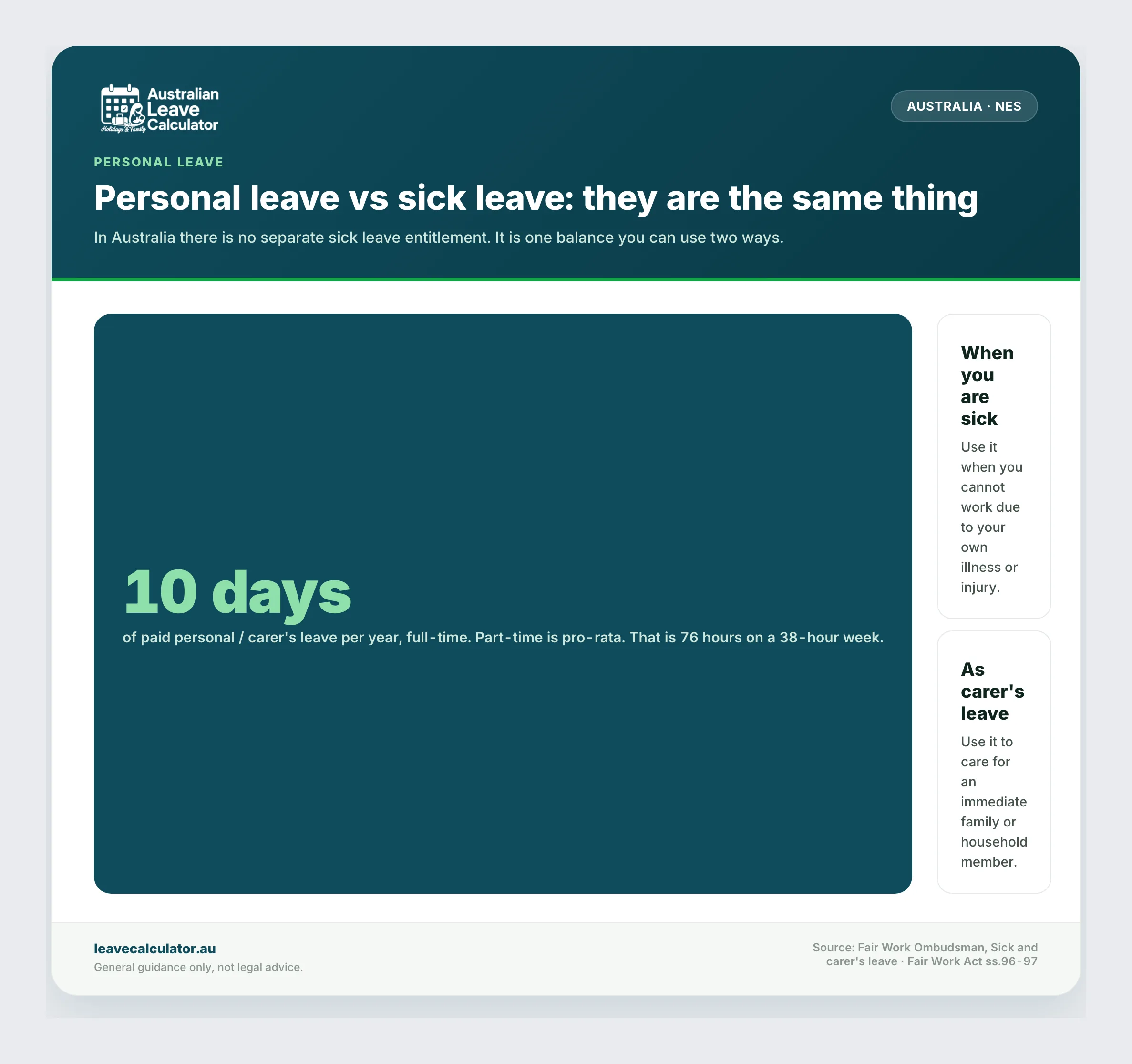
Sick leave and personal leave are the same thing
The term 'sick leave' is everyday language, not a legal category. The Fair Work Act 2009 calls the entitlement paid personal/carer's leave, and the Fair Work Ombudsman describes it as 'sick and carer's leave' or 'personal/carer's leave'. As the Fair Work Ombudsman puts it, 'Sick and carer's leave are part of the same leave entitlement.'
Every employee except a casual is entitled to it, a distinction that matters throughout this guide. For the legal background, see our guide to the Fair Work Act and the definitions in our glossary.
One balance, two ways to use it
The reason there is no standalone 'sick leave' is that one balance covers two situations. When you draw on it for your own illness or injury, people call it sick leave. When you draw on it to care for a family or household member, it is called carer's leave. Same pool of days, two labels.
How much personal leave you get
A full-time employee is entitled to 10 days of paid personal/carer's leave per year. Part-time employees get a pro-rata amount, worked out from their ordinary hours. The Fair Work Ombudsman expresses the entitlement as 1/26 of an employee's ordinary hours of work in a year.
On a standard 38-hour week, 10 days converts to 76 hours of paid personal/carer's leave a year. A part-time employee who averages 19 hours a week accrues half of that, or 38 hours a year. The spread of your hours does not change the total: 38 hours across four days accrues the same 76 hours as 38 hours across five days. For the full-time worked figures, see our personal leave on a 38-hour week breakdown.
To total what you have built up since you started, after leave you have taken and any unpaid periods, use accrued sick days.
How it accrues and rolls over
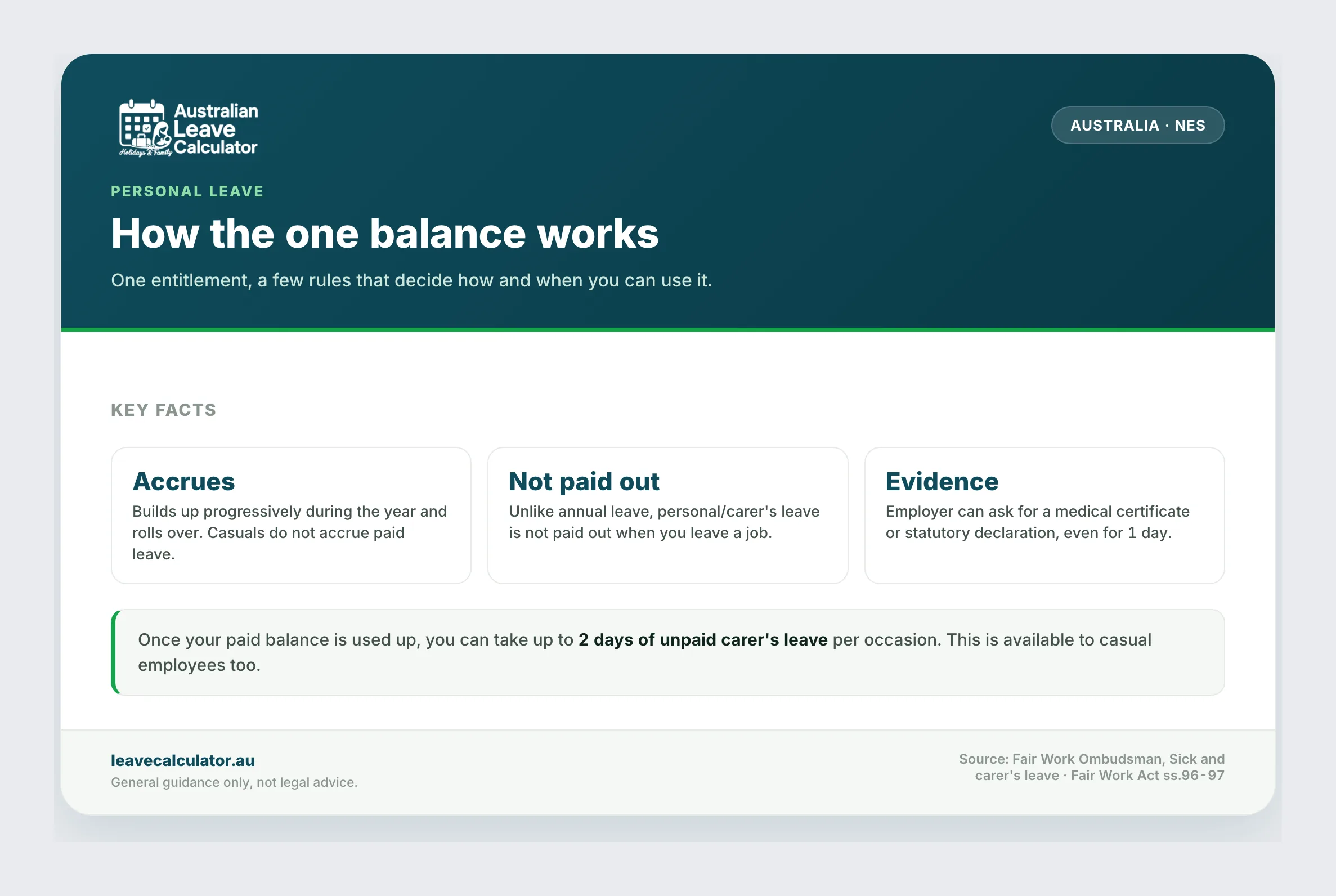
Paid personal/carer's leave is not handed to you in a lump on day one. It accrues progressively from your first day of work, based on your ordinary hours, and any unused balance carries over from year to year. There is no annual reset and no 'use it or lose it' cap under the NES.
Your balance keeps growing while you are on most paid leave, including annual leave, paid personal/carer's leave itself, jury duty and long service leave. It does not accrue during unpaid leave, such as unpaid parental or unpaid carer's leave. Our guide on whether you accrue leave while on leave covers this further.
Using personal leave when you are sick
Full-time and part-time employees can take paid personal leave when they cannot work because of a personal illness or injury. This can include stress and pregnancy-related illness. Workers compensation for stress differs by state: see stress leave in NSW, stress leave in Victoria and stress leave in QLD. There is no minimum or maximum amount you can take at one time: you can take as much as you have accrued.
You must let your employer know as soon as possible, which can be after the leave has started. Your employer can also ask for reasonable evidence, such as a medical certificate or statutory declaration. There is no minimum number of days before evidence can be required: an employer can ask for as little as one day, or less, off work. If you are asked and do not provide it, you may not be paid for that leave. What a valid certificate needs, including online and backdated ones, is covered in doctor's certificate for sick leave.
Using personal leave as carer's leave
The same balance is used when you need to care for or support an immediate family member or household member who is sick, injured or affected by an unexpected emergency. Immediate family includes a spouse or de facto partner (current or former), a child, parent, grandparent, grandchild or sibling, and the equivalent relations of your partner. A household member is any person who lives with you. Our dedicated carer's leave guide covers eligibility in full.
There is also a separate entitlement to 2 days of unpaid carer's leave per occasion. Full-time and part-time employees can use it once their paid leave is exhausted, and casual employees are entitled to it too. It can be taken in one block or split by agreement. Do not confuse carer's leave with compassionate and bereavement leave or family and domestic violence leave, which are separate entitlements with their own rules.
Sick use vs carer's use compared
Because both uses draw on the same NES balance, most of the rules are identical. The differences come down to why you are taking the leave and what happens once a paid balance runs out.
| Feature | Using it when you are sick | Using it as carer's leave |
|---|---|---|
| Reason for the leave | Your own personal illness or injury | Caring for an immediate family or household member who is ill, injured or has an emergency |
| Comes from the same balance | Yes | Yes |
| Paid | Yes, except casuals | Yes, except casuals |
| Notice and evidence can be required | Yes | Yes |
| Extra entitlement if paid leave runs out | Not applicable | 2 days unpaid carer's leave per occasion, also available to casuals |
| Fair Work Act reference | Section 97(a) | Sections 97(b) and 102 |
Termination, casuals and what you do not get
Unlike annual leave, paid personal/carer's leave is not paid out on termination; the rare exceptions are in is sick leave paid out. Whether you can be dismissed while off sick is covered in can you get fired for too many sick days.
Casual employees do not accrue paid personal/carer's leave at all; what they get instead is set out in do casuals get sick leave.
Frequently asked questions
Is sick leave the same as personal leave?
Yes. There is no separate legal entitlement called sick leave. Both terms describe paid personal/carer's leave, a single NES balance used either for your own illness or to care for a family or household member.
How many sick days do you get in Australia?
Full-time employees get 10 days of paid personal/carer's leave per year, which is 76 hours on a 38-hour week. Part-time employees get a pro-rata amount based on their ordinary hours. Casuals do not accrue paid sick leave.
Can my employer ask for a medical certificate for one day off?
Yes. There is no minimum number of days before evidence can be required. An employer can ask for reasonable evidence, such as a medical certificate or statutory declaration, for as little as one day or less. If you do not provide it when asked, you may not be paid for the leave.
Do casual employees get paid sick leave?
No, casuals receive a casual loading instead: see do casuals get sick leave.
Is unused sick leave paid out when I leave a job?
No, it is not paid out on termination, unlike annual leave: see is sick leave paid out.
Can I use my sick leave to look after my partner?
Yes. Using paid personal/carer's leave to care for a sick, injured or affected immediate family or household member is carer's leave, and it draws on the same balance as your own sick days.
Key takeaways
- There is no separate 'sick leave' entitlement: it is paid personal/carer's leave, one NES balance used two ways.
- Full-time employees get 10 days (76 hours on a 38-hour week) per year, pro-rata for part-time, accruing progressively and rolling over.
- Evidence can be required for as little as one day, and the same balance covers caring for an immediate family or household member.
- It is not paid out on termination (unlike annual leave), and casuals get a loading plus 2 days unpaid carer's leave per occasion instead.

Author & reviewer
Sarah has spent over a decade advising Australian SMBs on Fair Work, NES compliance, and payroll. Based in Sydney, she has worked across hospitality, retail and professional services.