

Few things are harder than losing someone close, or hearing that a family member has a life-threatening illness or injury. Australian workplace law recognises this through compassionate leave, also known as bereavement leave. It is one of the National Employment Standards, so it applies to every employee in the national system, including casuals. This guide explains what the leave covers, how the 2 days per occasion rule works, who counts as immediate family, how it is paid, how stillbirth and miscarriage are treated, and how it differs from carer's leave and paid family and domestic violence leave. It also covers bereavement leave in Victoria, and what the law says about funeral leave.
Key takeaways
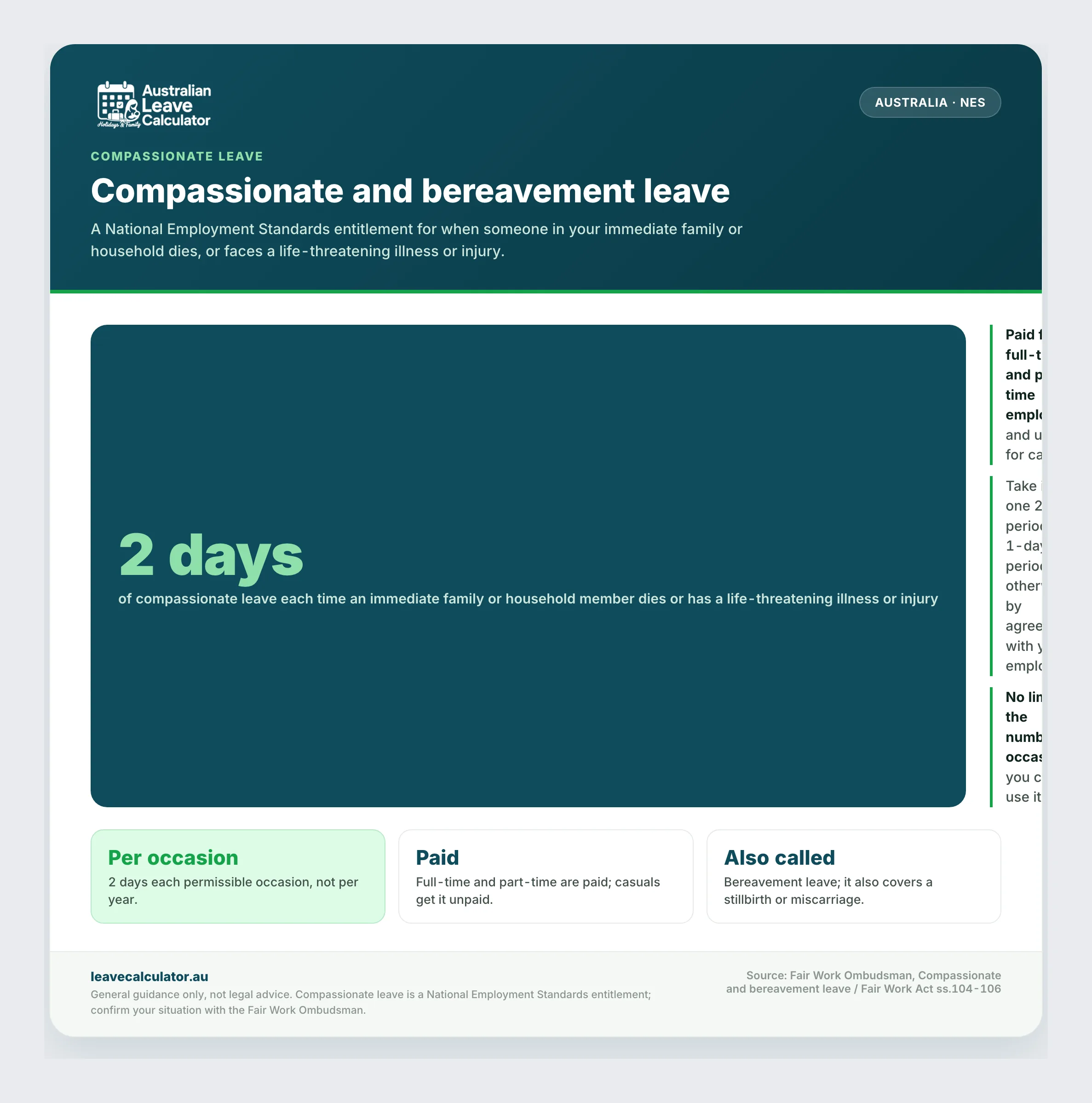
- You get 2 days of compassionate (bereavement) leave for each permissible occasion, not a yearly cap.
- It applies when an immediate family or household member dies, or contracts or develops a life-threatening illness or injury.
- Under the NES, full-time and part-time employees are paid at their base rate of pay; casuals take it unpaid.
- It also covers a stillbirth, and a miscarriage experienced by you or your current spouse or de facto partner.
- Source: Fair Work Act 2009 (Cth) ss.104-106 and the Fair Work Ombudsman.
What compassionate leave is
Compassionate leave, also called bereavement leave or funeral leave, is a minimum entitlement guaranteed by the National Employment Standards. Every employee covered by the national workplace relations system has it, whether full-time, part-time or casual. The core rule is simple: you are entitled to 2 days each time a qualifying event happens, which the law calls a permissible occasion. Because it is a national minimum, an award or enterprise agreement can add to it but never take it away. Under the Fair Work Act 2009 it is separate from annual leave and from sick and carer's leave, so using it does not eat into any other balance.
When you can take it: a death or a life-threatening illness or injury
Compassionate leave is not only for after a death. You can take it when an immediate family or household member is still alive but seriously unwell. Under the Act, a permissible occasion arises when a member of your immediate family or household:
- contracts or develops a personal illness that poses a serious threat to their life;
- sustains a personal injury that poses a serious threat to their life; or
- dies.
It also arises if a baby who would have been in your immediate family or household is stillborn, or if you or your current spouse or de facto partner has a miscarriage. So a life-threatening diagnosis for a parent, child or partner qualifies just as a death does, and each qualifying event is its own permissible occasion, which is why the leave is counted per occasion rather than per year.
Who counts as immediate family and household
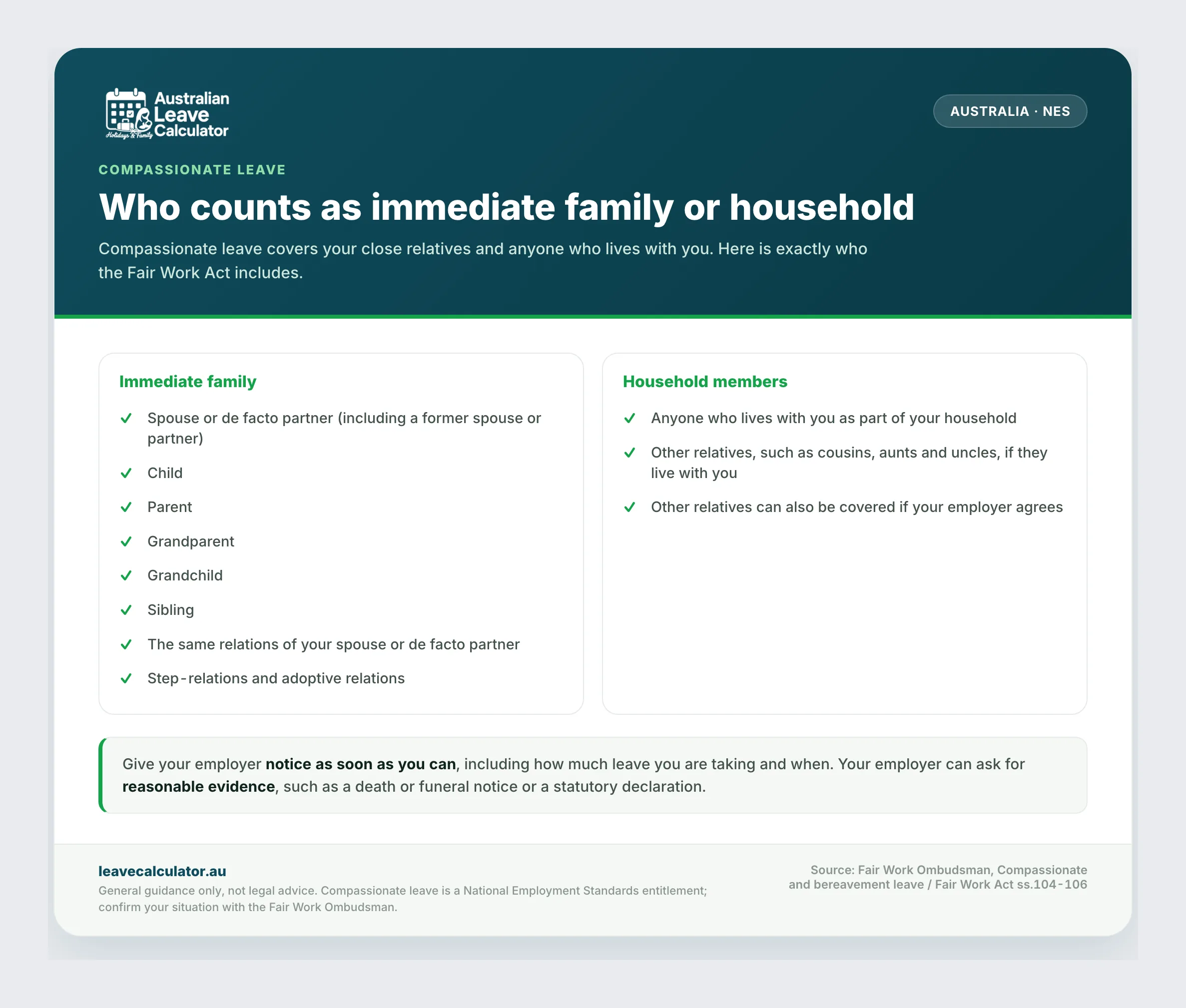
Compassionate leave can only be used for someone in your immediate family or your household. Under the Fair Work Act your immediate family includes your:
- spouse or former spouse;
- de facto partner or former de facto partner;
- child, parent, grandparent, grandchild or sibling; and
- a child, parent, grandparent, grandchild or sibling of your spouse or de facto partner (including a former spouse or partner).
Immediate family also takes in step-relations (such as a step-parent or step-child) and adoptive relations. A household member is anyone who lives with you, related or not, so a housemate who shares your home is covered. For relatives outside this list who do not live with you, such as cousins, aunts and uncles, the NES gives you no entitlement. Your employer can still agree to give you time off, paid or unpaid, but that is at its discretion rather than leave you are owed. Our leave glossary explains immediate family, de facto partner and permissible occasion in plain English.
How many days: per occasion, not per year
The entitlement is 2 days per permissible occasion, with no annual limit on how many occasions you can claim. Compassionate leave does not accumulate from year to year and is not part of your sick and carer's leave pool, so an unused day cannot be banked or carried forward. You can take the leave in whichever way suits the situation:
| How you can take the 2 days | What it looks like |
|---|---|
| A single continuous block | Two days in a row, for example the day of and the day after a funeral |
| Two separate single days | One day now and one day later within the same occasion |
| Any other pattern you both agree | Separate periods agreed with your employer |
Where the occasion is a life-threatening illness or injury, you can take the 2 days at any time while it persists. And if you are on paid annual leave when a qualifying event happens, you can take compassionate leave for those days instead. Section 89(2) treats you as not being on annual leave for the period of the other leave, so those days stay in your annual leave balance.
How it is paid, and what casuals get
Full-time and part-time employees are paid for compassionate leave at their base rate of pay for the ordinary hours they would have worked during the leave. The base rate does not include incentive-based payments and bonuses, loadings, monetary allowances, overtime or penalty rates. In the national system, casual employees take compassionate leave unpaid (section 106). Compassionate leave cannot be cashed out, and because it does not accumulate, there is no balance to pay out when your employment ends.
Stillbirth and miscarriage
The law makes clear that compassionate leave covers the loss of a pregnancy, and it is worded with care. You can take compassionate leave if a baby who would have been a member of your immediate family or household is stillborn, which the Fair Work Ombudsman describes as the birth of a baby of at least 400 grams or 20 weeks gestation who has not breathed or had a heartbeat since delivery. You can also take it if you, or your current spouse or de facto partner, has a miscarriage, the spontaneous loss of an embryo or foetus before 20 weeks of pregnancy. The miscarriage limb does not apply to a former spouse or former de facto partner, and where a miscarriage results in a stillborn child the stillbirth rules apply instead. Parents in this situation may also have rights to parental leave.
Notice and evidence
To be entitled to compassionate leave you must give your employer notice as soon as you can. Because these events are sudden, the law accepts that notice may be given after the leave has already started. You should say how much leave you are taking, and when. Your employer can ask for reasonable evidence of the reason, and a death or funeral notice or a statutory declaration will usually satisfy that request. If you do not provide evidence when it is properly asked for, you may not be entitled to the leave. These notice and evidence rules come from section 107 of the Fair Work Act and apply to paid and unpaid compassionate leave alike.
How it differs from carer's leave and paid family and domestic violence leave
Compassionate leave is easy to confuse with two other entitlements, but each has a different trigger and balance.
- Personal and carer's leave covers when you are not fit for work because of your own illness or injury, or when you care for or support an immediate family or household member affected by a personal illness, a personal injury or an unexpected emergency (section 97). Section 97 does not exclude life-threatening illness, so a serious illness can support carer's leave as well as compassionate leave. It draws on an accruing 10-day yearly balance, unlike compassionate leave's fresh 2 days per occasion. See carer's leave and personal leave versus sick leave.
- Paid family and domestic violence leave is a separate 10 days per year for employees experiencing family or domestic violence, with its own privacy rules, and has nothing to do with bereavement. See family and domestic violence leave.
- Compassionate (bereavement) leave is triggered by a death, a life-threatening illness or injury, a stillbirth or a miscarriage, and gives 2 days each time without accruing.
Fair Work Act 2009 (Cth) ss.12, 16, 89, 97, 104-106 and s 107. See the Fair Work Ombudsman, Compassionate and bereavement leave and the legislation.
Bereavement leave is compassionate leave in the Fair Work Act
In the national workplace relations system, bereavement leave is not a separate entitlement. Search the National Employment Standards for bereavement leave and you will not find it: they use one label, compassionate leave, in Division 7 of Part 2-2 of the Fair Work Act 2009. The Fair Work Ombudsman's compassionate leave page says it "is also known as bereavement leave", and funeral leave is another everyday name for the same thing.
That matters in practice for two reasons. First, if you are looking for your rights in an award, a policy or a payslip code, look for compassionate leave rather than bereavement leave. Second, because it is one of the minimum standards listed in section 61 of the Fair Work Act, no award, enterprise agreement, contract or workplace policy can give you less than the statutory floor. Under section 55, an award or agreement can only add ancillary or supplementary terms where the effect is not detrimental to the employee compared with the NES. So an employer policy that promises "three days paid bereavement leave per year" is a problem if it is intended to replace the per-occasion entitlement, because the NES gives 2 days every single time.
One state system is different. Western Australia's state industrial relations system has its own bereavement leave, set by the Minimum Conditions of Employment Act 1993 (WA). The WA Government says that in that system "Full time, part time and casual employees are entitled to up to two days of paid bereavement leave on the death of a member of the family or household". So casuals in the WA state system are paid for it, unlike casuals in the national system.
Fair Work Act 2009 (Cth) ss.55, 61 and 104-107. Section 61(2)(e) lists "personal/carer's leave, compassionate leave and paid family and domestic violence leave" as one of the National Employment Standards. See also the Fair Work Ombudsman, Compassionate and bereavement leave and the WA Government, Bereavement leave.
Bereavement leave in Victoria
If you work for a private-sector employer in Victoria, you get the same compassionate (bereavement) leave as everyone else in the national system: 2 days for each permissible occasion, paid at your base rate if you are full-time or part-time, and unpaid if you are casual. We found no separate Victorian law that gives bereavement leave, so the Fair Work Act rules in this guide apply in full.
Why the Fair Work Act covers Victorian workers
Victoria referred workplace relations matters to the Commonwealth Parliament through the Fair Work (Commonwealth Powers) Act 2009 (Vic). The Fair Work Act then extends the meaning of national system employer and employee to any person who employs someone in a referring State (sections 30C and 30D). That brings Victorian sole traders, partnerships and other unincorporated employers into the national system, not only companies.
Victorian public service: check your agreement
The Victorian public service is under the Fair Work Act too. The Victorian Public Service Enterprise Agreement 2024 was approved by the Fair Work Commission on 12 August 2024, and the Victorian government says the Agreement and the Fair Work Act provide the minimum conditions of employment for VPS employees. Enterprise agreements can provide more compassionate leave than the NES, so if you work in the Victorian public sector, read the compassionate leave clause of any enterprise agreement that covers you (clause 61 in the VPS Agreement 2024). The Victorian government's compassionate leave policy for the VPS also says:
- compassionate leave, with or without pay, may be granted at the employer's discretion when someone with a significant family or personal connection dies or has a life-threatening illness or injury, such as an aunt, an uncle, a sibling's partner or an elderly neighbour who has been part of your life for a long time;
- extra leave, with or without pay, may be granted at the employer's discretion once the entitlement is used up, for example where significant travel or religious or cultural requirements are involved; and
- if you are on paid annual leave or long service leave when an entitlement arises, you can ask to take compassionate leave instead and have that leave re-credited.
Victorian government schools: up to 3 days
The Victorian Department of Education's bereavement leave policy says an employee "may be granted bereavement leave on full pay of up to 3 days on account of the death of a member of their immediate family or household for the purposes of making funeral arrangements or attending the funeral". The same policy says the leave would not normally be granted beyond the date of the funeral, that a principal may grant paid leave for some deaths outside the immediate family (such as a foster parent, or a relative who has taken the place of a parent), and that more leave may be granted where 3 days is inadequate, for example because extensive travel is required.
Ceremonial leave for Aboriginal and Torres Strait Islander employees
Ceremonial leave is not part of the NES, but the Victorian public service provides it. Under the VPS Agreement 2024, employees of Aboriginal or Torres Strait Islander descent can be granted up to 3 days of paid ceremonial leave in each year of employment, in addition to compassionate leave. The Victorian government's policy says ceremonial obligations may include funerals, reburials, memorials, reopening of tombs or burial places, coming of the light, smoking ceremonies and welcoming ceremonies, and that extended family may include an aunty, uncle, niece, nephew or cousin.
Fair Work (Commonwealth Powers) Act 2009 (Vic) s 1; Fair Work Act 2009 (Cth) ss 30B-30D; Industrial Relations Victoria, Common policies on the Victorian Public Service Enterprise Agreement 2024 (Compassionate Leave and Cultural and Ceremonial Leave policies, April 2025); Victorian Department of Education, Bereavement Leave: Policy and Guidelines.
Funeral leave: what the law covers
Funeral leave is not a separate entitlement. In the national system, the NES leave for the funeral of an immediate family or household member is compassionate leave: 2 days for the death, which you can use for the funeral, for arranging it, for travel or simply to grieve. The word "funeral" does not appear anywhere in the National Employment Standards.
The death is the trigger, not the funeral
Section 104 makes the death of an immediate family or household member the permissible occasion, and section 105(1)(b) lets you take the leave "after the death". The Act sets no deadline between the death and the leave, and it does not say what the days must be used for. So if the funeral is delayed for weeks, or held overseas, nothing in the NES stops you taking your 2 days when it happens. Some employer policies are narrower. The Victorian Department of Education policy above ties its leave to arranging or attending the funeral, but the NES itself has no such limit.
Can you use sick or carer's leave for a funeral?
Not as an NES right. Paid personal/carer's leave can only be taken for the reasons in section 97: you are not fit for work because of your own illness or injury, or you are caring for or supporting an immediate family or household member because of their illness, injury or an unexpected emergency. Attending a funeral is not one of those reasons, and section 107 lets your employer ask for evidence that personal/carer's leave was taken for a section 97 reason. If grief leaves you unfit for work, that is a separate question, covered under personal leave below.
A funeral for someone outside your immediate family or household
For an aunt, uncle, cousin or friend who did not live with you, the NES gives no compassionate leave. Your options are:
- Annual leave. Your employer must not unreasonably refuse a request to take paid annual leave (section 88(2)).
- Unpaid leave by agreement. There is no NES right to unpaid leave for a funeral, so it needs your employer's agreement, and most unpaid leave does not count as service (section 22(2)).
- Your award, agreement or employer policy. Some go wider than the NES. In the Victorian public service, for example, compassionate leave can be granted at the employer's discretion when someone with a significant family or personal connection dies.
Awards that give more than 2 days
Some modern awards increase the compassionate leave itself. The Higher Education Industry-Academic Staff-Award 2020 (clause 21.2) and the Higher Education Industry-General Staff-Award 2020 (clause 25) both give 3 days of compassionate leave for each permissible occasion, still for the same deaths and illnesses as the NES. See the Higher Education (General Staff) Award page, or find your own industry on the awards page.
Fair Work Act 2009 (Cth) ss 22(2), 88, 97, 104, 105 and 107; Higher Education Industry-Academic Staff-Award 2020 cl 21.2; Higher Education Industry-General Staff-Award 2020 cl 25.
When 2 days is not enough
For most people it is not. Two days rarely covers a death, a funeral, the estate paperwork and the grief that follows. The NES does not extend the 2 days, but it does not stop you combining it with other leave. The main options are:
- Annual leave. Your employer can only refuse a request if the refusal is reasonable, and there is no minimum or maximum block, so a few extra days is a normal request. Some awards and agreements also allow annual leave in advance if your balance is empty.
- Personal leave. Section 97(a) allows paid personal leave when you are not fit for work because of a personal illness. The Act does not define personal illness, so whether grief qualifies depends on your circumstances and the evidence you can give. Any personal leave you take draws on your accrued balance. See personal leave versus sick leave.
- Unpaid leave. Available where your employer agrees. Under section 22(2), periods of unpaid leave do not count as service unless they are community service leave, a stand down, or a kind of leave or absence prescribed by the regulations, so a long unpaid absence can slow the accrual of paid leave.
- Award and agreement extras. Some instruments provide additional compassionate leave, and some provide ceremonial leave. Start at awards.
If the death is overseas
Section 104 says nothing about where the person died or where the funeral is held. The trigger is the relationship, not the geography, so a parent dying in Manila, Athens or Lagos is a permissible occasion in exactly the same way as a parent dying in Melbourne. What the Act does not do is give you travel time. Two days will not cover a flight to the other side of the world, so in practice employees combine the 2 days of compassionate leave with annual leave and agreed unpaid leave, and negotiate the block in one conversation rather than three.
Evidence works the same way. Section 107(3) asks only for evidence that would satisfy a reasonable person, so a death notice or funeral notice from an overseas publication, an overseas death certificate, or a statutory declaration setting out the facts should all be capable of meeting it. If documents are in another language, offer a translation rather than waiting to be asked.
Employer discretion and above-NES policies
Everything above is the floor, not the ceiling. Awards, enterprise agreements and other registered agreements can provide additional entitlements to compassionate leave, and under section 55(4) they may supplement the NES so long as the effect is not detrimental to the employee in any respect. Some enterprise agreements and workplace policies do better than 2 days, and some employers agree to give leave, paid or unpaid, when a cousin, an aunt, an uncle or a close friend dies, even though the NES does not require it. That extra leave is at the employer's discretion, not an NES entitlement. A policy can always be more generous. It simply cannot go below 2 days per occasion, cannot convert a per-occasion entitlement into a yearly allowance, and cannot exclude casuals from the unpaid entitlement.
A worked example
Priya works part-time, three days a week (Monday, Wednesday and Friday), 6 ordinary hours a day, at a base rate of $32.00 an hour. She also regularly picks up a Saturday shift paid at a penalty rate. Her father-in-law, her husband's father, dies on a Tuesday. The funeral is the following Monday.
Is he immediate family? Yes. Section 12 includes a parent of the employee's spouse. Priya does not need him to have lived with her.
How much leave? 2 days for this occasion. She takes the Wednesday to be with her husband and the following Monday for the funeral, which section 105(2)(b) allows as 2 separate periods of 1 day each.
How much pay? Each day is 6 ordinary hours. 2 days × 6 hours × $32.00 = $384.00, paid at her base rate. The Saturday penalty rate is irrelevant because it is excluded from base rate under section 16.
What if she needs more? Priya asks for the Friday in between as annual leave. Her employer can only refuse if the refusal is reasonable.
And if it happens again? If Priya's own grandmother dies four months later, that is a separate permissible occasion and a fresh 2 days. There is no annual cap.
Common questions
Is compassionate leave 2 days a year or 2 days each time?
It is 2 days for each permissible occasion, not a yearly allowance. Every qualifying event is a separate occasion with its own 2-day entitlement, so there is no annual cap.
Do casual employees get compassionate leave?
Yes. In the national system, casuals have the same entitlement to 2 days per occasion, but it is unpaid. Only full-time and part-time employees are paid, at their base rate for the ordinary hours they would have worked. Casuals in Western Australia's state system are different: their bereavement leave is paid.
Can I take compassionate leave for a friend or a cousin?
You are only entitled to it if that person lives with you and so counts as a household member. Cousins, aunts, uncles and friends are not immediate family. Your employer can still agree to give you time off, but that is at its discretion.
Can my employer ask for proof?
Yes. An employer can ask for reasonable evidence, such as a death or funeral notice or a statutory declaration. If you do not provide it when properly asked, you may not get the leave. See our frequently asked questions for more on notice and evidence.
Does compassionate leave come out of my sick leave?
Not under the National Employment Standards. It is a standalone entitlement that does not accumulate and is not part of your sick and carer's leave balance, so taking NES compassionate leave leaves your personal and carer's leave untouched. If an award or agreement covers you, check its clause too.

Author & reviewer
Sarah has spent over a decade advising Australian SMBs on Fair Work, NES compliance, and payroll. Based in Sydney, she has worked across hospitality, retail and professional services.