

Cashing out annual leave lets you take a cash payment for some of your accrued annual leave instead of taking the time off work. It is legal in Australia, but only in tightly defined circumstances: your award, enterprise agreement or (if you are award and agreement free) a written arrangement with your employer has to allow it, and strict conditions apply every time. This guide explains what cashing out is, the rules under the National Employment Standards and the Fair Work Act 2009, how much you are paid, how the payment is taxed, whether super is payable, and when cashing out is worth doing.
Key takeaways
- Cashing out means being paid for annual leave instead of taking the time off. It is only allowed if your award, enterprise agreement or a written arrangement (for award and agreement free staff) permits it, under Fair Work Act 2009 ss.92-94.
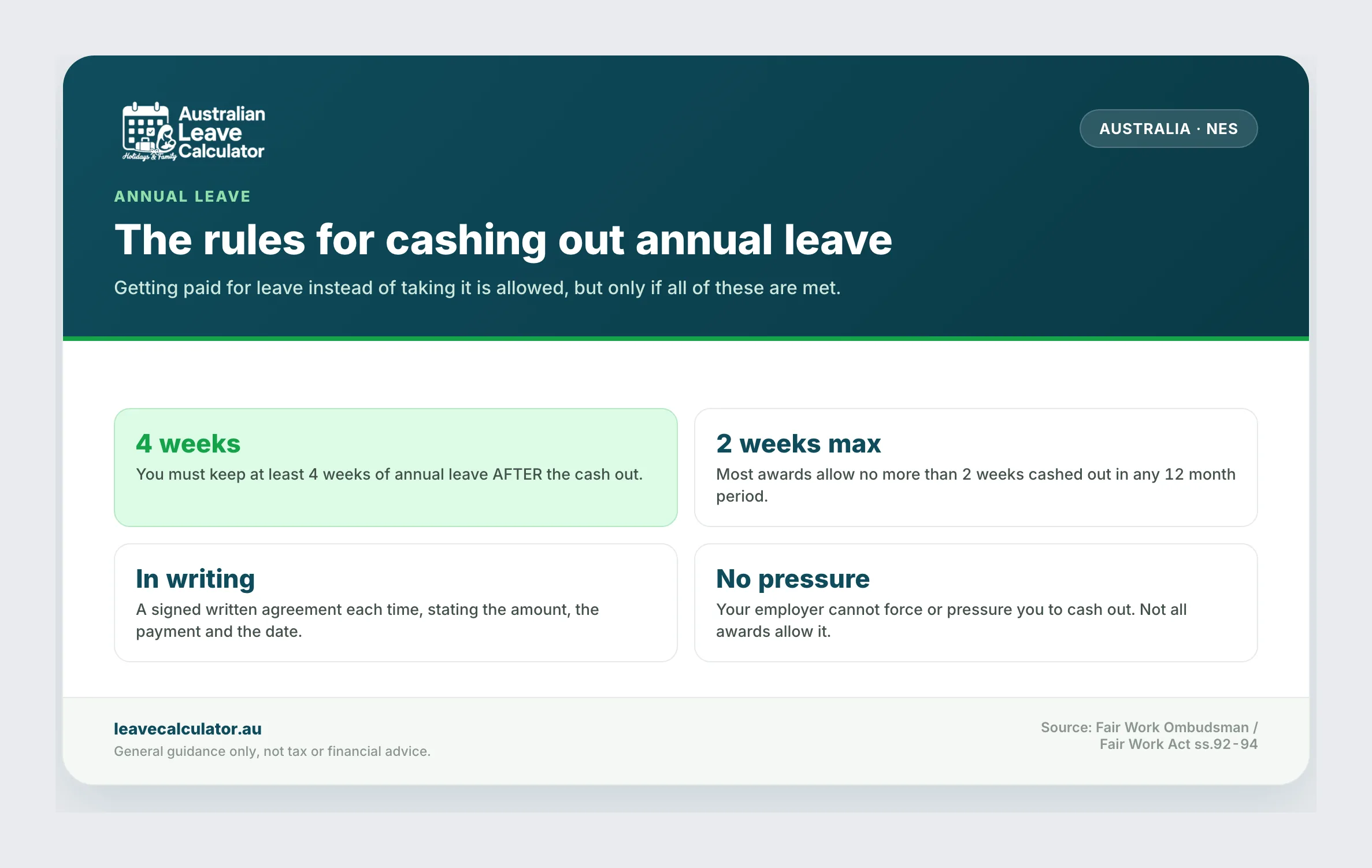
- You must keep at least 4 weeks of leave, cannot cash out more than 2 weeks in any 12 months under most awards, need a signed written agreement each time, and cannot be forced or pressured.
- The payment must equal what you would have earned by taking the leave, including annual leave loading (often 17.5%) where it applies.
- Cashed-out leave is taxed as ordinary income at your marginal rate and attracts super, which is different from unused leave paid out on termination.
What cashing out annual leave is
The Fair Work Ombudsman defines it plainly: "Cashing out annual leave is when an employee receives direct payment of their annual leave instead of taking paid time off work." You stay employed, keep working your normal roster, and receive money for a slice of the leave you have banked.
It is not the same as having your leave paid out when your job ends. That happens automatically on termination, is worked out differently for tax and super, and has no minimum-balance rule. Cashing out happens while you are still employed and is entirely optional for both sides. Leave you do not cash out or take simply carries forward: see does annual leave roll over.
One point that catches people out: annual leave does not keep accruing on the hours you cash out. Once a block of leave is paid out it is removed from your balance and is not replaced.
The reverse arrangement, giving up some pay to buy extra weeks off, is purchased leave. The purchased leave calculator shows what it costs per pay.
Cashing out (paid for leave you keep working through) is not the same as being directed to take excess annual leave, and neither is the same as taking leave in advance before you have accrued it.
Cashing out under a modern award
Most modern awards allow cashing out, but not all of them do, so the first step is to check the award that covers your job. If your award is silent on cashing out, you cannot cash out under it. You can find and read your award through the Fair Work Ombudsman's modern award resources or its Find My Award tool. Awards such as hospitality and retail set out their own cashing-out clauses.
Where an award does allow it, the same core conditions apply under most awards:
- You must have at least 4 weeks of annual leave left over after the cash out.
- You cannot cash out more than 2 weeks in any 12-month period.
- There must be a signed written agreement for each cash out that sets out the amount of leave being cashed out, the amount you will be paid, and the date it will be paid. If you are under 18, a parent or guardian must also sign.
- Your employer must keep the agreement as an employee record.
- Your employer cannot force or pressure you to cash out (or to not cash out) your leave.
The Fair Work Ombudsman publishes a template "Agreement to cash out annual leave" that employers and employees can complete, sign and each keep a copy of.
Fair Work Act 2009 (Cth) ss.92, 93 and 94(1), via the Federal Register of Legislation. Rules and template from Fair Work Ombudsman, Cashing out annual leave (updated 9 June 2026).
Enterprise agreements and award-free employees
If a registered enterprise agreement covers your role, annual leave can be cashed out only when the agreement allows it. When it does, similar safeguards apply: you must keep at least 4 weeks of annual leave, a written agreement must be made each time leave is cashed out, the payment must equal what you would have received had you taken the leave, and your employer cannot force or pressure you.
If you are award and agreement free (no award and no registered agreement applies to you), you can still agree with your employer to cash out annual leave. The agreement must be in writing, your employer must pay you the same amount you would have received if you had taken the leave, and you must have at least 4 weeks left in your balance after the rest is cashed out.
The three routes line up like this:
| Your situation | Can you cash out? | Key conditions |
|---|---|---|
| Covered by a modern award | Only if the award allows it (most do, some do not) | Keep at least 4 weeks; usually a maximum of 2 weeks per 12 months; signed written agreement each time; no pressure |
| Covered by an enterprise agreement | Only if the agreement allows it | Keep at least 4 weeks; written agreement each time; paid as if taken; no pressure |
| Award and agreement free | Yes, by written agreement with your employer | Keep at least 4 weeks; agreement in writing; paid as if taken |
How much you are paid
The golden rule is that cashing out must not leave you worse off: the payment has to be at least the amount you would have been paid if you had actually taken the leave. Under the National Employment Standards that means your base pay rate for the ordinary hours cashed out, and where your award, agreement or contract provides annual leave loading, the payment must include that loading too.
Many awards set annual leave loading at 17.5% of your ordinary rate. Some awards pay the higher of a 17.5% loading or the weekend and shift penalty rates you would otherwise have earned, compared across the whole period of leave. Whether loading applies to you, and at what rate, depends on your specific instrument. See our leave loading guide for how it is worked out.
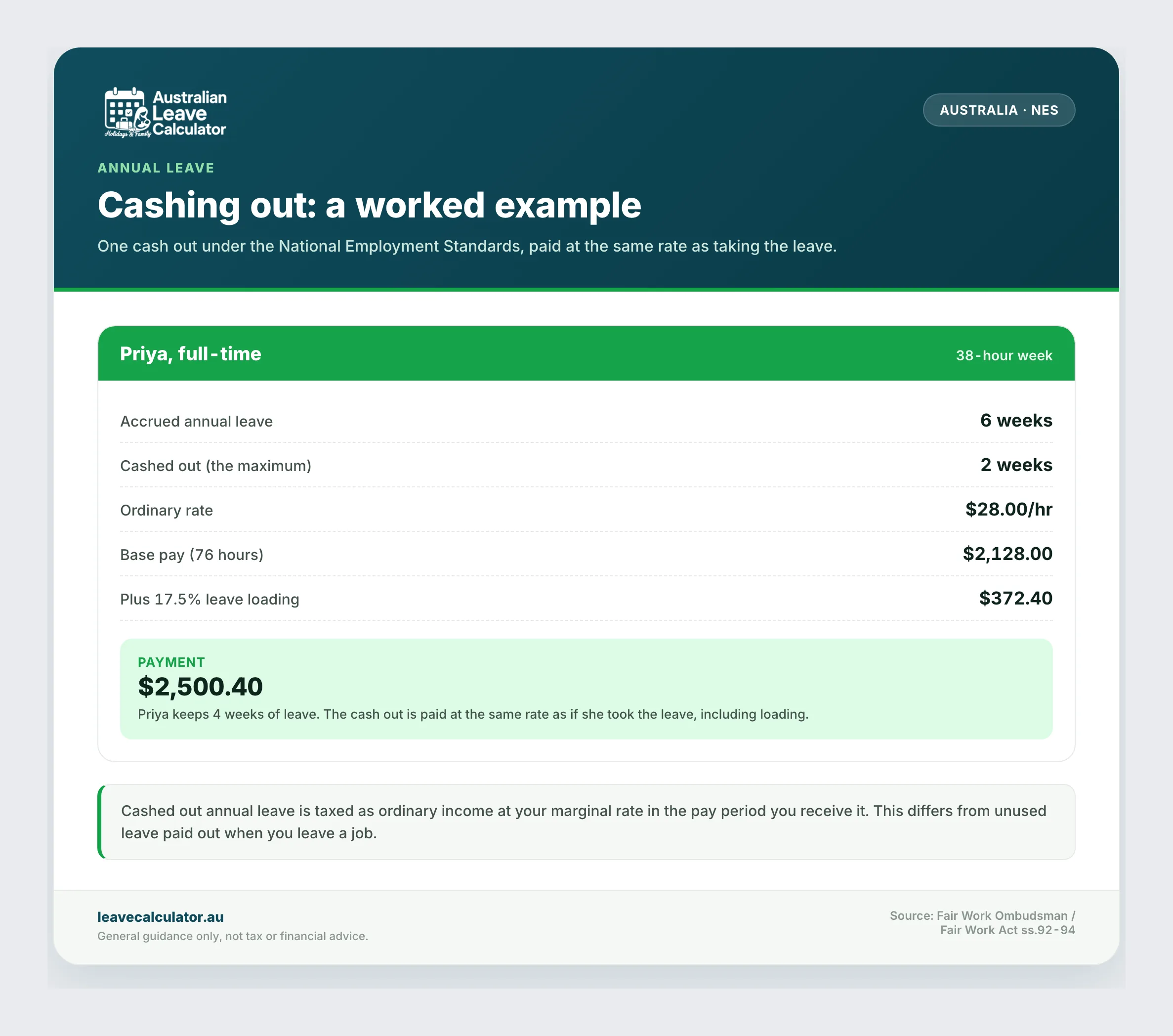
Maria works full-time on an annual leave 38-hour week in retail and has banked 10 weeks (380 hours) of annual leave. Her award allows cashing out, so she agrees in writing to cash out 2 weeks (76 hours), the most allowed in a 12-month period under most awards. Suppose her base rate is $28.00 an hour: her base payment is 76 x $28.00 = $2,128. Her award pays 17.5% leave loading, adding $372.40, for a gross cash-out payment of $2,500.40. Afterwards she still holds 8 weeks (304 hours) of leave, comfortably above the 4-week minimum.
Fair Work Act 2009 (Cth) s.90, via Fair Work Ombudsman, Payment for annual leave (updated 22 October 2025). Loading rate and worked figures from Fair Work Ombudsman, Calculating annual leave loading.
How cashing out is taxed
Because you cash out while you are still employed, the payment is treated as ordinary salary and wages. It is added to your income for the pay period, PAYG tax is withheld using the normal tax tables, and it is ultimately taxed at your marginal tax rate. The Australian Taxation Office classifies it as "cash out of leave in service", an in-employment leave payment rather than a termination payment.
This is different from unused annual leave that is paid out when you leave a job. Those termination payments use a separate ATO schedule. For a normal termination such as resignation or retirement, unused annual leave and loading that accrued after 17 August 1993 are taxed at marginal rates and included in salary and wages; but where leave is paid out because of a genuine redundancy, invalidity or an early retirement scheme, tax is withheld from the annual leave and loading at a flat 32%. Cashing out during employment never attracts that concessional redundancy treatment.
| Feature | Cashing out during employment | Unused leave paid on termination |
|---|---|---|
| When it happens | While you are still employed | When your job ends |
| PAYG tax | Ordinary income at your marginal rate | Marginal rate for a normal termination; 32% on the redundancy-related portion |
| Super guarantee | Payable (counts as ordinary time earnings) | Not payable (not ordinary time earnings) |
| Is it optional? | Yes, both sides must agree in writing | Automatic, paid regardless |
ATO, Schedule 7 tax table for unused leave payments on termination (payments from 1 July 2026); ATO, Disaggregation of gross (updated 12 November 2025).
Is superannuation paid on cashed-out leave?
Yes, in most cases. The ATO treats cashed-out annual leave taken in service as ordinary time earnings, which means your employer has to pay super guarantee on it, just as they would if you had taken the leave and been paid for it. Cashed-out annual leave loading is generally included as well.
There is one narrow exception. If annual leave loading is clearly linked to a notional loss of the opportunity to work overtime, that loading is treated as overtime and is not ordinary time earnings, so super is not payable on that part. The common 17.5% type of leave loading is not caught by this exception.
By contrast, when unused leave is paid out on termination it does not form part of ordinary time earnings, so no super is payable on it.
Cash out of leave in service is ordinary time earnings: ATO, Disaggregation of gross. Unused leave on termination is not: ATO, When a worker leaves your business (updated 9 June 2026).
When cashing out is (and is not) a good idea
Cashing out can make sense when you have built up more leave than you can realistically take and you want the money now. If your balance is heading towards excessive levels (generally more than 8 weeks, or 10 weeks for shiftworkers), cashing out up to 2 weeks can bring it down, although being directed to take some leave, or simply booking a holiday, are alternatives worth weighing.
Points to weigh up before you sign:
- Rest matters. Annual leave exists so you can recover, and you still need genuine breaks even after a cash out.
- There is a cap. Under most awards you can only cash out 2 weeks in any 12 months, and you must keep at least 4 weeks banked.
- No pressure is allowed. Your employer cannot make you do it. The decision has to be genuinely yours and recorded in writing.
- Consider the alternatives. Taking the leave, or arranging it around public holidays, gives you the same pay plus the time off.
Common questions
Can my employer force me to cash out annual leave?
No. It is unlawful for an employer to force, or try to force, you to make (or not make) an agreement to cash out annual leave. Any cash out must be a genuine, voluntary decision recorded in a signed written agreement.
How much annual leave can I cash out?
Under most awards the maximum is 2 weeks of accrued annual leave in any 12-month period, and you must always keep at least 4 weeks of leave in your balance after the cash out. Enterprise agreements can set their own limits within the same 4-week floor.
Do I still get leave loading if I cash out?
If your award, enterprise agreement or contract entitles you to annual leave loading when you take leave, that loading must be included in the cash-out payment, because the payment has to equal what you would have received if you had taken the leave.
Is cashed-out leave taxed at a higher rate?
No. It is taxed as ordinary income at your marginal rate, the same as your normal pay. The flat rates that can apply to some leave paid out on termination do not apply to cashing out while you are still employed.
Do casual employees get to cash out annual leave?
No. Casual employees do not accrue paid annual leave in the first place, so there is nothing to cash out. Cashing out only applies to full-time and part-time employees who accrue annual leave.

Author & reviewer
Sarah has spent over a decade advising Australian SMBs on Fair Work, NES compliance, and payroll. Based in Sydney, she has worked across hospitality, retail and professional services.