

Carer's leave lets you take time off work to care for or support someone in your immediate family or household who is sick, injured or affected by an unexpected emergency. In Australia it is not a stand-alone entitlement with its own separate balance. It is one half of a single leave type the Fair Work Act 2009 calls paid personal/carer's leave, the same balance you draw on when you are unwell yourself. This guide covers what carer's leave is, how much you get, how it accrues and rolls over, the extra unpaid days, who you can care for, and the notice and evidence required. Carer's leave is used heavily in health and care work, where the Nurses Award, Aged Care Award, SCHADS Award and Medical Practitioners Award set the surrounding roster and penalty rules.
Key takeaways
- Carer's leave shares the one 10-day paid personal/carer's leave balance.
- Part-timers get a pro-rata share; casuals get 2 days unpaid carer's leave per occasion.
- It covers immediate family and household members who are ill, injured or facing an emergency.
- It is not paid out on termination, and reasonable evidence can be required.
What carer's leave is
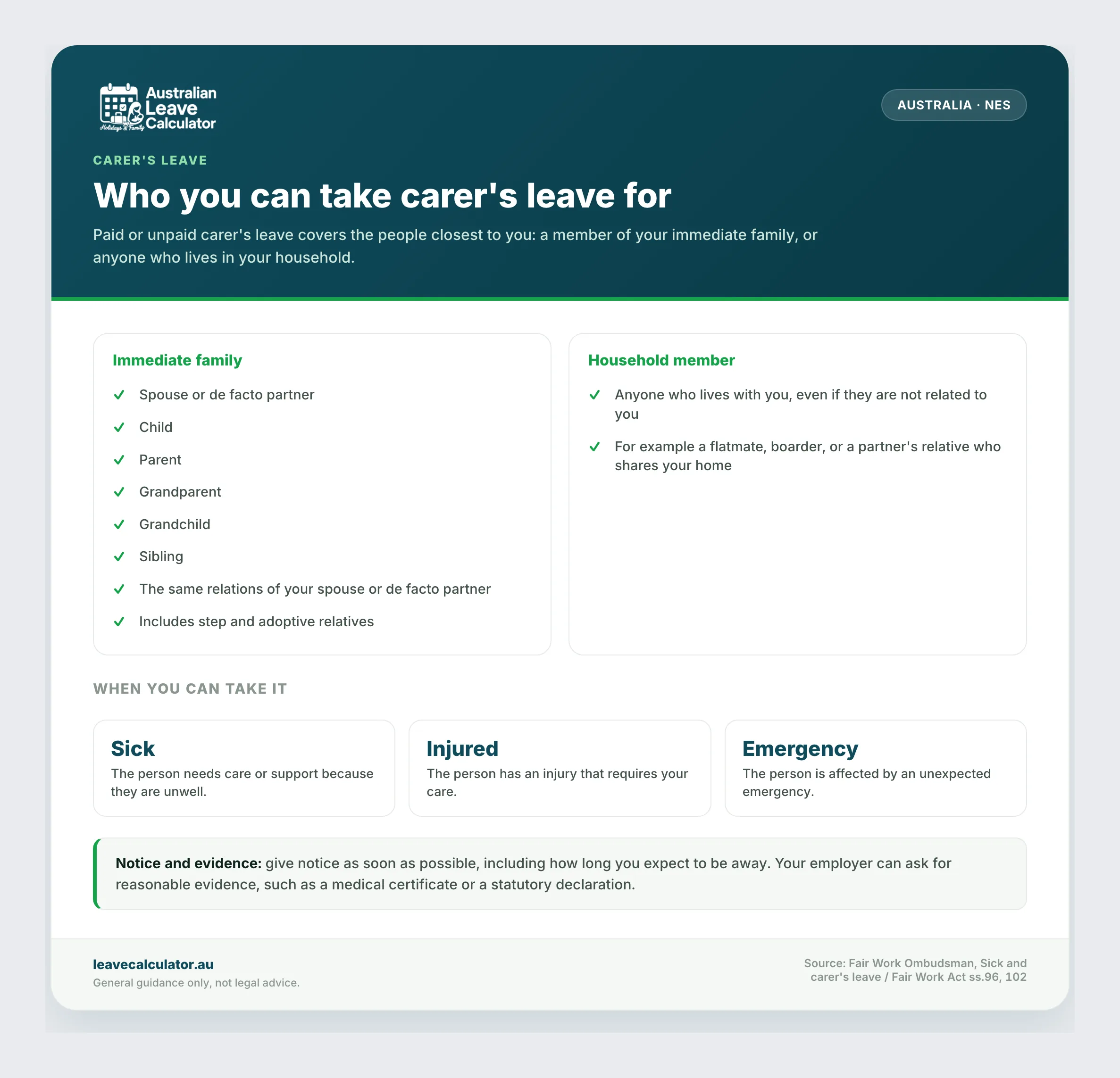
Under the National Employment Standards, a full-time or part-time employee may take paid personal/carer's leave to provide care or support to a member of their immediate family or household who needs it because of a personal illness, a personal injury, or an unexpected emergency. It sits alongside sick leave, which is the same entitlement used when the illness or injury affects you rather than someone you care for.
The Act does not define an "unexpected emergency", but it can include a child's school or childcare closing suddenly; which leave covers other emergencies is set out in emergency leave in Australia. Carer's leave is different from compassionate and bereavement leave, which applies when a family or household member dies or has a life-threatening illness, and different again from family and domestic violence leave.
It shares the same balance as your sick leave
This is the point most people miss: carer's leave is not a separate pot of days on top of your sick leave. Sick leave and carer's leave are part of the same entitlement, which is why the Act calls it one combined thing, paid personal/carer's leave. Every hour you use caring for a family member comes out of the exact same balance you would use if you were off sick yourself, so using most of it on your own illness leaves less for caring. For a fuller comparison, see personal leave versus sick leave.
How much carer's leave you get
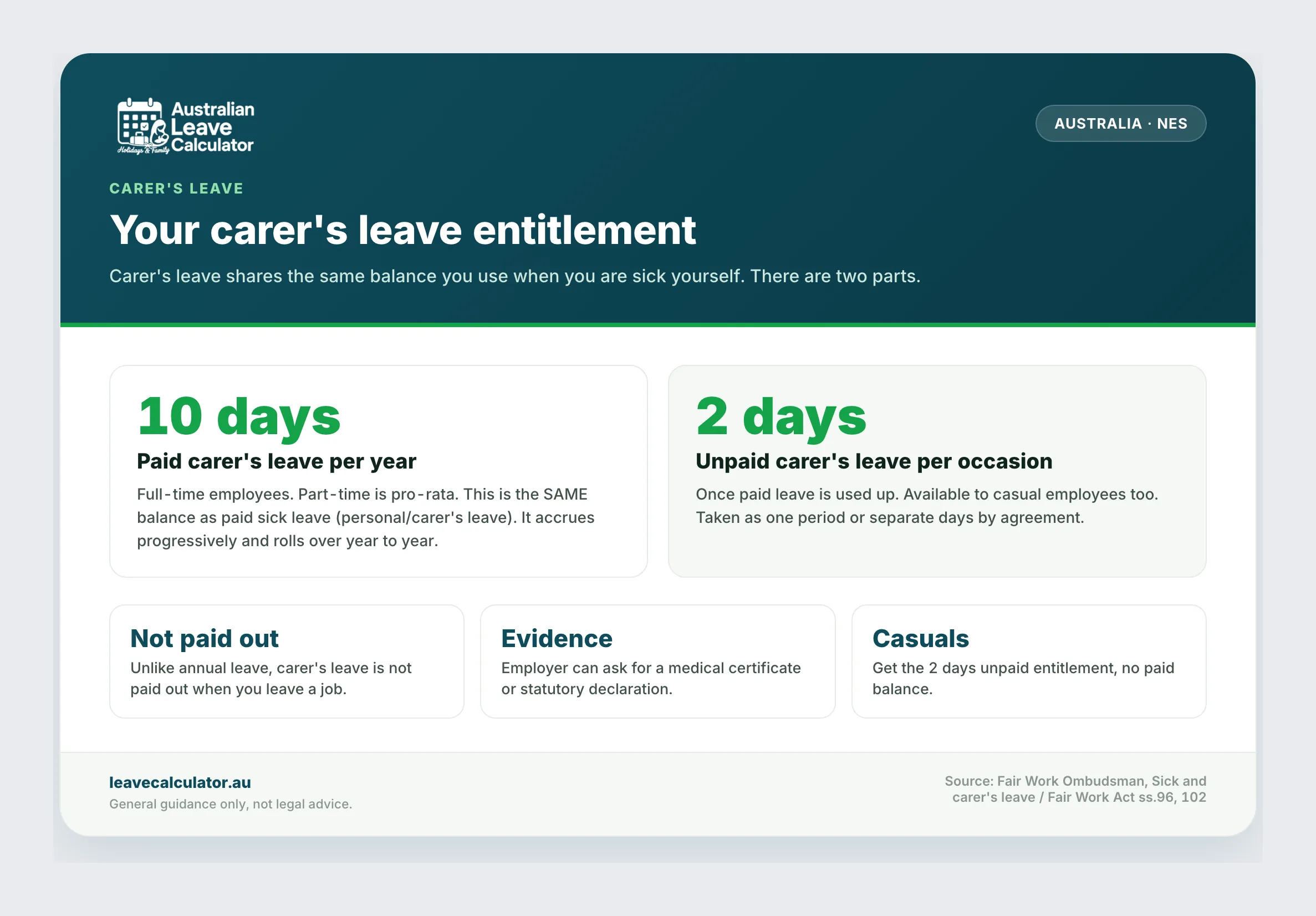
A full-time employee is entitled to 10 days of paid personal/carer's leave for each year of service. Part-time employees get the same on a pro-rata basis, worked out as 1/26 of their ordinary hours over a year. Because it is measured in your ordinary hours, payroll usually tracks it in hours. A full-time employee on a standard sick leave on a 38-hour week accrues 76 hours of paid personal/carer's leave a year (10 days of 7.6 hours). A part-timer on 19 hours a week accrues 38 hours. The spread of hours does not change the total: 38 hours over four or five days both give 76 hours a year.
The leave accrues progressively from your first day, based on your ordinary hours, and any balance left at year end carries over. It does not reset or expire. It keeps building while you are on most paid leave but not during unpaid leave such as unpaid parental leave; see do you accrue leave while on leave. There is no minimum or maximum you can take at once.
Paid and unpaid carer's leave at a glance
There are two layers to carer's leave: paid leave from your personal/carer's balance, and a separate right to unpaid carer's leave once that balance is gone.
| Feature | Paid carer's leave | Unpaid carer's leave |
|---|---|---|
| Who can use it | Full-time and part-time employees | All employees, including casuals |
| How much | Part of your 10-day (76-hour full-time) yearly personal/carer's balance | 2 days per occasion |
| When available | Whenever you have a paid balance left | Full-time and part-time: only once paid leave is used up. Casuals: any qualifying occasion |
| Paid? | Yes, at your ordinary hours of pay | No |
| Notice and evidence | Yes (Fair Work Act s 107) | Yes (Fair Work Act s 107) |
The extra 2 days of unpaid carer's leave
Once a full-time or part-time employee has used up all their paid sick and carer's leave, they can take unpaid carer's leave of 2 days per occasion, each time an immediate family or household member needs care because of illness, injury or an unexpected emergency. Because it is per occasion, a fresh 2-day entitlement applies to each new qualifying event rather than being a yearly cap.
You can take the 2 days as one continuous block, or split them into separate periods (for example, four half-days) if you and your employer agree. You cannot use unpaid carer's leave when you could instead take paid personal/carer's leave, so it is genuinely a top-up for when the paid balance is exhausted. An employer cannot take negative action against you for taking it. If your employer contacts you while you are away, the right to disconnect sets out when you can refuse to respond.
Who you can care for
Carer's leave can only be used for a member of your immediate family or your household. Under the Fair Work Act, an immediate family member is any of:
- your spouse or former spouse;
- your de facto partner or former de facto partner;
- your child;
- your parent;
- your grandparent;
- your grandchild;
- your sibling; or
- a child, parent, grandparent, grandchild or sibling of your spouse or de facto partner (including a former one).
This includes step-relations and adoptive relations. A household member is simply any person who lives with you, even if not related, so a sick housemate is covered, while a relative outside this list who does not live with you generally is not. See our leave glossary for plain-English definitions.
Carer's leave for casual employees
Casual employees do not accrue paid sick and carer's leave, a trade-off reflected in their casual loading. But casuals are not shut out: every employee, including a casual, is entitled to 2 days of unpaid carer's leave per occasion when an immediate family or household member needs care for the same reasons that apply to everyone else. The notice and evidence rules apply to casuals too.
Notice and evidence
To be entitled to carer's leave you must let your employer know. Notice has to be given as soon as practicable, which can be after the leave has started (for example, when you are dealing with an emergency first), and you should say how long you expect to be away.
If your employer asks, you must give evidence that would satisfy a reasonable person that the leave was for a genuine qualifying reason. A medical certificate or a statutory declaration are the usual acceptable forms, and employers can ask even for a single day. An award or registered agreement can set out when evidence is required, but the request must always be reasonable. If you are asked and do not provide it, you may not be paid. These rules come from section 107 of the Fair Work Act and cover paid and unpaid carer's leave alike. What a valid medical certificate should contain, including online and backdated ones, is covered in doctor's certificate for sick leave.
Carer's leave and ending employment
Unlike annual leave, sick and carer's leave is not paid out when your employment ends. Any unused personal/carer's balance simply lapses on your last day; it is not cashed out in your final pay. That is a key difference from annual leave, where the unused balance must be paid out on termination. Other leave types, such as parental leave, have their own separate rules.
Frequently asked questions
Is carer's leave separate from sick leave?
No. Sick leave and carer's leave are the same entitlement, paid personal/carer's leave, drawn from a single balance of 10 days a year for a full-time employee.
How many days of carer's leave can I take in a year?
There is no separate annual cap. You can use as much of your accrued balance as you have, for your own illness or for caring. Once it runs out, you can take 2 days of unpaid carer's leave per occasion.
Can I take carer's leave to look after a sick friend?
Only if that friend lives with you and so counts as a household member. Otherwise carer's leave is limited to immediate family members.
Can my employer ask for a medical certificate?
Yes, for reasonable evidence such as a medical certificate or statutory declaration, even for a single day. If you do not provide it when asked, you may not be paid. See our frequently asked questions for more on evidence and pay.
- Carer's leave and sick leave share one balance: 10 days a year full-time (76 hours on a 38-hour week), pro-rata for part-time, accruing progressively and rolling over.
- Once paid leave is used up, all employees, including casuals, can take 2 days of unpaid carer's leave per occasion.
- You can only use it for an immediate family member (spouse, de facto, child, parent, grandparent, grandchild, sibling and their equivalents through a partner) or anyone who lives with you.
- Give notice as soon as practicable, provide a medical certificate or statutory declaration if asked, and remember it is never paid out when you leave the job.

Author & reviewer
Sarah has spent over a decade advising Australian SMBs on Fair Work, NES compliance, and payroll. Based in Sydney, she has worked across hospitality, retail and professional services.