

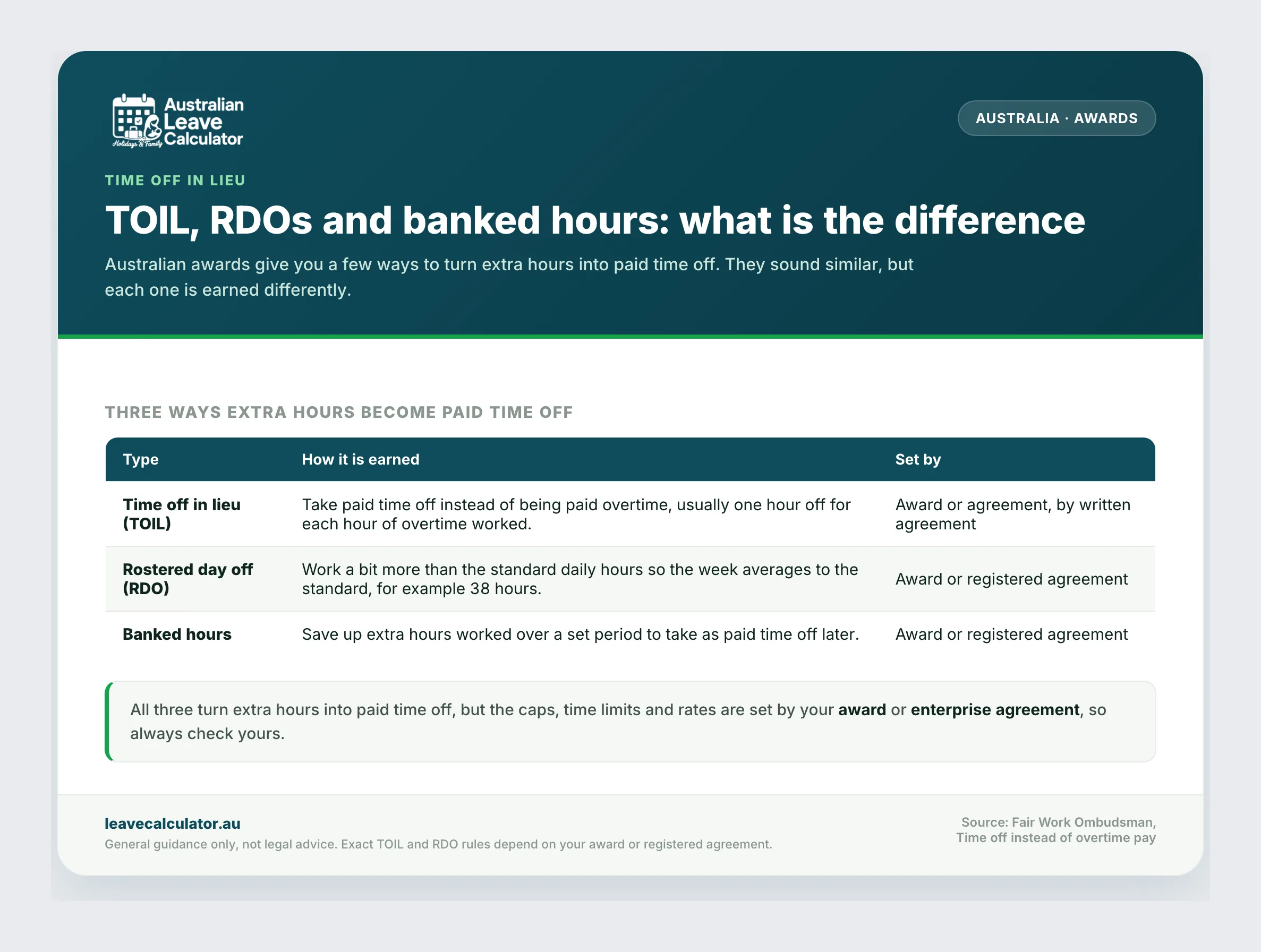
Time off in lieu (TOIL) lets you take paid time off work instead of being paid for overtime. It sits alongside two arrangements people often confuse with it: rostered days off (RDOs) and banked hours. None of the three are National Employment Standards entitlements. They come from your modern award or enterprise agreement, so the precise rules always depend on the instrument covering your job. This guide explains what each one is, how the time accrues, how they differ from annual leave, and what happens to any unused credit when you leave. Time off in lieu arrangements differ sharply by industry: compare the Mining Award, Security Award and Road Transport Award pages.
Key takeaways
- TOIL is paid time off taken instead of overtime pay, agreed in writing, usually one hour off per overtime hour unless your award sets a higher rate.
- If TOIL is not taken within the period your award allows, it is generally paid out at the overtime rate, not your ordinary rate.
- Rostered days off are earned by working slightly more than your paid daily hours so the week averages 38, then taking the banked time as a paid day off.
- TOIL, RDOs and banked hours come from your award or agreement, not the NES, and any accrued credit is usually paid out when your job ends.
What time off in lieu is
Time off in lieu (TOIL) is paid time off you take instead of being paid for overtime. Overtime is work performed outside the ordinary hours set out in your award or agreement, usually paid at a higher rate. With TOIL, rather than taking that higher payment, you and your employer agree to bank the time and take it off later at your ordinary rate. The Fair Work Ombudsman puts it plainly: some awards and registered agreements allow an employee to take paid time off instead of being paid overtime pay, an arrangement also known as 'time in lieu', 'time off in lieu' or 'TOIL'.
TOIL is not a standalone National Employment Standard. It exists only because your award or agreement provides for it, so whether you can use it, and on what terms, depends on the instrument covering you. Where an award is silent on TOIL, overtime is simply paid out in your wages.
'Time off instead of overtime pay' from Fair Work Ombudsman, Overtime pay (content last updated 12 May 2026).
Your award or agreement sets the rules
Because TOIL is an award or agreement matter rather than a blanket legal right, the detail sits in the overtime clause of the instrument covering your job. The Fair Work Ombudsman directs employees to check the terms for their own industry, noting that the details about when overtime applies differ under each award and registered agreement.
Your award or agreement will typically answer:
- whether TOIL is available at all for the overtime you work
- the rate at which time accrues (covered in the next section)
- how long you have to take the time before it must be paid out
- whether a written agreement is needed each time, or a standing arrangement is allowed
- any cap on how much TOIL you can bank at once.
Because these terms vary, find the award covering your job before relying on any figure here. Our guide to modern awards shows how, or browse by industry on the awards page, then read its overtime and TOIL clause for the exact accrual rate and time limits.
How TOIL agreements work
Where an award permits TOIL, it usually sets the same kind of ground rules:
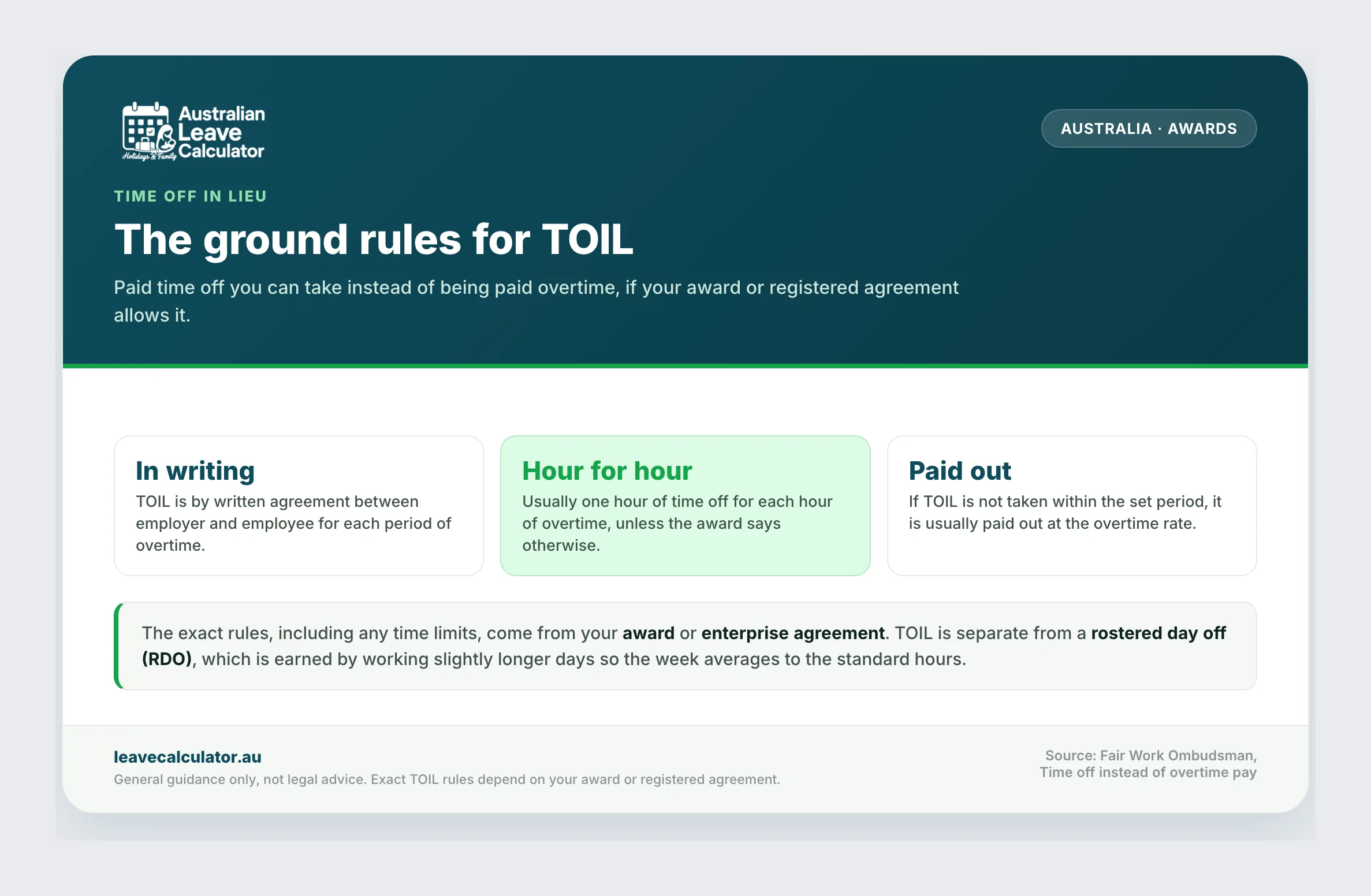
- A written agreement. Many awards require the agreement to take TOIL to be in writing, and some require a fresh one for each occasion of overtime.
- Usually hour for hour. Time is commonly accrued at the equivalent overtime hours worked: one overtime hour gives one hour off, unless your award states a higher rate.
- A time limit. Awards generally give you a set period to take the time, for example within six months.
- Paid out if not taken. If you do not take the TOIL in that period, the overtime is usually paid out at the overtime rate that would have applied, not your ordinary rate.
- No forcing. You generally cannot be made to take TOIL against your wishes: it is a genuine choice recorded by agreement.
Because the accrual rate, time limit and paperwork differ between instruments, read your own clause for the exact figures.
Priya works under an award that allows TOIL at one hour off per overtime hour. She works 5 hours of overtime one week and agrees in writing to bank the time rather than be paid, then takes it as a half-day off the following month. Had she not taken it within the period her award allows, her employer would have had to pay those 5 hours at the overtime rate (say time and a half), not her ordinary rate. Your award may use different figures, so treat this as an illustration only.
Rostered days off explained
A rostered day off (RDO) is a different arrangement again. The Fair Work Ombudsman describes it as a day in a roster period that an employee does not have to work, paid or unpaid depending on how the award or agreement sets it up.
Where RDOs are paid, they are earned because an employee has worked extra hours that add up over a set period, then taken as an RDO. In practice you work slightly more than your paid daily hours so that, once the extra minutes are counted, your week still averages the standard 38 ordinary hours, and those banked minutes build into a full paid day off. The arrangement is common in construction and manufacturing (browse these on the awards page): employees work a little over 8 hours a day and take a paid RDO on a set cycle, such as one day every four weeks. The RDO is paid time, set by your award or agreement, and is not overtime.
RDO definition and how paid RDOs accrue from Fair Work Ombudsman, Rostered days off (content last updated 13 May 2026).
Banked hours
Banked hours are extra hours you accumulate and save to take as paid time off later, where an award, agreement or workplace policy allows it. Some workplaces use 'banked hours' loosely for any of these arrangements, so check which clause your time is credited under and what happens if it is not used. The common theme across all three: they convert hours worked now into time off later, shifting when you are paid rather than adding an entitlement on top of your leave, and they come from your award or agreement, not the NES.
TOIL, RDOs and annual leave compared
The three are funded and governed differently: TOIL and banked hours convert extra work into time off, RDOs convert slightly longer ordinary hours into a paid day off, and annual leave is a legal minimum that accrues automatically.
| Feature | Time off in lieu (TOIL) | Rostered day off (RDO) | Banked hours |
|---|---|---|---|
| What creates it | Overtime you choose to bank instead of being paid | Working slightly longer ordinary hours across a cycle | Extra hours saved under an award, agreement or policy |
| Where the rules come from | Your award or agreement | Your award or agreement | Your award, agreement or policy |
| How it accrues | Usually one hour off per overtime hour | Extra daily minutes add up so the week averages 38 | As set by the instrument |
| If not taken | Usually paid out at the overtime rate | Accrued credit generally paid out | Generally paid out per the instrument |
Annual leave is the odd one out: a legal minimum of 4 weeks a year (5 for many shiftworkers) under the Fair Work Act 2009, accruing automatically, often attracting 17.5% leave loading, and it cannot be traded below the statutory minimum. TOIL, RDOs and banked hours offer none of those guarantees. Use the annual leave calculator for the statutory side.
What happens when your job ends
When you leave a job (by resignation, redundancy or dismissal), any time you have banked but not yet taken usually has to be settled in your final pay.
- Unused TOIL is generally paid out at the overtime rate that applied when you worked the hours.
- Accrued RDO credit (extra hours worked towards your next RDO but not yet taken) is generally paid out too, so you are not left having worked for free.
- Banked hours are treated the same way, paid out under the award, agreement or policy they were credited under.
The exact method and rate come from your award or agreement, so check the clause or ask your employer how the figure was worked out. This is separate from your unused annual leave, paid out under the National Employment Standards; both can appear on the same final payslip.
Common questions
Is time off in lieu the same as a rostered day off?
No. TOIL is time off taken instead of being paid for overtime you have already worked. An RDO is earned by working slightly longer ordinary hours across a cycle so your week still averages 38, then taken as a paid day off. TOIL comes out of overtime; an RDO comes out of your ordinary hours.
Can my employer make me take TOIL instead of overtime pay?
Generally no. Under most awards, taking TOIL instead of overtime pay is by agreement, usually in writing, and you cannot be forced against your wishes. If you do not agree, the overtime is paid in your wages. Check your award for the exact wording.
What happens if I do not use my TOIL in time?
Most awards set a period within which TOIL must be taken. If it is not taken in that window, your employer usually has to pay out the overtime at the overtime rate, rather than letting it expire. The length of the period is set by your award or agreement.
Do TOIL or RDOs reduce my annual leave?
No. TOIL, RDOs and banked hours are separate from annual leave. They do not draw down your annual leave balance or any other NES entitlement, and annual leave keeps accruing in the normal way alongside them. See the glossary for definitions.
Where exactly do I find the rules that apply to me?
In the award or enterprise agreement covering your job, usually in the overtime, hours of work or RDO clause. Start with our guide to modern awards or browse by industry on the awards page, then read the specific clause. Our FAQ and the Fair Work Ombudsman can help if you are still unsure.

Author & reviewer
Sarah has spent over a decade advising Australian SMBs on Fair Work, NES compliance, and payroll. Based in Sydney, she has worked across hospitality, retail and professional services.