

A large annual leave balance can feel like a perk, but for both sides it often turns into a problem. This guide explains what counts as excessive annual leave in Australia, why employers want to bring big balances down, and the exact process that modern awards and the Fair Work Act 2009 set out before an employee can be told to take some of it. The short version: the law expects both sides to try to agree first, and only then does a formal written direction with strict limits apply. Award clauses on directing excess leave vary, as the Graphic Arts Award, Gardening and Landscaping Award and Waste Management Award pages show.
Key takeaways
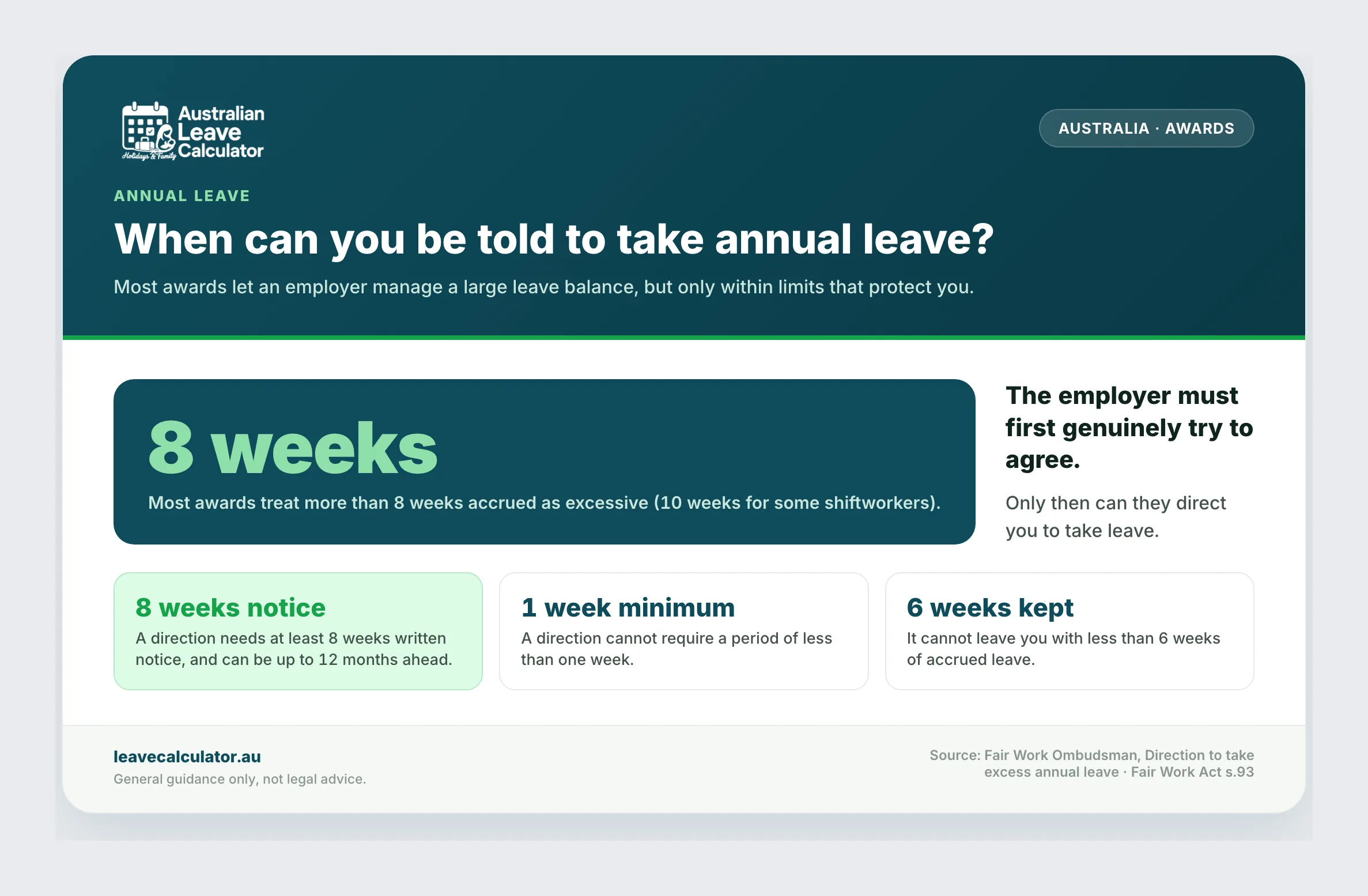
- Most awards treat more than 8 weeks accrued as excessive (10 weeks for some shiftworkers).
- An employer must genuinely try to agree before directing you to take leave.
- A direction needs at least 8 weeks notice and cannot cut your balance below 6 weeks.
- Award-free employees can be required to take leave only where it is reasonable.
What counts as excessive annual leave
There is no single figure. In the national workplace system, excess annual leave is typically when an employee has accrued more than 8 weeks of paid annual leave. For shiftworkers, the threshold is typically 10 weeks. These figures come from the model "excessive leave" term in most modern awards, so the precise trigger and process depend on the award or registered agreement that covers the job. Below that mark, your balance simply carries forward: see does annual leave roll over.
Because thresholds and rules differ between awards, always check the one that applies to you, for example through the Fair Work Ombudsman list of awards. Not sure how much leave you have banked? Our annual leave calculator can estimate your balance from your start date and hours.
Why big leave balances are a risk for employers
Accrued annual leave is money the business owes. It sits on the books as a liability and must be paid out when someone leaves, valued at the pay rate that applies at payout, not when it was earned, so a growing balance costs more every time wages rise. Large balances also point to staff who rarely switch off, raising fatigue and coverage risks. That is why many employers monitor balances and act before leave becomes excessive.
Try to reach agreement first
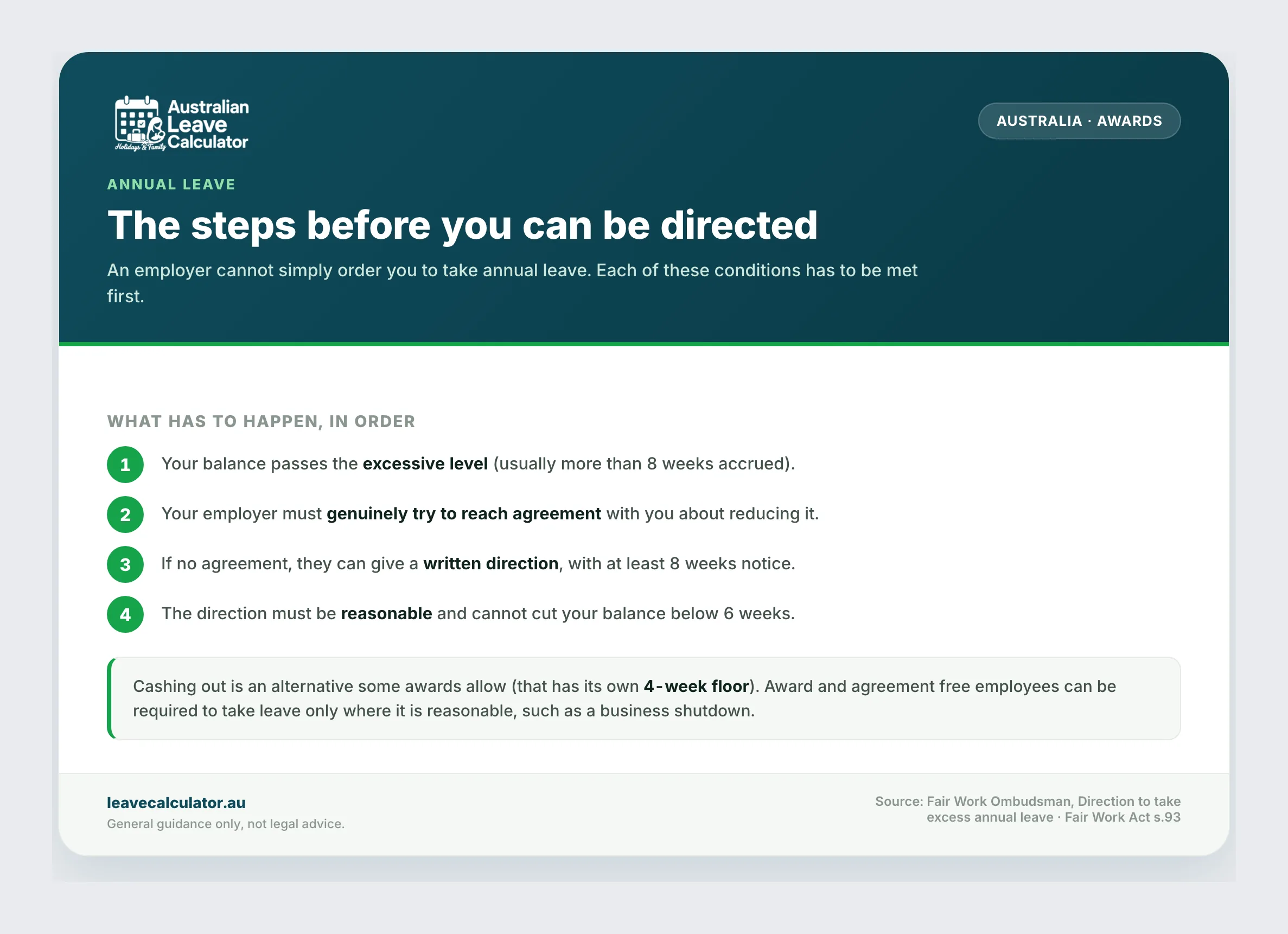
A direction to take leave is not the first step. Under most awards, an employer can only direct an employee to take annual leave if they have not been able to agree about when the excess leave will be taken. In practice the employer is expected to genuinely try to reach agreement first: usually a meeting or written request to plan some leave and a real effort to find dates that suit both.
This matters: if an employer jumps straight to a direction without attempting agreement, it may not be valid. An agreed plan is usually faster and lets the employee pick dates that suit them.
Being directed to take excess leave under an award
If no agreement can be reached, most awards let the employer direct the employee in writing to take some of the excess. The direction carries protections so it cannot wipe out an entire balance or spring leave on someone at short notice, as the table below shows.
| Rule | What the award direction requires |
|---|---|
| When it can apply | Employee has more than 8 weeks accrued (10 weeks for a shiftworker), as in Clerks Award cl 32.6(a), and no agreement has been reached about reducing the excess |
| Form | The direction must be given in writing |
| Notice | At least 8 weeks' notice, and not more than 12 months, before the leave starts |
| Minimum period | The period of leave must be at least 1 week long |
| Remaining balance | Generally cannot leave the employee with less than 6 weeks of accrued annual leave |
| Award-free or agreement-free | Employer may require leave only where the requirement is reasonable (see below) |
How these windows compare with the notice for a shutdown or your own leave request is set out in how much notice do you need for annual leave.
The exact wording of your award controls here, so an employer relying on a direction should read the award clause. The Fair Work Ombudsman also offers a free Direction to take excessive annual leave template with a sample letter and instructions.
Enterprise agreements and award-free employees
If an enterprise agreement covers the job, check it for the rules on excess leave, as some set out their own process. Where an agreement says an employee can be directed but does not spell out specific rules, the direction must simply be reasonable.
Employees who are award-free and agreement-free are covered directly by the Fair Work Act. Section 94(5) lets an employer require these employees to take paid annual leave, but only where the requirement is reasonable, and the Act flags an excessive balance as one situation that may be reasonable.
Cashing out as an alternative
Taking time off is not the only way to cut a balance. Where a modern award or enterprise agreement allows it, an employee can cash out some annual leave instead: being paid for it while staying at work. Award-free employees can agree to cash out under section 94. Either way the Act sets firm guardrails.
- The employee must keep at least 4 weeks of accrued annual leave after each cash-out (a different floor from the 6-week minimum for a direction to take leave).
- Each cash-out must be a separate written agreement between employer and employee.
- The employee must be paid at least the full amount they would have received on leave, which is where leave loading can come in.
Cashing out cannot be forced: it is always by agreement. For more detail, see our guide to cashing out annual leave.
Shutdown directions are a separate rule
Being directed to take leave during a business shutdown, such as the Christmas and New Year close-down, runs on different rules from an excess-leave direction. A shutdown is when the business temporarily closes, and whether staff can be directed to take leave then depends on the shutdown clause in the award or agreement, which often has its own notice requirements.
A shutdown is not the same as a stand down, which is when employees cannot be usefully employed for reasons outside the employer's control, such as an equipment breakdown or natural disaster. For award-free and agreement-free employees, an employer can still require paid annual leave over a shutdown where reasonable. If a shutdown falls across a public holiday, the employee is generally still paid for that holiday.
A worked example
Simone has worked full time in a distribution centre for over 10 years. She is a dayworker covered by the Storage and Wholesale Award and has 12 weeks of annual leave accrued. Because that is more than 8 weeks, she has excessive annual leave under her award.
Her employer, Oscar, first organises a meeting to discuss the balance, but they cannot agree. Checking the award, Oscar confirms he can now direct Simone in writing. He decides on a 3 week direction starting in 3 months' time. That leaves her with 9 weeks accrued (above the 6-week floor), gives well over the minimum 8 weeks' notice, and beats the one-week minimum, so the direction is valid.
What to do if you disagree
If you are given a direction you think is wrong, check the detail against your award or agreement: the accrued-balance trigger, whether the employer genuinely tried to agree first, the notice period, the one-week minimum, and the 6-week remaining balance. A direction that skips one of these may not be valid.
- Raise it in writing with your employer or HR, and ask which clause they rely on.
- Read the relevant award or agreement clause before responding.
- Contact the Fair Work Ombudsman Infoline on 13 13 94, or your union or industry association, for tailored help.
Frequently asked questions
How much annual leave is considered excessive?
Typically more than 8 weeks accrued, or more than 10 weeks for a shiftworker, under the model term in most modern awards. Your specific award or agreement may define it differently, so check the instrument that covers you.
Can my employer force me to take annual leave?
Only in limited situations and after following the rules. For excess leave, the employer must try to agree first, then give a written direction with at least 8 weeks' notice, for at least one week, without leaving you below 6 weeks accrued. For award-free employees it must be reasonable under s.94(5).
Do I keep accruing leave while I am on the directed leave?
Yes. Paid annual leave is paid time, so you keep accruing entitlements during it. See our guide on whether you accrue leave while on leave.
Can I cash out my excess leave instead of taking it?
Only if your award or agreement allows it (or, if you are award-free, by agreement under s.94). You must keep at least 4 weeks accrued, agree it in writing each time, and be paid the full amount you would have received on leave.
- Excessive annual leave is typically more than 8 weeks accrued (10 weeks for shiftworkers), but your award or agreement sets the exact trigger.
- A direction is a last resort: the employer must genuinely try to agree on dates first.
- An award direction must be in writing, give 8 weeks to 12 months' notice, cover at least one week, and leave you with at least 6 weeks accrued.
- Cashing out is a voluntary alternative that must keep at least 4 weeks accrued and be agreed in writing each time.

Author & reviewer
Sarah has spent over a decade advising Australian SMBs on Fair Work, NES compliance, and payroll. Based in Sydney, she has worked across hospitality, retail and professional services.