

Paid family and domestic violence (FDV) leave is one of the entitlements in the National Employment Standards, and it gives every employee in the national workplace relations system the right to time off, on full pay, to deal with the impact of family or domestic violence. It is a sensitive subject, so this guide sets out the facts plainly: how many days you get, who can use the leave, what it can be used for, how you give notice and evidence, and the strong confidentiality rules that keep it off your pay slip. If you or someone else is in immediate danger, call 000. For counselling and support, call 1800RESPECT on 1800 737 732.
Key takeaways
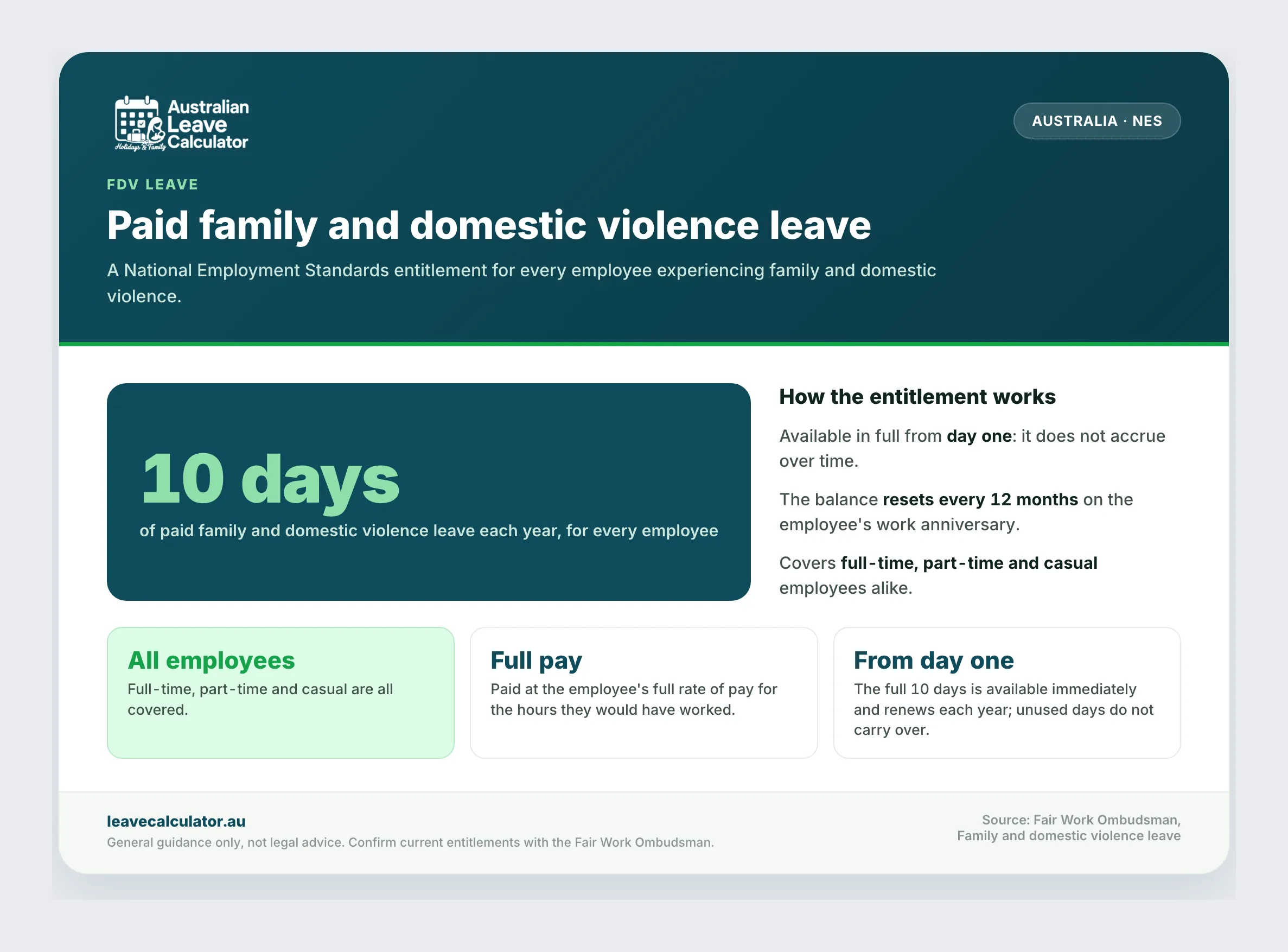
- All employees are entitled to 10 days of paid family and domestic violence leave each year, including full-time, part-time and casual employees.
- The full 10 days are available immediately from day one. The leave does not accumulate, it resets on your work anniversary, and unused days do not carry over.
- Full-time and part-time employees are paid their full rate of pay for the hours they would have worked; casuals are paid their full rate for the hours they were rostered.
- Your employer must keep your situation confidential, and the leave must not appear on your pay slip. Source: Fair Work Act 2009 (Cth) ss.106A-106E.
What paid family and domestic violence leave is
Paid family and domestic violence leave is a minimum entitlement under the National Employment Standards (NES), in the same way that annual leave and paid sick and carer's leave are. It gives employees a set amount of paid time off to deal with the impact of family and domestic violence when it is not practical to do so outside of working hours. The entitlement comes from the Fair Work Act 2009 and applies right across the national workplace relations system.
Because it is an NES minimum, an award, enterprise agreement, contract or workplace policy can add to it but can never provide less. If a policy or agreement offers fewer than 10 days, the NES entitlement still applies.
Who is eligible, including casuals
Every employee is eligible, regardless of how long they have worked or how many hours they do. That means full-time, part-time and casual employees are all covered, and the leave is available from the first day of employment rather than building up over time. There is no minimum length of service and no pro-rata reduction for part-timers or casuals: a casual who works one shift a week has the same 10-day entitlement as a full-time worker. To actually take the leave, an employee must be experiencing family and domestic violence and need the time to deal with its impact.
Fair Work Act 2009 (Cth) ss.106A-106E. See the Fair Work Ombudsman, Family and domestic violence leave.
How many days, and how you are paid
The entitlement is 10 days of paid leave in every 12-month period. Three features make it work differently from most other leave:
- Available in full immediately. All 10 days are there from day one; you do not accumulate them gradually the way you accrue annual or personal leave.
- It does not accumulate. The balance resets to 10 days on each work anniversary, 12 months after your start date.
- Unused days do not carry over. If you use 3 days in a year, the remaining 7 are not added to next year's balance; you simply start again at 10.
The leave is a standalone entitlement, separate from your personal and carer's leave, your annual leave and every other NES right, so using it does not reduce those balances. Taking it does not break your continuous service.
How the leave is paid depends on your employment type:
| Employment type | How the leave is paid |
|---|---|
| Full-time and part-time | Full rate of pay for the hours they would have worked if they were not on leave |
| Casual | Full rate of pay for the hours they were rostered to work |
Your full rate of pay is more than base pay. It includes incentive-based payments and bonuses, loadings (such as casual loading), monetary allowances, overtime or penalty rates, and any other separately identifiable amounts you would have earned for those hours.
Demi is a casual employee at a fast-food outlet. She takes 5 days of leave in one week to deal with the impact of family and domestic violence, during which she had been rostered to work 25 ordinary hours. Her employer must pay her base rate plus her 25% casual loading for those 25 rostered hours, along with any other loadings or allowances she would have received had she worked. Her leave balance drops by 5 days and renews to 10 days on her work anniversary.
What family and domestic violence means, and who counts
Family and domestic violence means violent, threatening or other abusive behaviour by a person connected to the employee that both seeks to coerce or control the employee and causes them harm or fear. It is not limited to physical violence.
For this leave, the person behaving that way can be one of three kinds of people:
| The person can be | Who this includes |
|---|---|
| A close relative | Your spouse or former spouse; de facto partner or former de facto partner; child, parent, grandparent, grandchild or sibling. It also covers those same relatives of your current or former spouse or de facto partner, and a person related to you according to Aboriginal or Torres Strait Islander kinship rules. |
| A member of your household | Anyone who currently lives with you. |
| A current or former intimate partner | A partner you are, or were, in an intimate personal relationship with. |
What you can use the leave for
You can use paid FDV leave to do something to deal with the impact of family and domestic violence where it is not practical to do that outside your working hours. Common examples include:
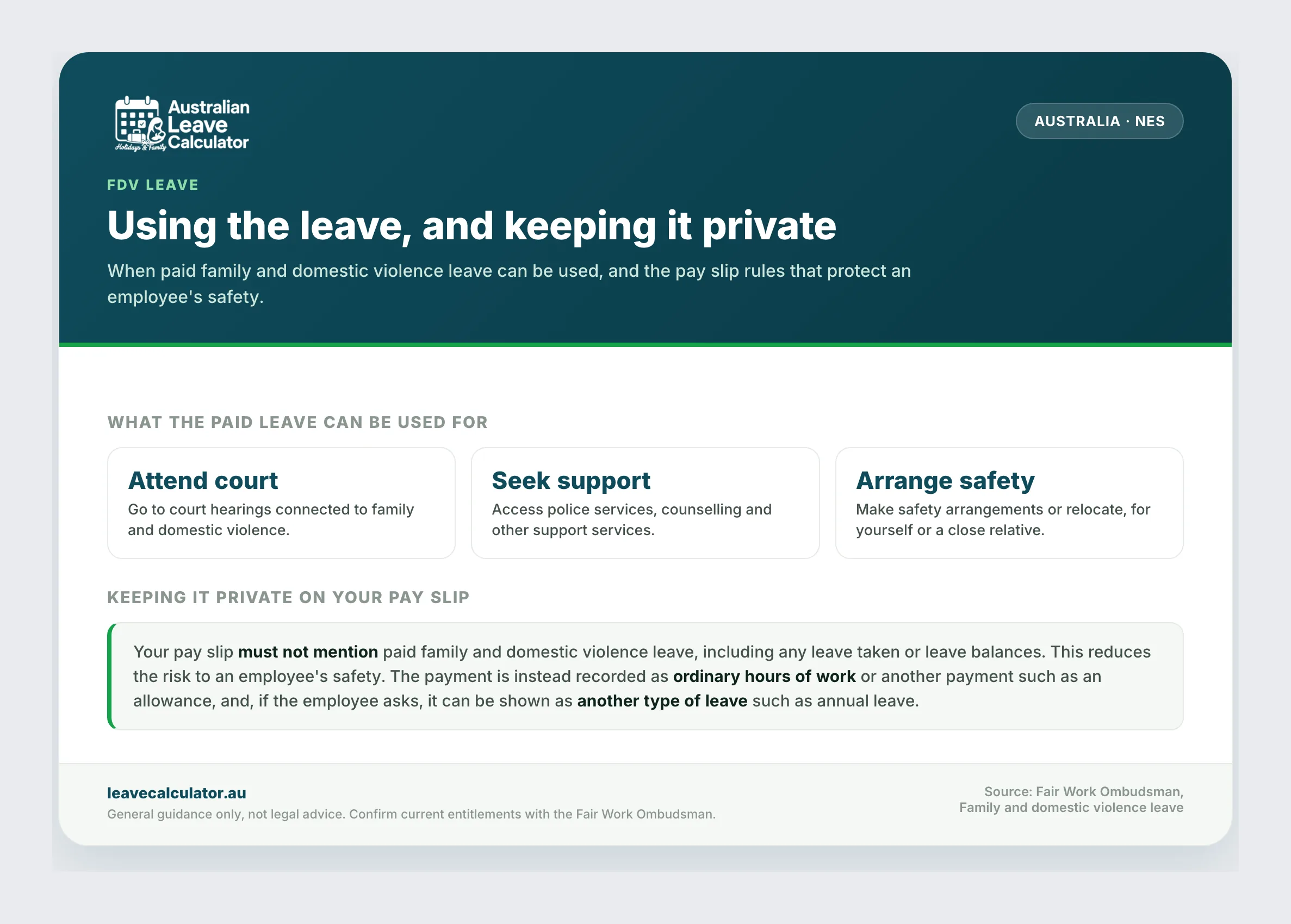
- Making arrangements for your safety or the safety of a close relative, including relocation.
- Attending court hearings or legal appointments.
- Accessing police services.
- Attending counselling or medical appointments.
- Meeting with a family violence support service, or accessing financial services.
The leave does not have to be taken all at once. It can be a single day, several separate days, or, if you and your employer agree, less than a day at a time. You can also switch to it from a period of other paid leave, such as annual leave or sick and carer's leave.
How to give notice and evidence
To take the leave, let your employer know as soon as possible. Notice can be given after the leave has already started, and you should tell your employer how long you expect to be away. Your employer can ask for evidence that would satisfy a reasonable person that the leave is being taken to deal with the impact of family and domestic violence and that it was not practical to act outside work hours. Acceptable evidence can include a statutory declaration, documents issued by police or a court, or documents from a family violence support service. If you are asked for evidence and do not provide it, you may not be paid for the leave, and an employer can request evidence even for a single day or less.
Payment and timing from Fair Work Ombudsman, Taking family and domestic violence leave; notice and evidence (Fair Work Act 2009 (Cth) ss.106B, 106C, 107) from Fair Work Ombudsman, Notice and evidence for family and domestic violence leave.
Confidentiality and the pay slip rule
The law builds in strong confidentiality, because disclosing that someone is experiencing family and domestic violence can put them at risk. Your employer must take reasonable steps to keep any information you provide confidential, including the notice you give and any evidence. They can only disclose it if it is required by law or is necessary to protect someone's life, health or safety. Experiencing family and domestic violence is also a protected attribute, so an employer cannot take adverse action against you, such as dismissing you or treating you unfavourably, because of it.
There are also specific pay slip rules. Paid family and domestic violence leave must not be mentioned on a pay slip, including any leave taken and any leave balance. Instead, the amount paid has to be recorded as ordinary hours of work, or as another kind of payment for performing work such as an allowance, bonus or overtime payment. If you ask, your employer can record the time as another type of leave, for example annual leave. The aim is to make your pay slip look as close as possible to how it would have looked if you had not taken the leave, so it does not reveal your situation.
Pay slip rules from Fair Work Ombudsman, Pay slips (paid family and domestic violence leave on pay slips). Confidentiality and protection from adverse action: Fair Work Act 2009 (Cth) ss.106C, 351.
Where to get support
Support is free and confidential, and you do not have to face this alone.
1800RESPECT is the national domestic, family and sexual violence counselling, information and support service. Call 1800 737 732 (24 hours) or visit 1800RESPECT.org.au. In an emergency, or if you or someone else is in immediate danger, call 000. For questions about your leave entitlement and pay, contact the Fair Work Ombudsman.
For related entitlements, see our guides to carer's leave and compassionate and bereavement leave.
Common questions
Do casual employees really get 10 days of paid FDV leave?
Yes. All employees are entitled to the full 10 days each year, and that expressly includes casuals, who are paid their full rate of pay for the rostered hours they miss, including casual loading.
Does family and domestic violence leave accumulate if I do not use it?
No. Unlike annual leave, it does not build up over time. The full 10 days are available immediately, the balance resets on each work anniversary, and any days you did not use do not carry over into the next year.
Will taking this leave show up on my pay slip?
No. Pay slips must not mention paid family and domestic violence leave or its balance. The amount is instead recorded as ordinary hours or another kind of payment, or, if you request it, as another type of leave such as annual leave.
Can my employer ask me to prove why I am taking the leave?
Yes. An employer can ask for evidence that would satisfy a reasonable person, such as a statutory declaration or documents from police, a court or a support service, even for a single day off. Any information you give must be kept confidential.
Is the leave paid at my normal rate?
Full-time and part-time employees are paid their full rate of pay for the hours they would have worked, and casuals for the hours they were rostered. Full rate of pay includes loadings, allowances, penalty rates, bonuses and other separately identifiable amounts.

Author & reviewer
Sarah has spent over a decade advising Australian SMBs on Fair Work, NES compliance, and payroll. Based in Sydney, she has worked across hospitality, retail and professional services.