

When people picture taking leave in Australia, annual leave and sick and carer's leave come to mind first. But the law and many workplace documents recognise a much wider set of reasons to be away from work, from jury duty to caring for a newborn, grieving a death, or dealing with family violence. Beside these legal rights sit workplace perks such as study leave and sabbaticals that depend entirely on your employer. This guide maps the leave types beyond the basics and sorts each into a legal entitlement or employer policy.
Key takeaways
- Community service leave (including jury duty), unpaid parental leave, unpaid carer's leave, compassionate leave and family and domestic violence leave are all National Employment Standards (NES) rights, on top of annual and personal leave.
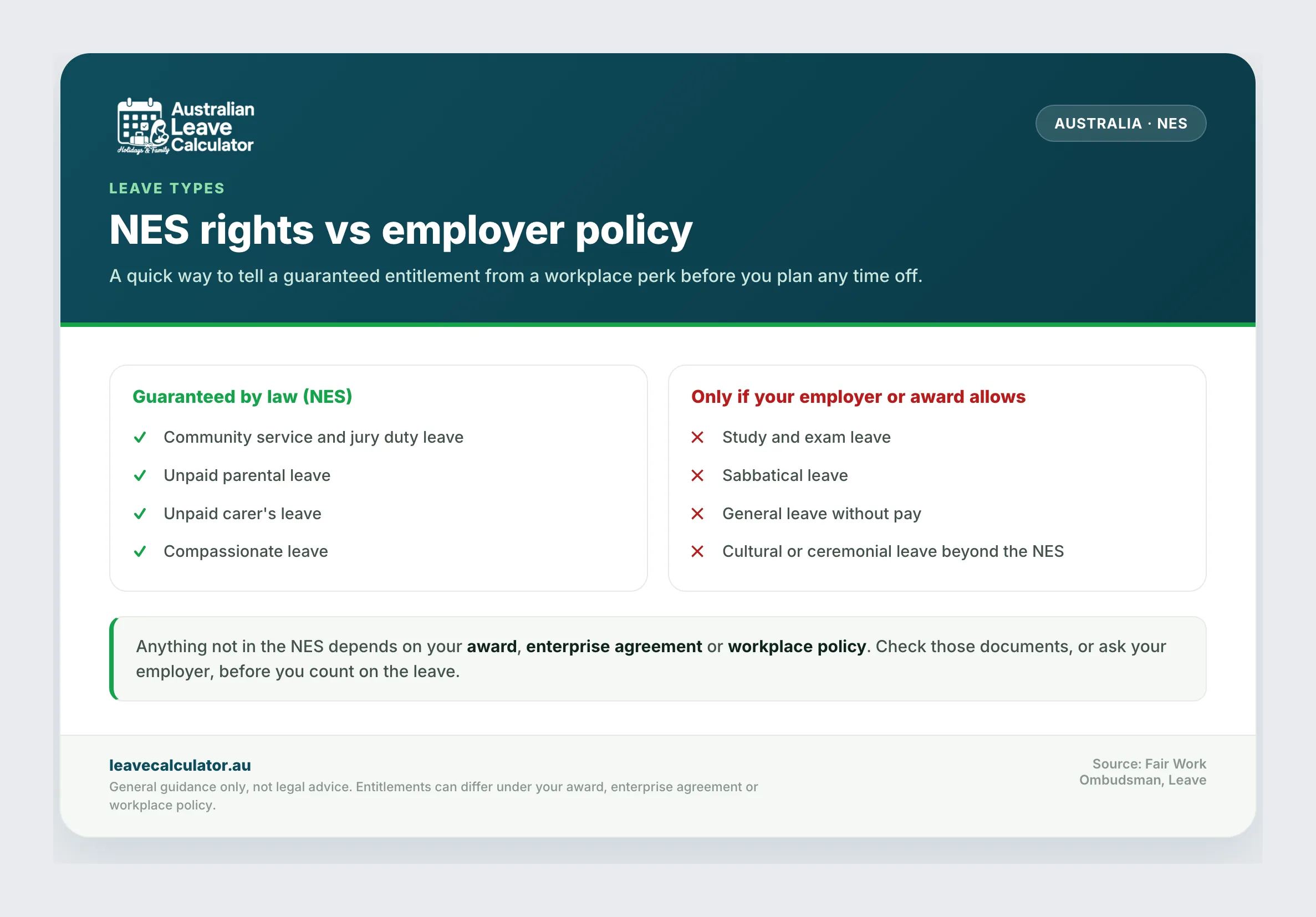
- Study or exam leave, sabbaticals and cultural or ceremonial leave are not in the NES. They exist only if an award, agreement, contract or workplace policy provides them.
- For jury duty, full-time and part-time employees get make-up pay for the first 10 days; casuals are not paid under the NES.
- Unpaid parental leave gives up to 12 months, with a right to request up to a further 12 months.
- Any leave the NES does not cover can still be taken as leave without pay, but only if your employer agrees.
Leave beyond annual and personal leave
Every leave type in Australia comes from one of two places. The first is the National Employment Standards (NES), 11 minimum entitlements in the Fair Work Act 2009that apply no matter what your contract says. The second is everything layered on top: modern awards, enterprise agreements, contracts and workplace policies. Annual leave and personal/carer's leave are the best known NES entitlements, but far from the whole picture. Which bucket it sits in tells you whether you can insist on it or must negotiate.
Community service leave and jury duty
Community service leave is an NES entitlement that lets all employees, including casuals, take time off for certain civic duties. It covers two activities: jury duty and voluntary emergency management with a recognised body such as the State Emergency Service (SES), a fire authority like the CFA, or the RSPCA during animal rescues. You can take it plus reasonable travel and rest, with no cap. Except for jury duty, community service leave is unpaid.
Jury duty is the paid part. Under the NES, employers must pay full-time and part-time employees 'make-up pay' for the first 10 days they are absent: the difference between the base pay rate for the ordinary hours they would have worked and any amount the court pays (excluding expense allowances). Casuals are not paid under the NES, though a state law, award or agreement may pay them. See our community service and jury duty leave guide.
Unpaid parental leave
Unpaid parental leave lets eligible employees care for a newborn or newly adopted child. An employee with at least 12 months of continuous service can take up to 12 months of unpaid leave, and can request up to a further 12 months, for a possible 24 months in total. Both parents can each take up to 12 months, and need not be off at the same time. Part of the entitlement can be taken flexibly, as single days across the child's first two years rather than one continuous block. It is unpaid: government Parental Leave Pay and employer-funded paid parental leave are separate. See our parental leave pages for eligibility and notice.
Unpaid carer's leave
Separate from the paid personal/carer's leave balance, the NES gives every employee 2 days of unpaid carer's leave per occasionwhen an immediate family or household member needs care because of illness, injury or an unexpected emergency. Full-time and part-time employees can only use it once their paid sick and carer's leave is exhausted, so it is a genuine top-up; casuals, who do not accrue paid leave, can use it for any qualifying occasion. Our carer's leave guide and the personal and carer's leave calculator show how it works alongside the paid entitlement.
Compassionate and family and domestic violence leave
Compassionate (bereavement) leave is an NES right of 2 days each time an immediate family or household member dies or develops a life-threatening illness or injury; it also covers stillbirth and miscarriage. Full-time and part-time employees are paid at their base rate, casuals take it unpaid, and it does not accumulate. The detail is in our compassionate and bereavement leave guide.
Family and domestic violence leave is a separate, standalone NES entitlement of 10 days of paid leave each yearfor all employees, including casuals. It is available in full immediately and resets on the employee's work anniversary. Our family and domestic violence leave guidecovers eligibility and access, and the national 1800RESPECT service can help.
Leave without pay by agreement
Some NES leave is unpaid by design: unpaid parental leave, unpaid carer's leave, unpaid community service leave, and compassionate leave for casuals. Beyond these, an employee can ask for leave without pay for reasons the NES does not cover, for example a long trip or further study. This is not an automatic right: it can only be taken if the employer agrees. Watch the effect on service, too. Apart from unpaid community service leave, unpaid leave generally does not count towards your length of service, so it can reduce accrued paid leave and, sometimes, redundancy pay. Our leave without pay guide covers how to request it.
Study and exam leave
Study leave, exam leave and time off for professional training are notNES entitlements. There is no general legal right to paid time off to sit an exam or attend a course. Where it exists, it comes from a modern award, an enterprise agreement, your employment contract or an employer's study-assistance policy. Some awards do build in protected training entitlements, most notably for apprentices and trainees, who are often entitled to paid time for required off-the-job training. Otherwise, whether you get paid leave, unpaid leave, or must use annual leave is up to your workplace, so get it in writing before you enrol.
Sabbatical and cultural leave
A sabbatical or career break, an extended period away with a job to return to, is not an NES entitlement either. Sabbaticals are purely a matter of employer policy or negotiation, and are often structured as leave without pay, purchased leave, or a block of accrued long service leave, the closest thing the law provides to a paid extended break. Cultural or ceremonial leave, for example to attend Sorry Business, is likewise not a standalone NES right, though some awards and policies provide for it, and it can otherwise be taken as leave without pay or annual leave.
NES right versus employer policy
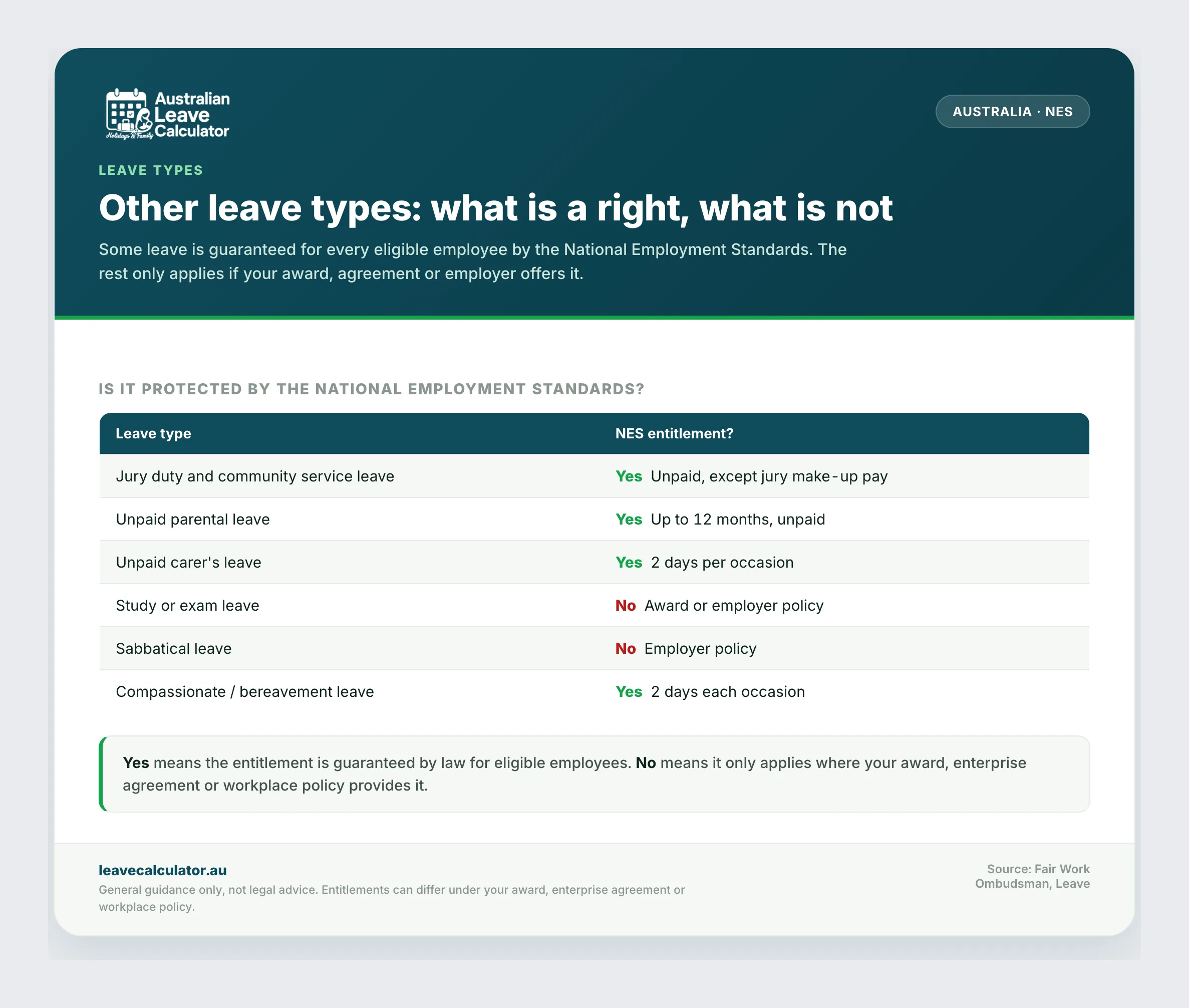
The most useful question about any leave type is whether it is an NES right or employer policy. If it is in the NES, your employer must provide it and cannot contract out, though an award, agreement or policy can add more on top. If it is not, it exists only where a document creates it, and your employer generally has discretion. The table below sorts the common types.
| Leave type | Is it an NES right? |
|---|---|
| Community service leave (including jury duty) | Yes |
| Unpaid parental leave | Yes |
| Unpaid carer's leave | Yes |
| Compassionate / bereavement leave | Yes |
| Family and domestic violence leave | Yes (paid) |
| Study or exam leave | No (award, agreement or policy) |
| Sabbatical or career break | No (employer policy) |
| Cultural or ceremonial leave | No (award, agreement or policy) |
| General leave without pay | Not automatic (by agreement) |
We have dedicated guides for community service and jury duty leave, carer's leave, compassionate and bereavement leave, family and domestic violence leave and leave without pay, plus the full National Employment Standards. See also time off in lieu, our leave glossary and public holidays.
Common questions
Is jury duty paid in Australia?
For full-time and part-time employees, yes, at least for the first 10 days: your employer pays make-up pay, the gap between your base pay rate and the court's payment. Casuals are not paid under the NES, but may be entitled to payment from the court or under a state law, award or agreement.
Do casual employees get any of these leave types?
Yes. Casuals can take community service leave, unpaid carer's leave (2 days per occasion), unpaid compassionate leave (2 days per occasion) and the full 10 days of paid family and domestic violence leave each year. What casuals do not get is paid jury duty or the paid part of compassionate leave.
Is study or exam leave a legal right?
No. Study and exam leave are not in the National Employment Standards. You only have a right to them if your award, enterprise agreement, contract or a workplace policy provides them. Apprentices and trainees are a common exception, as some awards give them paid time off for required training.
Can my employer refuse leave without pay?
For leave the NES does not specifically create, yes: ordinary leave without pay can only be taken if your employer agrees, so it can be refused. NES entitlements such as unpaid parental leave are different, because where you meet the eligibility rules they are a right. See our frequently asked questions for more.

Author & reviewer
Sarah has spent over a decade advising Australian SMBs on Fair Work, NES compliance, and payroll. Based in Sydney, she has worked across hospitality, retail and professional services.